
Food Packaging Material Specification Checklist for Buyers
A copyable checklist for food packaging material requests: component specs, FDA and EU documents to ask for, line-fit checks and sample trial records.

What this article covers
A five-module request record for buyers asking packaging material and component suppliers for quotes: what to specify, which food-contact documents to request for US and EU markets, how to match them to the component, and how to prepare a line trial and receiving check.
Covered
- A copyable five-module material request checklist
- Component specification fields without assumed limits
- Which FDA and EU food-contact documents to request and how to match them
- Line-compatibility, sample trial and receiving records
- Milk bottle and yogurt cup examples
Not covered
- Compliance certification or legal opinion
- Supplier audits and supplier recommendations
- Packaging machine purchase and acceptance testing
- Prices, tolerances, barrier values or sampling plans
A material quote built on a name like “food-grade PET bottle” can price the wrong part and arrive without the documents or dimensions your line needs. Before you ask for prices, describe the complete pack and how it will be used, specify each component by drawing and revision, request the food-contact documents that apply in your market, and plan a line trial and a receiving check.
For buyers preparing a request to packaging material or component suppliers, the useful starting point is one record that every supplier answers in the same shape. This checklist gives you that record in five modules, with columns for your requirement, the supplier’s answer, the evidence and who owns each open point. It is a purchasing aid: it shows whether information is present, and it does not certify that a material complies, approve a supplier or replace your QA review. Use it with the other food packaging buying guides, which cover machine requests, budgets and acceptance testing.
Scroll horizontally for hidden columns. The first column stays in view.
| Input or item | Typical value or source | Why it matters |
|---|---|---|
| Food and process | Your product specification and process record | Decides which use conditions documents must cover |
| Destination market | Sales plan (US, EU or both) | US and EU ask for different documents |
| Complete pack | Approved component list with revision | A cup quoted without its lid is not comparable |
| Component drawing | Your drawing or the supplier’s, with revision and units | Material names do not fix dimensions or finish |
| Performance values | QA requirement stated as value, unit, method and conditions | A number without its method cannot be compared |
| Food-contact documents | Supplier statement or declaration naming the exact item | Coverage is limited to the item and conditions it names |
| Line format data | Machine manual and change-part list | Material that fits the drawing can still fail on the machine |
| Trial and receiving record | Your trial plan and goods-in procedure | Shows whether delivered material matches what was agreed |
The material request checklist, in five modules
A complete request covers five things: the product and its market, each component’s specification, the documents that apply, fit with your existing line, and samples with receiving checks. Every row gets an owner and a status. The status records whether the information has been supplied, and it says nothing about whether the material complies.
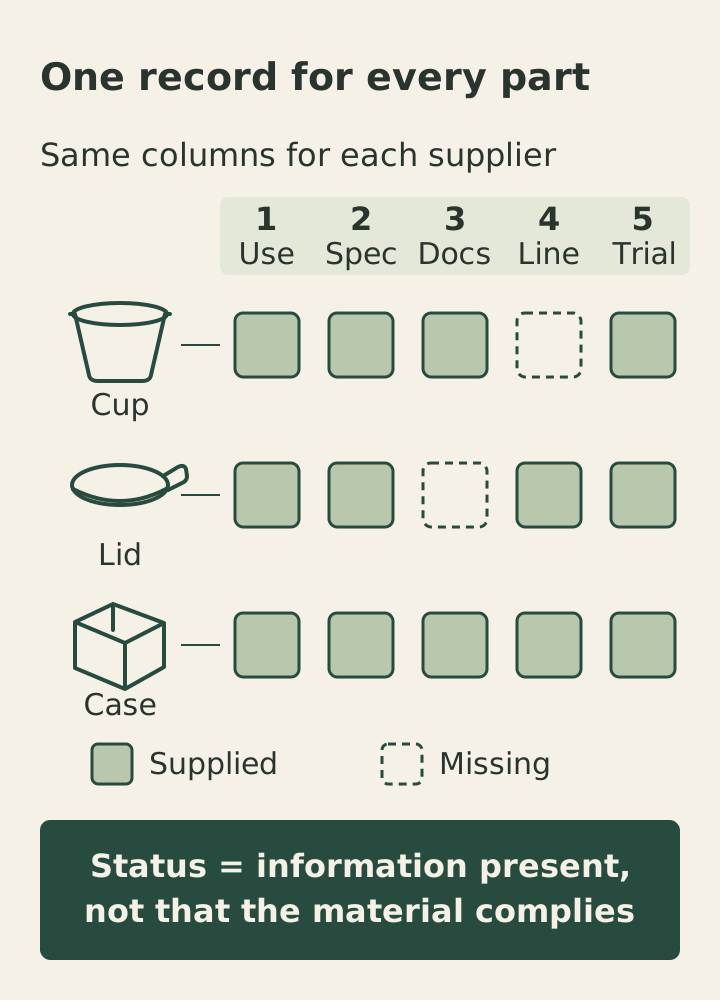
The structure borrows from the packaging machine RFQ checklist, which asks every bidder to answer in the same shape so responses can be lined up. Here the subject is the material and components rather than the machine. Copy the rows into a spreadsheet or your purchasing system, delete rows that do not apply, and send the same version to every supplier.
Scroll horizontally for hidden columns. The first column stays in view.
| Module | Item | Your requirement or file | Supplier answer | Evidence and revision | Owner / status |
|---|---|---|---|---|---|
| 1 Product, process, market | Food type and relevant characteristics | Fill in | Fill in | Product spec ref. | Fill in |
| 1 Product, process, market | Fill, process and storage conditions in contact with the pack | Fill in | Fill in | Process record ref. | Fill in |
| 1 Product, process, market | Destination markets | Fill in | Fill in | Sales plan | Fill in |
| 1 Product, process, market | Complete component list | Fill in | Fill in | BOM revision | Fill in |
| 2 Component specification | Drawing and revision for each component | Fill in | Fill in | Drawing number | Fill in |
| 2 Component specification | Material construction, layers and decoration | Fill in | Fill in | Supplier spec sheet | Fill in |
| 2 Component specification | Performance values with method and conditions | Fill in | Fill in | Test or data reference | Fill in |
| 2 Component specification | Artwork and print revision | Fill in | Fill in | Artwork file ref. | Fill in |
| 2 Component specification | Delivery format, packing and pallet pattern | Fill in | Fill in | Supplier packing spec | Fill in |
| 3 Applicable documents | Food-contact statement or declaration for each component and market | Fill in | Fill in | Document title, date | Fill in |
| 3 Applicable documents | Use conditions the document covers | Fill in | Fill in | Section of document | Fill in |
| 3 Applicable documents | Lot quality report, where agreed | Fill in | Fill in | Template or sample | Fill in |
| 3 Applicable documents | Handling and storage instructions | Fill in | Fill in | Document ref. | Fill in |
| 4 Line compatibility | Machine format data sent to supplier | Fill in | Fill in | Manual section | Fill in |
| 4 Line compatibility | Supplier confirmation against that format data | Fill in | Fill in | Written reply | Fill in |
| 5 Samples and receiving | Production-representative samples and quantity | Fill in | Fill in | Sample lot ID | Fill in |
| 5 Samples and receiving | Trial plan, method and acceptance criteria | Fill in | Fill in | QA plan ref. | Fill in |
| 5 Samples and receiving | Receiving checks and lot identification | Fill in | Fill in | Goods-in procedure | Fill in |
| 5 Samples and receiving | Change notification commitment | Fill in | Fill in | Agreement clause | Fill in |
| 5 Samples and receiving | Contact for nonconforming deliveries | Fill in | Fill in | Name or role | Fill in |
For the status column, four values are enough: supplied, missing, not applicable, awaiting QA review. “Supplied” means the supplier answered and attached the evidence. It does not mean your QA team has accepted that evidence, and it does not mean the material complies with any rule. Keep those decisions in your own approval record.
Takeaway: Send one structured record to every supplier and track what is missing before you compare prices.
Define the product, process and complete pack first
Suppliers can only say which documents and values apply if they know what the pack will hold and how it will be used. State the food, the fill and storage conditions, the markets and the full list of parts. Without these, a declaration or a performance value has nothing to be checked against.
Food-contact rules in both markets are tied to use. FDA explains that the status of a food-contact material is decided substance by substance, for each substance reasonably expected to migrate under its intended use. The EU framework regulation applies to materials that, in their finished state, are intended to contact food or can reasonably be expected to transfer constituents under normal or foreseeable use. In practice, a supplier cannot confirm coverage for “dairy” in general. It needs the food type, the temperatures and times of filling and storage, and whether the part touches the food directly.
Record these items in module 1:
- The food and the characteristics your QA team considers relevant to contact, such as fat content or acidity
- The fill temperature, any heat treatment in the pack, and storage temperature and duration
- Whether each part touches the food, sits outside a sealed layer, or is transport packaging only
- Every market where the packed product will be sold
- The complete component list with a revision number
The complete pack matters as much for documents as for cost. A milk bottle request includes the bottle, closure, any liner or tamper band, label and outer case. A yogurt request includes the cup, lidding, any overcap and the tray or case. The milk packaging formats guide and the yogurt packaging guide explain how product type shapes those parts. If you are still choosing between rigid and flexible formats, read bottle versus pouch packaging before you write the component list.
Common mistake: Asking several suppliers to quote “yogurt cups” when one quotes the cup only and another includes lidding and overcaps. The prices and the documents then describe different packs.
Takeaway: Write down the food, the conditions and every part before any supplier is asked about compliance or price.
Specify each component without guessing limits
Give each component a drawing with a revision, its construction, and every performance value you need stated as value, unit, test method and test conditions, with an owner who sets the number. This guide supplies the fields only. The numbers come from your product, your machine and your QA team, never from a generic list.
Scroll horizontally for hidden columns. The first column stays in view.
| Component | Fields to request | Who sets the value |
|---|---|---|
| Bottle | Drawing and revision, capacity basis, neck finish, weight, material and any colorant, decoration | Your drawing or agreed supplier drawing |
| Closure | Finish matching the bottle, liner or seal type, tamper feature, application and removal torque method | Closure supplier with your QA and capping data |
| Cup or tray | Drawing, flange or rim dimensions, stacking and denesting features, material construction | Your drawing; machine change parts |
| Lidding | Construction, sealing layer, die-cut or reel format, peel behavior requirement, print | QA requirement and sealing station data |
| Film or rollstock | Construction and layer order, width, thickness basis, reel outside diameter, core, unwind direction, splice rules | Machine manual and QA requirement |
| Pouch | Format, dimensions, gusset, fitment or zipper, seal areas, construction | Your pouch specification |
| Labels, inks and adhesives | Label stock, adhesive type, ink system, which side faces the food | Labeler data and QA requirement |
| Outer pack and pallet | Case dimensions, count, pallet pattern, wrapping, labeling for lot traceability | Warehouse and customer requirements |
For flexible materials, the machine decides several of these fields. Unified Flex, a film converter, writes that printing presses, laminators and vertical form-fill-seal machines need specified web widths, roll diameters and stable unwind performance, and that poor slitting can show up as tracking problems, registration faults and inconsistent bag length. That is a supplier’s description of its own service, but it is a reasonable reminder to take reel and core data from your machine documentation and send it with the request. The food pouch formats guide lists further points to give a pouch or film supplier. For rigid containers, beverage bottle materials explains why a material name is not a specification on its own.
Performance values need their method. For seal strength, ASTM F88/F88M covers the strength of seals in flexible barrier materials, and its public summary notes that the way a specimen is held changes the result, so one technique should be used throughout a test series. When you ask for seal-strength data, record the method and edition, the technique, the sample configuration and the agreed criterion. The same applies to barrier, thickness or torque values. A seal-strength result also describes only the seal; it does not establish shelf life, food safety or regulatory compliance.
Common mistake: Comparing two suppliers’ barrier or seal-strength figures that were measured by different methods or at different conditions. Ask both to report against the method and conditions your QA team names.
Takeaway: Request fields, units and methods from suppliers; let your drawings and QA requirements supply the numbers.
Ask for the documents that apply, then check what each covers
Request a food-contact document for each component and each market, then check that it names the exact item, the issuer, the date and the use conditions you recorded in module 1. A document that names a different grade, supplier or use does not cover your purchase, however similar the material sounds.
United States
FDA lists five routes by which a substance in a food-contact material can be authorized: a regulation in Title 21, GRAS status, a prior sanction, a Threshold of Regulation exemption, or an effective food contact substance notification (FCN). Each authorization has three parts to check: the identity of the substance, its specifications such as purity or physical properties, and limits on the conditions of use. Under 21 CFR 174.5, any substance used as a component of a food-contact article must be of a purity suitable for its intended use and used within any prescribed limits, and a listing does not relieve the use from other requirements of the Act. The regulation’s own example is a regulated packaging material that imparts odor or taste to a particular food.
Two points from FDA’s page shape the request. An FCN is effective only for the manufacturer, the substance and the conditions of use it identifies, and not for a similar or identical substance made by another manufacturer. And a buyer may ask the manufacturer for a letter of guaranty certifying that a particular product is acceptable for the intended food-contact use.
Scroll horizontally for hidden columns. The first column stays in view.
| 21 CFR part | Title (eCFR) | What to ask the supplier |
|---|---|---|
| 174 | Indirect food additives: general | Which authorization each relevant substance relies on |
| 175 | Adhesives and components of coatings | Whether adhesives or coatings in the construction are covered for your use |
| 176 | Paper and paperboard components | Coverage of paper or board layers for your food and conditions |
| 177 | Polymers | The polymer authorization and any conditions of use it carries |
| 178 | Adjuvants, production aids, and sanitizers | Whether additives or processing aids are covered |
| 179 | Irradiation in the production, processing and handling of food | Whether any irradiation step applies to your food or pack, and which provision the supplier relies on; the part also covers radiation sources, and its Subpart C (179.45) is titled “Packaging materials for irradiated foods” |
The table is a map of where provisions sit, not a single certification scheme. Ask the supplier which basis applies to your component and use, and for an FCN, the notification reference and confirmation that the substance comes from the notifying manufacturer.
European Union
Regulation (EC) No 1935/2004 applies to all food-contact materials and requires that, under normal or foreseeable use, they do not transfer constituents in quantities that could endanger health, bring an unacceptable change in the food’s composition or deteriorate its taste and odor. Its Article 16 requires a written declaration of compliance for materials covered by specific EU measures; where none exist, member states may keep their own declaration rules. So the declaration you can expect depends on the material.
For plastics, Regulation (EU) No 10/2011 is such a measure. It covers all-plastic items, plastic multilayers, their printed or coated forms, plastic gaskets in caps and closures, and plastic layers in multi-material multilayers; it excludes ion exchange resins, rubber and silicones, and leaves rules on adhesives, coatings and printing inks in place. At stages other than retail, a written declaration must be available. It is issued by the business operator, must allow easy identification of what it covers, and must be renewed when substantial changes in composition or production alter migration, or when new scientific data arrive. Supporting documents, which can include test results, calculations or other reasoning, are made available to national authorities on request. A buyer can ask what supporting evidence exists, but the regulation does not give every customer the full dossier.
Use the declaration content set out in Annex IV of the consolidated text to match the document to your purchase:
Scroll horizontally for hidden columns. The first column stays in view.
| Field to match | Where it appears in a plastics declaration | Question if it does not match |
|---|---|---|
| Issuer and manufacturer or importer | Identity and address of both | Who stands behind this document for my supply? |
| Item identity | Identity of the material, article or intermediate | Does it name my component, grade and revision? |
| Date | Date of the declaration | Is it current after the last change? |
| Food types | Specifications on use: type of food | Does it include my food? |
| Time and temperature | Treatment and storage in contact with food | Do my fill and storage conditions fall inside it? |
| Surface-to-volume ratio | Highest ratio for which compliance was verified, or equivalent | Does my pack size fall inside it? |
| Functional barrier | Confirmation where one is used in a multilayer | Is a barrier layer relied on? |
| Restricted substances | Information allowing downstream compliance | Does my converter or filler need this information? |
The annex has further conditional fields, for example for material intended for reprocessing. Ask your QA reviewer which apply; the table above is a matching aid, not a complete legal list.
Traceability is a requirement in its own right. Article 17 of the framework regulation requires systems that identify the businesses from which and to which materials are supplied, with items identifiable through labeling or documentation. Put a lot or batch field on every delivery document you ask for.
Other documents
Keep three further documents separate from food-contact evidence. A technical specification sheet defines what the supplier will deliver. A lot quality report or certificate of analysis, where the supplier offers one or you agree it, should report against the characteristics in your specification. A safety data sheet or handling instruction covers storage and handling; it does not substitute for a food-contact statement.
Common mistake: Accepting a declaration because it names the same polymer as your component. The document covers the item, issuer and conditions it names, so check identity and use conditions line by line.
Takeaway: Ask for the document that applies to each part and market, then match identity, date and use conditions before filing it as received.
Check fit with the line you already run
Send suppliers the format data from your machines, not only the drawing of the pack. Reel dimensions, closure application, label application and sealing conditions come from the equipment, and a component that matches its drawing can still stop a line if these were never shared.
Collect the data in module 4 before the request goes out:
- For bottles and closures, the capper type, closure feed and the torque application and check method. The bottle capping machine selection guide explains why application and removal torque are specified separately.
- For labels on chilled or wet containers, the container surface condition, label stock and adhesive used today. The cold and wet bottle labeling checklist lists the checks by group.
- For cups and lidding, cup dimensions held by the change parts, the sealing station type and the lidding format. The yogurt cup filling and sealing checklist covers cup and lid compatibility at the machine.
- For film, the reel width, outside diameter, core, unwind direction and splice requirements given in the machine manual.
Ask each supplier to confirm in writing which of these they have checked against their product, and which they cannot confirm without a trial. A gap here is a reason to schedule a trial, and it should not be read as a reason to reject the supplier.
Takeaway: Give suppliers the machine’s format data and get a written answer on each point.
Prepare samples and a material trial record
Plan the trial before samples arrive: identified production-representative samples, recorded machine settings, recorded faults, and a method and criterion agreed by QA in advance. A trial shows whether this material runs on this line under these settings. It does not certify the pack or set a shelf life.
Ask the supplier to state whether samples come from production equipment and production materials, and to identify the lot. Hand samples made a different way may behave differently. Then record the trial in a form that someone else could repeat:
Scroll horizontally for hidden columns. The first column stays in view.
| Trial record field | What to write | Who signs |
|---|---|---|
| Sample identity | Supplier, item, revision, lot, date received | Purchasing |
| Line and format | Machine, change parts, product filled | Production |
| Settings | Settings used, and any changes made during the run | Production |
| Observations | Faults, stops, rejects, and where they happened | Production and QA |
| Measurements | Method, edition, sample configuration, results | QA |
| Criterion | The pass rule agreed before the trial | QA |
| Decision and open points | Accept, retest or reject, with reasons | QA and purchasing |
A material trial is a different exercise from accepting a new machine. The packaging machine FAT checklist covers machine acceptance with written criteria; adapt its record discipline for the material trial, but keep the two records apart.
Takeaway: Agree the method and the pass rule before the trial, and record settings and faults so the result can be repeated.
Receiving checks and change notification
At goods-in, check that each delivery carries the item identity, revision, lot and document references in the purchase order, and that its condition matches what was agreed. Separately, ask the supplier to commit to notifying you of changes to construction, materials or production site before they ship.
Scroll horizontally for hidden columns. The first column stays in view.
| Receiving or change item | What to check or agree | Owner |
|---|---|---|
| Identity and revision | Delivery documents match the PO and drawing revision | Goods-in |
| Lot reference | Lot or batch number recorded and traceable to the supplier’s records | Goods-in |
| Documents | Lot quality report received where agreed; food-contact document on file is current | QA |
| Condition | Packing, pallet and visible damage against the agreed packing spec | Goods-in |
| Disposition | Who can release, hold or reject a delivery | QA |
| Change notification | Advance notice of changes to construction, materials, process or site | Purchasing |
| Document renewal | Updated declaration when a change affects what it covers | QA |
The last row follows the EU plastics rule that a declaration must be renewed when substantial changes in composition or production alter migration. Your own QA rules decide the sampling plan at goods-in; this checklist does not set one. To compare suppliers on cost, use accepted deliveries as the denominator, as the food packaging cost worksheet does for cost per accepted pack.
Takeaway: Tie each delivery to its lot and documents, and make change notification part of the supply agreement.
Two dairy examples: milk bottle and yogurt cup
The two records below show the checklist applied to two common dairy packs, a milk bottle and a set yogurt cup. They list the parts, use conditions, drawings and documents to request and leave every value blank, because the values belong to your product, line and market.
Scroll horizontally for hidden columns. The first column stays in view.
| Example record | Milk in a plastic bottle | Set yogurt in a cup |
|---|---|---|
| Components | Bottle, closure with any liner or tamper band, label, outer case | Cup, lidding, any overcap, tray or case |
| Use conditions to state | Fill temperature, chilled storage duration, light exposure | Fill and set conditions, chilled storage duration |
| Drawings | Bottle and closure finish, label panel | Cup and flange, lidding format, overcap fit |
| Documents per component | US basis or letter of guaranty; EU declaration for plastic parts | Same, including the sealing layer of the lidding |
| Line data | Capper, labeler and case packer format data | Cup feed, sealing station and lid format data |
| Trial focus | Closure application, label adhesion on chilled bottles | Seal quality, lid placement, cup handling |
| Values | Fill in from your specification | Fill in from your specification |
For format choices before this stage, the milk format comparison and the yogurt container comparison set out the trade-offs by product type.
Takeaway: The examples show complete component lists and document requests; your specification supplies the numbers.
When this does not apply
This checklist is for buying ordinary packaging materials and components for an existing or planned line, where the job is collecting comparable supplier information. Several situations need specialist validation, legal review or a different record, and a general request checklist should not stand in for them.
- Aseptic or retort packs, and packs heat-treated after filling, need specialist process and material validation.
- Active or intelligent materials have special requirements under Article 4 of the EU framework regulation and need specific review. Repeat-use containers also fall outside a one-way purchase record.
- Regulatory testing, migration studies and compliance opinions belong to qualified specialists.
- Supplier certification audits assess a supplier’s systems and sites, which is a different scope from a material request.
- Buying a packaging machine is covered by the RFQ and FAT checklists, and releasing finished product by your own quality system.
- Environmental claims such as compostable or recyclable need their own evidence for the finished item and the collection route. The compostable packaging guide explains what that evidence looks like.
Takeaway: Use the checklist to collect information; send specialist questions to the people qualified to answer them.
Common questions
These answers cover how the checklist sits next to other purchasing documents, which parts belong in the request, what a “food grade” description does and does not tell you, and three material questions buyers often search for. Each answer points to the module or guide that holds the detail.
Can I copy this checklist into a purchasing document?
Yes. The tables are plain text, so you can copy them into a spreadsheet, a request template or your purchasing system and delete rows that do not apply. There is no separate PDF; adapting the rows to your own document keeps the revision under your control.
Does this checklist replace a packaging machine RFQ?
No. This record covers materials and components. A machine request covers output, utilities, hygiene, controls and acceptance terms, and the RFQ checklist gives that structure. The two meet at module 4, where machine format data goes into the material request.
Which closures, labels and consumables belong in the request?
Include every part that ends up in or on the finished pack: closures, liners, tamper bands, labels, lidding, overcaps, inks and adhesives that are part of the construction, and the outer case. Warehouse supplies such as stretch wrap or tape can go on a separate list unless they are part of the agreed delivery format.
Is a material specification checklist the same as a supplier audit?
No. A specification checklist records what you are buying and which documents should accompany it. An audit examines a supplier’s systems, sites and controls, and is run under its own scope and procedure.
Does a food-grade description identify the documents I need?
No. “Food grade” is not a document. FDA and EU texts tie coverage to the specific substance or item, its issuer or manufacturer and its conditions of use, so ask for a statement or declaration that names your component and your use.
What is the cheapest packing material?
There is no universally cheapest packing material, because the lowest unit price and the lowest cost per accepted pack can point to different offers. Screen materials for your food, process and line first, then compare offers for the same complete pack on the same delivery basis using the food packaging cost worksheet.
What types of packaging materials are commonly used for dairy products?
Common dairy packs include HDPE, PET or glass bottles, polymer-coated paperboard gable-top cartons, film pouches, and cups or tubs with a sealed lid. This site’s milk guide notes that the bottle material changes light protection, weight and breakage handling. Use the milk and yogurt guides to choose a format for your product, then this checklist to specify it.
What are some sustainable materials for food packaging?
Materials often put forward include PET, HDPE and glass for recycling, and compostable materials such as PLA. None is sustainable by name alone: a recycling claim depends on a collection route that accepts the finished item, and a compostable claim on an industrial or home composting route that accepts it, with evidence for the complete item. This checklist does not rank them; add that evidence as a row in module 3. The PLA food packaging guide and the compostable packaging guide explain what to ask for.
Method and evidence boundaries
This checklist was compiled on October 11, 2026 from official FDA and eCFR texts, the consolidated EU food-contact regulations, ASTM’s public summary of a seal-strength method and one film converter’s guidance. The five modules, status values and example records are editorial organizing suggestions. No materials were tested and no supplier documents were reviewed.
In detail, the sources are FDA’s guidance on the regulatory status of food-contact components, the current eCFR text of 21 CFR 174.5, the part titles for 174 to 179 and the Part 179 subpart titles, the consolidated English texts of Regulation (EC) No 1935/2004 and Regulation (EU) No 10/2011, ASTM’s public summary of F88/F88M-23, and a film converter’s description of slitting requirements. No prices, tolerances or pass values are given. If you find an error in how a rule is described, the editorial policy explains how to send a correction. Sources and further reading are listed below.
Takeaway: Every row is a request for your supplier’s evidence and your QA team’s decision, not a value this page supplies.
Sources and method
This article is based on documentary research of the sources listed. It is not a hands-on equipment test. Supplier statements and editorial judgement are identified in the text.
- Determining the Regulatory Status of Components of a Food Contact Material Supports: status depends on each substance expected to migrate under intended use; the five authorization routes; FCNs are effective only for the identified manufacturer, substance and conditions of use; authorizations have identity, specification and use-limitation parts; buyers may ask the manufacturer for a letter of guaranty; the list of 21 CFR parts 174 to 179. Retrieved 2026-10-11.
- 21 CFR 174.5 General provisions applicable to indirect food additives Supports: purity suitable for intended use, use within prescribed limitations, and that a listing does not relieve a use from other provisions of the Act (odor or taste example). eCFR text up to date as of 2026-10-07. Retrieved 2026-10-11.
- 21 CFR Chapter I, Subchapter B: Food for Human Consumption Supports: current titles of parts 174 to 179 used in the part map table, and the Part 179 subpart titles (Subpart B, radiation and radiation sources, 179.21 to 179.43; Subpart C, packaging materials for irradiated foods, 179.45). No individual limits from these parts are reproduced. Retrieved 2026-10-11.
- Regulation (EC) No 1935/2004 on materials and articles intended to come into contact with food (consolidated text 2021-03-27) Supports: Article 1 scope of finished materials and articles; Article 3 general requirements; Article 16 declaration of compliance where specific measures apply and national rules otherwise; Article 17 traceability. Read from the official consolidated English text on 2026-10-11.
- Commission Regulation (EU) No 10/2011 on plastic materials and articles intended to come into contact with food (consolidated text 2026-07-14) Supports: Article 2 scope, including plastic gaskets in caps and closures and plastic layers in multi-material multilayers, and its exclusions; Article 15 declaration of compliance and renewal; Article 16 supporting documents; Annex IV declaration content, including food type, time and temperature, and surface-to-volume ratio. Retrieved 2026-10-11.
- ASTM F88/F88M-23 Standard Test Method for Seal Strength of Flexible Barrier Materials Supports: scope (seal strength of flexible barrier materials) and the public significance statement that test technique affects results and should be kept consistent within a test series. Procedure and values not reproduced. Retrieved 2026-10-11.
- Film Slitting for Flexible Packaging Supplier engineering guidance: presses, laminators and VFFS machines need specified web widths, diameters and stable unwind; poor slitting can cause tracking, registration and bag-length problems. Attributed supplier view, not an industry tolerance. Retrieved 2026-10-11.
Next reading
Food Packaging Costs: Scope, the Food Dollar, and Cost per Pack
Compare food packaging costs from the complete pack, included charges, and accepted output. Keep the 2023 food-dollar cents in their national account.
Read the guide
Packaging Machine RFQ Checklist for Food and Beverage Buyers
A copy-ready request-for-quotation structure for packaging machines, with eight modules of fields to fill in and a method for comparing quotes line by line.
Read the guide
Yogurt Packaging: Cups, Bottles and Pouches for Different Products
Match yogurt packaging to product type: set, stirred, drinkable or squeeze. Compare cups, bottles and spouted pouches and their filling and sealing needs.
Read the guideMore in Buying Guides
Bottle vs Pouch Packaging: What Changes on the Production Line?
Moving a liquid product between rigid bottles and flexible pouches changes filling, closing, conveying, changeover and cases. Use this guide to scope the work.
Read the guide
Packaging Line Cost: Building a Project Budget Beyond the Machine
Build a packaging line budget from nine components, from machines and change parts to FAT, SAT, training and contingency, and learn how to collect each figure.
Read the guide
Factory Acceptance Testing for Packaging Equipment: Planning the Checks
Finding defects after shipment can delay installation. Prepare a FAT protocol, representative materials, raw test records and an agreed punch list.
Read the guide