
Factory Acceptance Testing for Packaging Equipment: Planning the Checks
Finding defects after shipment can delay installation. Prepare a FAT protocol, representative materials, raw test records and an agreed punch list.

Discovering unresolved defects after shipment can mean rework and delayed installation. Prepare four FAT outputs before release: an agreed protocol, representative materials, raw test records and a punch list with documented closure or approved SAT transfer.
Scroll horizontally for any hidden columns →
| Stage | Location and purpose | Record to prepare |
|---|---|---|
| FAT | Equipment maker; verify agreed machine requirements before shipment | Protocol, material lots, test results and release decision |
| SAT | Installed site; verify utilities, integration and site-dependent checks | Carry-forward items, site test evidence and handover |
Start with the FAT preparation checklist; use the detailed comparison below to allocate checks between sites.
FAT and SAT: what each is for
A FAT takes place at the equipment maker’s facility before shipment. A site acceptance test (SAT) takes place at your plant after installation. Each catches different problems.
Scroll horizontally for any hidden columns →
| FAT | SAT | |
|---|---|---|
| Where | Supplier’s facility | Your plant |
| When | After build, before shipment | After installation and utility connection |
| Main purpose | Confirm the machine meets the specification and find defects while fixes are easiest | Confirm it works in the real site, with real utilities, upstream and downstream equipment |
| Materials | Buyer-supplied product or simulant, containers, closures, labels, film | Production materials in production conditions |
| Typical gaps | Cannot reproduce your site utilities, line interfaces or full environment | Cannot easily rework major mechanical or design issues |
| Who attends | Buyer’s project team, supplier engineers | Buyer’s operators, maintenance, supplier technicians |
| Output | Test records, punch list, release for shipment | Final acceptance records, handover to production |
The PMMI OpX Leadership Network has published a free work product called “One Voice Factory Acceptance Tests: Protocols for Capital Equipment in the CPG Industry”. According to PMMI, a revised edition added leadership guidance, expanded the responsibilities of equipment makers and end users, and included Virtual FAT material as an appendix. OpX says the protocols are meant to resolve criteria for FAT, virtual FAT and SAT expectations, whose miscommunication often leads to confusion, unbudgeted travel and material costs, and longer timelines. This guide does not copy the OpX protocol, so get the original for a project of any size.
Some checks belong in SAT rather than FAT, such as final utility performance, drains and the interface to upstream and downstream equipment. Decide in advance which tests go where and write that into the protocol, so nobody assumes the other test covered a check.
Writing the FAT protocol
Write the protocol before the machine is built, and agree on it with the supplier. Tie it to your specification or request for quotation so that each test traces to a requirement. Our RFQ checklist puts acceptance criteria in its eighth module for that reason.
A workable protocol has these parts:
- Scope and references: The specification, drawings and revision numbers that govern the test, and who may approve a change.
- Roles: Who runs the machine, who witnesses, who records, who signs.
- Prerequisites: Machine complete, calibrated instruments, safety circuits verified, documents available.
- Test list: Each test with purpose, method, settings, sample size and acceptance criterion.
- Materials plan: What the buyer supplies, in what quantity and condition.
- Records: Forms, data capture, photos or video, instrument identification.
- Deviation handling: How a failure is recorded, who decides to retest, and how a punch list item is raised.
- Sign-off. What must be complete before the machine is released for shipment.
FAT preparation checklist
- Protocol drafted and agreed with the supplier before the machine is finished
- Specification and revision numbers listed in the protocol
- Attendees named for both parties
- Test dates, hours and travel arranged
- Buyer materials ordered, labeled and shipped to the supplier in time
- Measuring equipment identified and calibration status checked
- Safety and access rules agreed
- Recording method agreed: forms, photos, video, data exports
- Pass, retest and fail rules agreed
Materials the buyer supplies
The supplier cannot know how your containers and products behave, so you specify and ship materials that represent production. According to the OpX total cost of ownership guidelines, FAT costs include material and product costs, set-up costs at the equipment maker, and time and travel, so these items belong in the budget; see our guide to packaging line cost.
Scroll horizontally for any hidden columns →
| Material | What to define | Notes |
|---|---|---|
| Product or simulant | Source, properties to match, quantity, storage and shipping | If you use a simulant, state which product property it represents (for example viscosity) and which it does not |
| Containers | Type, grade, tolerances, lot, quantity, representative of production | Include containers at the tolerance extremes you expect to receive |
| Closures or lidding | Type, finish match, lot, quantity | Our bottle capping machine selection guide lists the matching items |
| Labels, film or cartons | Stock, size, quantity | Use production grade where possible |
| Cleaning materials | Agents and procedure | Only when cleaning checks are in scope |
| Spare and reject samples | Marked defective or out-of-tolerance samples | Used to confirm that inspection and reject systems work |
You define the quantities. Base them on the number of test runs, the sample sizes, and the extra allowance for setup, adjustment and retests. Do not accept a supplier’s statement that “standard materials” will be enough unless you have compared them with yours.
Acceptance criteria
Write each criterion as a measurable statement with a method, a sample size and a pass rule, and tie it to the specification. Avoid wording such as “runs smoothly”.
Typical categories for packaging equipment are:
- Mechanical and safety: Guards, interlocks, emergency stops, access for cleaning and maintenance.
- Throughput: Containers per time unit at the agreed conditions, run for a defined period.
- Fill quantity: Fill weight or volume against the target and tolerance, for a defined sample. If fill compliance relates to labeled net contents, the NIST Handbook 133 describes procedures for checking packaged goods by weight or volume, and your quality team can use it when writing the sampling plan.
- Closure or seal: Torque, seal strength or integrity checks using your method.
- Labeling and coding: Position, adhesion, legibility and code content.
- Rejects and inspection: Known-defective samples are rejected, and good ones are not.
- Changeover: The steps and time to change from one format to another, performed by your operators if possible.
- Cleaning and hygiene: Accessibility of product-contact parts and the ability to disassemble and clean them. Under 21 CFR 117.40, food equipment must be designed and built to be adequately cleanable, and a FAT lets you see this on the machine.
- Controls and data: Recipes, alarms, user levels, data export and interfaces that can be demonstrated at the supplier.
- Documentation: Manuals, drawings and parts lists at the agreed revision.
Do not copy numerical limits into your protocol from this guide. They come from your product, your containers, your process and your customers.
Test run checklist
- Each test cites the requirement it verifies.
- Each test has a method, sample size and pass rule.
- Runs are long enough to reveal intermittent problems.
- Both nominal and worst-case containers are run.
- Reject systems are challenged with known defects.
- Changeovers are timed and recorded.
- Cleaning access is demonstrated.
- Any adjustment made during the test is recorded.
Records
Record what was run, not only whether it passed. Include:
- Date, time, machine serial number and software version
- Settings and recipe used
- Lot numbers of product, containers, closures and labels
- Instrument IDs and calibration status
- Raw measurements, not only pass or fail
- Names of operators and witnesses
- Photos or video of key steps, if both parties agree
- Each deviation or failure, with time and description
Copy this record for each requirement. Sample size and pass rules come from the agreed project protocol; this guide supplies no default limits.
Scroll horizontally for any hidden columns →
| Record field | Project entry |
|---|---|
| Requirement ID and specification revision | ____ |
| Method, settings and instrument ID | ____ |
| Product and packaging material lot IDs | ____ |
| Agreed sample size and actual sample count | ____ |
| Acceptance rule and units | ____ |
| Raw results or file reference | ____ |
| Deviation ID, owner and disposition | ____ |
| Correction, retest and closure evidence | ____ |
Agree which representatives sign each test record and when. Agree in the protocol how the records are shared and how long they are kept.
Punch list closure
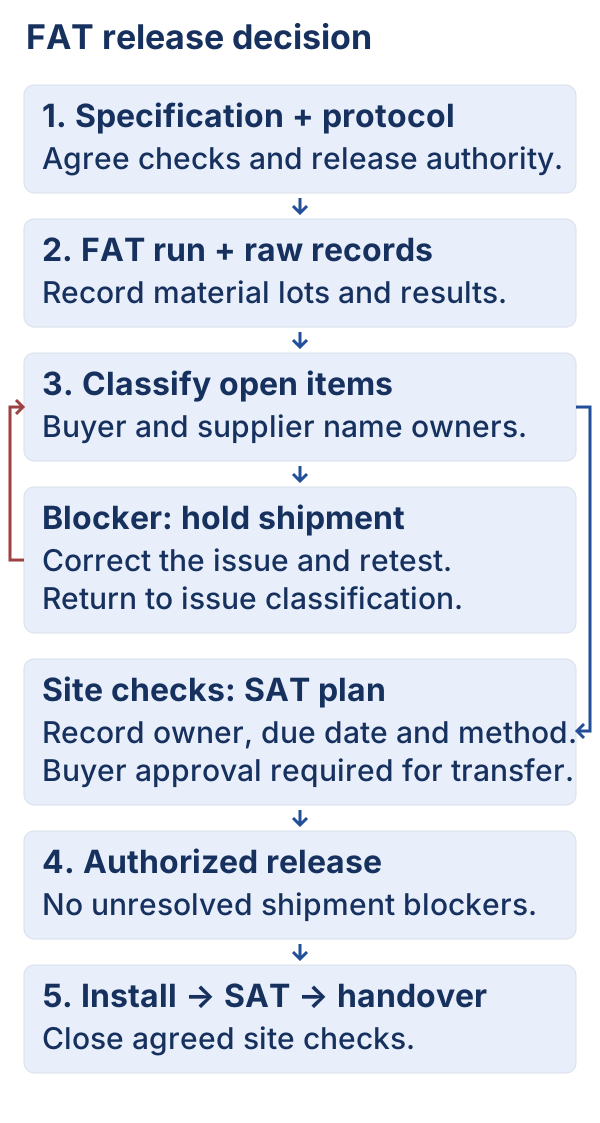
A punch list is the list of open items after the FAT. Record each item with a number, description, severity, owner, due date, and the evidence that will close it. Name the buyer’s release approver and the supplier’s responsible owner in the protocol. They agree which items block shipment; the buyer’s designated approver records acceptance of a SAT transfer, its justification, owner, due date and required evidence. Unresolved blockers stay open through correction and retest and prevent release under that agreement.
The OpX total cost of ownership guidelines list “confirmed FAT punchlist items completed”, final acceptance of the equipment, and documentation provided by the equipment maker as SAT considerations. The punch list therefore links the two tests. Use one simple rule: no item is closed by a statement alone. Closure needs evidence such as a retest record, a photo or a revised drawing.
Punch list checklist
- Every item has an owner and a due date.
- Every item is classed as a shipment blocker, a SAT item or a documentation item.
- Closure evidence is defined for each item.
- The buyer signs off the retests.
- Open items carry forward into the SAT protocol.
- Final documents and drawings are updated to as-built status.
Virtual FAT
PMMI states that the revised OpX guidance now includes the Virtual FAT material as an appendix. A virtual FAT can reduce travel, but it still needs the same protocol, materials and records. Agree in advance how you will see the machine, how samples will be handled, and which checks need physical presence.
Questions to ask suppliers
- Will you provide a draft FAT protocol, and can we change it?
- Which tests do you propose for FAT and which for SAT, and why?
- What materials do you need from us, in what quantity and by when?
- Can we run our own product and containers, including worst-case samples?
- Can our operators run the changeover?
- What instruments will you use, and what is their calibration status?
- How do you record deviations, and who decides on retest?
- What is the shipment release rule, and what happens to open items?
- What does the FAT cost us beyond the quoted price?
What needs project-specific validation
A FAT cannot validate everything. These points need your own product, site and data:
- Performance with real production lots over a long run.
- Behavior with your site utilities and environment.
- Integration with upstream and downstream equipment.
- Shelf-life, product quality and food-safety outcomes, which depend on the product and process as well as the machine.
- Operator skill and training after handover.
List them in the protocol as SAT or commissioning items, and do not let a FAT report imply they are covered.
Context from regulated industries
In pharmaceutical projects, the ASTM E2500 verification approach treats FAT and SAT as commissioning activities within good engineering practice. According to ISPE’s summary of the 2025 revision, vendor test documents can be used for verification if the regulated company has assessed the vendor, and the system owner or subject-matter experts may take part in vendor testing depending on risk. This pharmaceutical context does not set this guide’s food-equipment acceptance criteria: decide what evidence you need and who will witness it.
Sources and method
This article is based on documentary research of the sources listed. It is not a hands-on equipment test. Supplier statements and editorial judgement are identified in the text.
- One Voice Factory Acceptance Tests: Protocols for Capital Equipment in the CPG Industry Supports: the existence of the OpX FAT work product, its audience of consumer packaged goods companies and equipment makers, and its purpose of resolving FAT, virtual FAT and SAT expectations that otherwise cause confusion, unbudgeted travel and material costs, and longer timelines.
- OpX Leadership Network offers updated FAT guidance Supports: the revised edition's added leadership guidance, expanded responsibilities of both equipment makers and end users, and Virtual FAT material included as an appendix.
- Total Cost of Ownership (TCO): Packaging and Processing Machine Guidelines Supports: the FAT cost considerations of material and product costs, set-up costs at the equipment maker, and time and travel, and the SAT considerations of completed FAT punch list items, final acceptance and documentation from the equipment maker.
- ASTM E2500-25 Standard Guide: Approval and Updates Supports: context that, in the regulated-industry verification approach, commissioning test documentation such as FAT and SAT sits within good engineering practice, that vendor test documents may be used where the vendor has been assessed, and that system owners or experts may take part in vendor testing.
- NIST Handbook 133: Checking the Net Contents of Packaged Goods Supports: that a published procedural guide exists for checking net contents of packaged goods, covering weight-based and volume-labeled packages, which a buyer may consult when writing fill-quantity acceptance checks.
- 21 CFR 117.40 Equipment and utensils Supports: the requirement that food equipment be designed and built to be adequately cleanable, which a FAT can check for accessibility and cleanability.
Next reading
Packaging Machine RFQ Checklist for Food and Beverage Buyers
A copy-ready request-for-quotation structure for packaging machines, with eight modules of fields to fill in and a method for comparing quotes line by line.
Read the guide
Packaging Line Cost: Building a Project Budget Beyond the Machine
Build a packaging line budget from nine components, from machines and change parts to FAT, SAT, training and contingency, and learn how to collect each figure.
Read the guide
Bottle Capping Machine Selection: Caps, Torque and Changeover
How to match a capping machine to the closure and bottle finish: cap types, application vs removal torque, heads, change parts and pre-purchase validation.
Read the guideMore in Buying Guides

Bottle vs Pouch Packaging: What Changes on the Production Line?
Moving a liquid product between rigid bottles and flexible pouches changes filling, closing, conveying, changeover and cases. Use this guide to scope the work.
Read the guide
Food Packaging Costs: Materials, Quotes and Cost per Pack
Build a food packaging cost worksheet for materials, conversion, printing, freight and waste, with qualitative PLA and dairy-container examples.
Read the guide