
Packaging Line Cost: Building a Project Budget Beyond the Machine
Build a packaging line budget from nine components, from machines and change parts to FAT, SAT, training and contingency, and learn how to collect each figure.
What this article covers
List project costs beyond the machine quote, assign sources and owners, and prevent double counting.
Covered
- Nine budget categories and a copyable worksheet
- One-time startup and recurring operating costs
Not covered
- Price ranges, returns, financing and accounting treatment
A budget limited to the machine quote can omit integration, utilities and startup work. Build one project budget across the nine categories below, assigning a source and an owner to each line; keep recurring operating costs separate.
Scroll horizontally for any hidden columns →
| Budget category | Data source | Buyer-side owner |
|---|---|---|
| A. Machines | Comparable supplier quotes | |
| B. Change parts | Format-specific parts list | |
| C. Conveyors / integration | Layout and interface quotes | |
| D. Utilities | Demand tables and site upgrade quotes | |
| E. Installation / startup | Rigging, setup and commissioning scope | |
| F. FAT / SAT services | Protocol, fees, attendees and travel | |
| G. Training / initial spares | Training scope and spare-parts quotes | |
| H. Trial materials | Trial, FAT, SAT and commissioning quantity plan | |
| J. Contingency | Named risks and organization policy |
The categories are this publication’s planning structure, informed by PMMI OpX guidance. Give each expense one owning line ID; use the blank budget worksheet to record its evidence and inclusion status.
The nine components
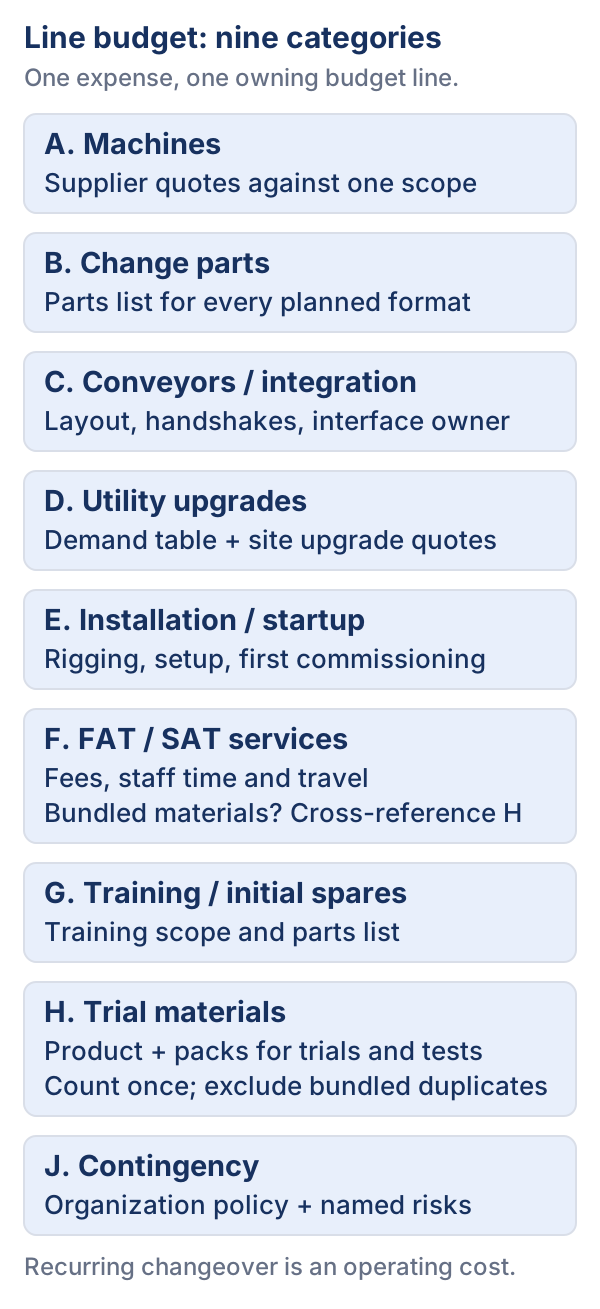
Use the opening categories as the budget index; collect the supporting detail below.
Machines
Most buyers already know how to collect the machine line item. The risk is comparing quotes with different scopes. Use one request document and a scope matrix, as described in our RFQ checklist. Ask which options are priced separately and which items the supplier has assumed you provide. The factors that move the price of one machine are set out in what drives a single machine quote below.
Change parts
List purchased change parts as one-time project spending. Recurring changeover labor and lost operating time belong in operating costs; first setup and commissioning time belong in the one-time startup lines under E. This is a planning split, not an accounting capitalization rule. The OpX guidelines list changeover options among the equipment design and application costs, and state that the buyer provides expected rates and needs while the equipment maker provides design capabilities. Ask for the change-part list per format and for how each part is changed: by hand, with tools, or automatically. Our comparison of bottle and pouch lines shows how the change parts differ by container type.
Conveyors and integration
Quotes often leave out conveyors, accumulation tables, transfers, guarding and line controls. Draw the line layout and mark every interface where one supplier’s equipment meets another’s, or where a new machine meets an existing one. For each interface, write down who supplies the conveyor, who programs the handshake signals, who commissions it, and who is responsible when the two machines do not work together. The OpX guidelines list integration with other contractors and trades among the site-specific items to account for.
Utilities
The OpX guidelines state that the equipment maker provides usage requirements at maximum and continuous consumption rates, while the buyer calculates costs based on local site conditions. They list compressed air, electrical, gas, water and water treatment. Ask each bidder for a table of utility demand, then ask your plant engineering team whether the supply is there. If it is not, the upgrade is a project cost that may not appear in any supplier’s quote.
Installation
The OpX guidelines list unloading, uncrating and disposal; assembly; initial set-up; and installation service technicians as installation considerations, and ask buyers to define requirements and responsibilities for preparing and executing the installation. Add three site items: rigging and access (doors, floor loading, elevators), any contractor trades, and permits. Under 21 CFR 117.40, food equipment must be installed so that it and adjacent spaces can be cleaned and maintained, so allow for clearances and for drains and wall or floor finishes where the layout requires them.
FAT and SAT
Acceptance testing costs more than the supplier’s fee. The OpX guidelines note that FAT costs include materials and products, set-up costs at the equipment maker, and time and travel, and that SAT costs include completion of confirmed FAT punch list items, final acceptance of the equipment, and documentation from the equipment maker. PMMI describes the FAT guidance as a way to avoid confusion that leads to unbudgeted travel and material costs and longer schedules. Use factory acceptance planning to agree material quantities. In this worksheet, put materials under H and testing services, staff time and travel under F. If materials are inseparable from a bundled F quote, keep the charge there and mark H as a cross-reference excluded from the total.
Training and spares
Agree the scope, level and hours of initial training up front. The OpX guidelines divide training level into basic, intermediate and advanced and list technical training and documents as parts of the scope. For spares, ask each supplier for a recommended list and treat it as open to negotiation. The OpX list also mentions operations and maintenance documentation, spares, wear parts and lubricants.
Trial materials
Product, containers, closures, labels, film and cartons used in trials, FAT and commissioning all cost money. They are easy to forget because they sit in purchasing and production budgets rather than the project budget. Take quantities from the FAT and SAT protocols, add commissioning runs, and decide who pays for scrap. Record materials once: H owns separately priced materials; any materials already counted in a bundled F quote are cross-references only.
Contingency
Your organization’s policy sets the contingency. One habit helps: tie each contingency amount to a named risk, such as an unconfirmed utility, an interface not yet specified or a container still under development, and release it only when that risk is resolved. This guide suggests no percentage, since a general figure would not reflect your project.
What drives a single machine quote
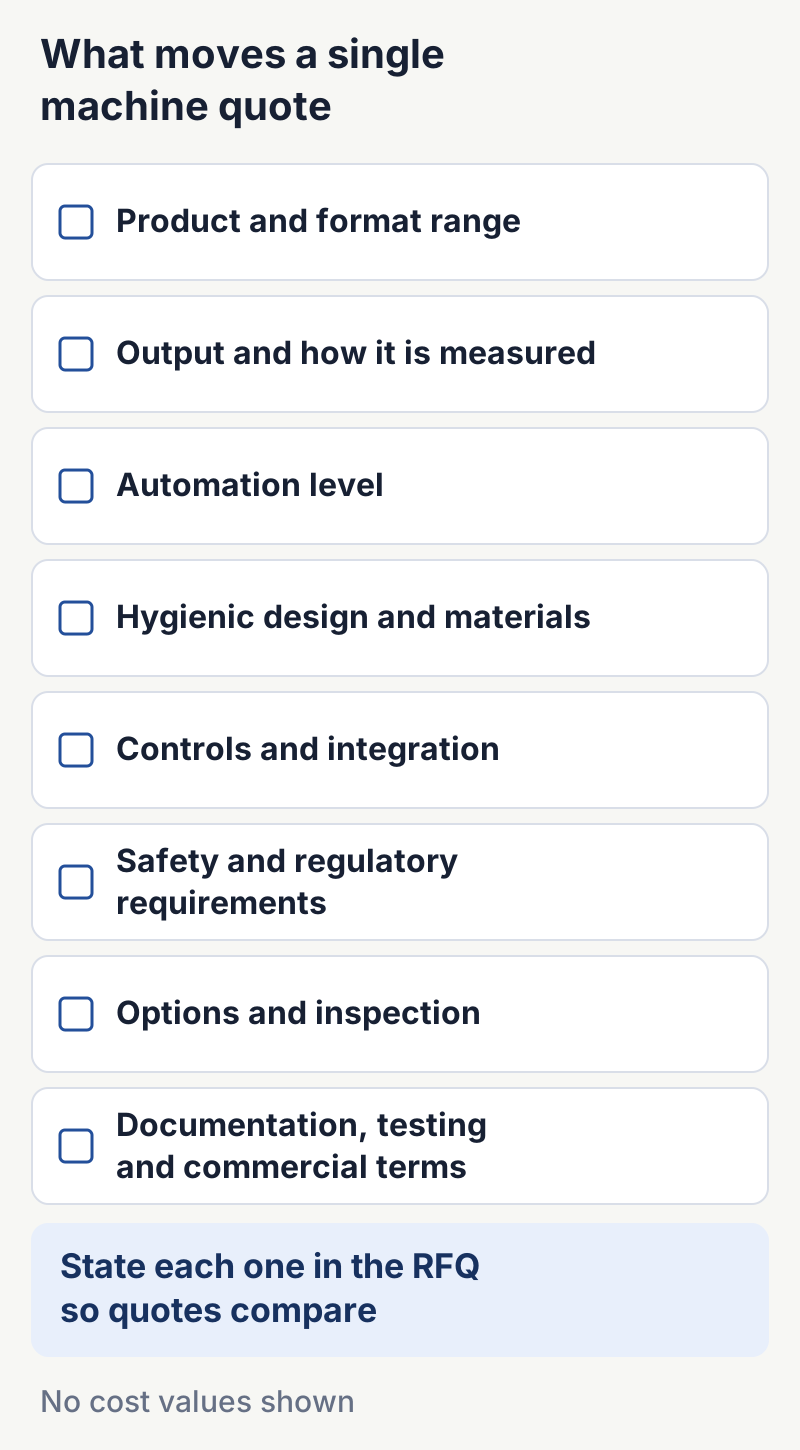
Buyers searching for a packaging machine price, or for a price on a small machine, usually meet two kinds of figure: listing prices for standard machines and project quotes for specified ones. Neither can be compared until you know what was specified. Use the factors below to check what each quote specifies before comparing figures.
The PMMI OpX total cost of ownership guidelines group several of these under equipment design and application: the material and design of equipment need to be fit for purpose for the manufacturing environment, and engineering, health, safety and environmental requirements, specific controls and changeover options all carry cost. The guidelines also ask the buyer to define, before quoting, the products and volumes, the process, the work environment, the standards that apply (they give company standards, 3-A and GMA guidelines as examples) and regulatory requirements. The table below is our own grouping of those topics and the common commercial items, stated qualitatively.
Scroll horizontally for any hidden columns →
| Factor | Why it changes the quote | What to state so quotes compare |
|---|---|---|
| Product and format range | Each extra container size, closure or pouch style adds change parts and set-up, and difficult products (foaming, particulates, hot fill) need specific designs | Every product, container and closure, marked as fixed or possible |
| Output and how it is measured | Higher output can mean more heads, lanes or a different machine structure | Packages per minute or per shift, the product and container it applies to, and the measuring window |
| Automation level | Automatic infeed, discharge and changeover add mechanisms and controls compared with a semi-automatic station | What the operator should do per package, and which changeovers must be tool-free or automatic |
| Hygienic design and materials | The OpX guidelines note that material and design must be fit for purpose and that sanitation can add labor | Cleaning method, product-contact materials, washdown and any hygiene standard you require |
| Controls and integration | Control platform, programming and signals to neighboring machines are engineered items | Your control standard, the signals to and from adjacent machines, and data you want recorded |
| Safety and regulatory requirements | Guarding, safety risk assessment and electrical requirements for the destination site add design work | The site’s safety and electrical requirements and the regulations the line must meet |
| Options and inspection | Coders, rejects, checkweighers, vision or extra change parts may be quoted as options | Which options you need, and a request to price each separately |
| Documentation, testing and commercial terms | FAT, documentation, crating, freight, installation support, training, spares, warranty and price validity sit inside or outside the machine price | Which of these are included, as lines on one scope matrix |
Why two quotes for a similar machine differ
When two quotes for what looks like the same machine are far apart, the cause is usually one of three things. The scopes differ: one includes change parts, FAT and installation support while the other lists them as options or leaves them out. The assumptions differ: the output was rated on a different product or container, or one supplier assumed manual changeover and the other automatic. Or the designs differ: hygienic class, materials, controls or safety features are not the same. Ask both suppliers to answer the same request and to list exclusions and assumptions in writing, as the RFQ checklist describes, before you compare totals.
Getting a figure for a small machine
For a small business, the question “how much does a food packaging machine cost?” has the same answer structure as for a large one: it depends on the factors above, and a figure means something only next to its scope. A catalog or listing price for a standard tabletop or semi-automatic machine can be a useful first check, but confirm what it includes: change parts for your containers, delivery, installation, training and spares are often separate. If the machine will later join a line, ask how it connects to conveyors and other machines, because the price of adding that later belongs in the budget too. The equipment section explains manual, semi-automatic and automatic stations in more detail.
A worksheet you can copy
Copy the blank table and add a unique sub-ID for each expense. Replace unknown with quoted or estimated when evidence is available. Enter a source reference even for an internal estimate.
Scroll horizontally for any hidden columns →
| Owning ID / item | Source / reference | Amount / currency | Status | Included in quote | Buyer owner | Date / validity | Risk / assumption | Duplicate of ID | Count in total? |
|---|---|---|---|---|---|---|---|---|---|
| A / Machines | unknown | ||||||||
| B / Change parts | unknown | ||||||||
| C / Integration | unknown | ||||||||
| D / Utility upgrades | unknown | ||||||||
| E / Installation and startup | unknown | ||||||||
| F / FAT and SAT services | unknown | ||||||||
| G / Training and initial spares | unknown | ||||||||
| H / Trial materials | unknown | ||||||||
| J / Contingency | unknown |
Common mistake: Counting one batch of FAT materials in both F and H. Choose one owning ID; mark the other row “duplicate of [ID]” and “No” under “Count in total?”. Check bundled quotes before adding separate allowances. Unknown values remain blank, not zero.
Illustrative calculation
The structure below shows how to add the components. Replace each variable with a figure from your own sources.
Illustrative calculation—not a measured result. One-time project planning budget = A (machines) + B (change parts) + C (conveyors and integration) + D (utilities work) + E (installation) + F (FAT and SAT costs) + G (training and spares) + H (trial materials) + J (contingency tied to named risks).
A through J are placeholders with no values. Sum only owning rows marked to count in the total, after removing overlaps in bundled quotes. Calculate recurring labor, utilities, wear parts, cleaning and changeover time separately; initial commissioning time stays in startup spending.
One-time project spending and operating cost
The project budget above groups one-time acquisition and startup spending for planning; finance decides the accounting treatment. Operating cost recurs: labor, utilities, wear parts, maintenance, cleaning, quality losses and changeover time. The OpX guidelines divide costs into acquisition and operation, and the same split works here. Do not compare two machines on capital cost alone if their operating cost differs, and do not claim a saving until you have used your own data to calculate it.
Budget completeness checklist
- Every machine in the line has a quote on a common scope matrix.
- Change parts are listed per format and priced separately.
- Every interface between machines has a named owner.
- Utility demand is tabulated and checked against site supply.
- Installation, rigging and permits are assigned to a party.
- FAT/SAT services, travel and staff time are recorded; test materials have one owning line only.
- Training scope, level and hours are written down.
- A recommended spares list is requested and reviewed.
- Trial and commissioning materials are quantified.
- Each contingency item is tied to a named risk.
- Each figure has a source, date and unique ID; duplicated or bundled charges are excluded from extra totals.
Questions to ask suppliers
- What is excluded from this quote that I will need to buy elsewhere?
- Which options are priced separately, and which are required for the specified performance?
- What utility connections do you require, and who makes them?
- Which change parts are included for the formats in the RFQ?
- What are the FAT and SAT scopes, and what does each cost me beyond the quoted fee?
- How many training hours are included, and for how many people?
- Which spares do you recommend, and which are single-source?
- Until when is the price valid, and which items could change before then?
What needs project-specific validation
- Utility availability and the cost to extend it.
- Interfaces with existing equipment, which often reveal work that does not show on paper.
- Changeover time, measured on the actual machine with your operators.
- Material quantities for trials and commissioning.
- Local permit, inspection and contractor requirements.
Takeaway: Close each unknown in the budget worksheet, or carry it as a named risk. Use the RFQ scope matrix to reconcile inclusions and the FAT planning guide to agree trial quantities.
Sources and method
This article is based on documentary research of the sources listed. It is not a hands-on equipment test. Supplier statements and editorial judgement are identified in the text.
- Total Cost of Ownership (TCO): Packaging and Processing Machine Guidelines Supports: the acquisition-cost topics listed in the guidelines, including equipment design and application, engineering, project requirements, installation, initial training, validation and utilities, and the list of FAT, SAT, spares, documentation, permit and shipping considerations.
- Revamped industry tool allows manufacturers to understand total cost of machinery purchase Supports: the OpX position that acquisition and operating costs must be considered, not just the price, and that the tool includes an Excel workbook for recording key costs.
- OpX Leadership Network offers updated FAT guidance Supports: the OpX statement that FAT misunderstandings can lead to unplanned travel and material expenses and longer schedules, and that virtual FAT material is part of the guidance.
- One Voice Factory Acceptance Tests Supports: the description of the FAT work product, its audience of CPG companies and equipment makers, and its aim of resolving FAT, virtual FAT and SAT expectations.
- 21 CFR 117.40 Equipment and utensils Supports: the requirement that food equipment be installed so it and adjacent spaces can be cleaned and maintained, which affects installation scope and utilities.
Next reading
Packaging Machine RFQ Checklist for Food and Beverage Buyers
A copy-ready request-for-quotation structure for packaging machines, with eight modules of fields to fill in and a method for comparing quotes line by line.
Read the guide
Factory Acceptance Testing for Packaging Equipment: Planning the Checks
Finding defects after shipment can delay installation. Prepare a FAT protocol, representative materials, raw test records and an agreed punch list.
Read the guide
Bottle vs Pouch Packaging: What Changes on the Production Line?
Moving a liquid product between rigid bottles and flexible pouches changes filling, closing, conveying, changeover and cases. Use this guide to scope the work.
Read the guideMore in Buying Guides
Food Packaging Costs: Materials, Quotes and Cost per Pack
Build a food packaging cost worksheet for materials, conversion, printing, freight and waste, with qualitative PLA and dairy-container examples.
Read the guide