
Contact
Contact the Naturally Iowa Packaging Review editorial team by email about articles, sources, corrections and privacy, and see what this address cannot do.
Email: editorial@naturallyiowa.com
What you can contact us about
- Questions about an article
- Source material relevant to a topic we cover
- Correction requests. Please include the article URL, the exact statement concerned, and a supporting source if you have one.
- Privacy requests
What this address is not
This is not a sales desk. We do not provide factory quotes, equipment sales, or engineering services, and we cannot validate a specific process or product.
This publication is not affiliated with the historical dairy business associated with this domain. We cannot answer questions about its former products, orders, or staff.
How corrections are handled
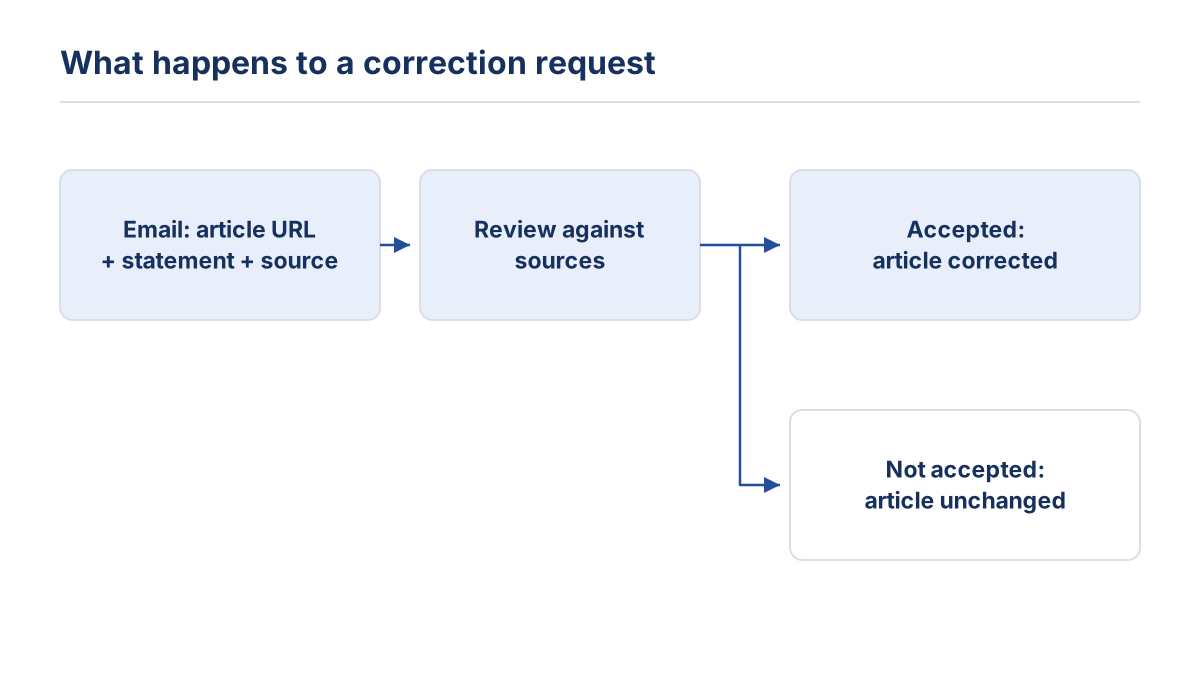
We review correction requests against the sources. Accepted corrections are made in the article itself. The full process is described in our Editorial Policy.
How to write a useful correction request
A request can be reviewed quickly when it identifies exactly what is in question. Please include:
- The article URL.
- The exact statement, copied from the page.
- What you believe is wrong or out of date, in a sentence or two.
- A source that supports your view, with its publisher and date if you can.
A short template:
Article: https://naturallyiowa.com/equipment/bottle-capping-machine-selection/
Statement: "[paste the sentence as it appears]"
Concern: [what is incorrect, or what has changed]
Source: [title, publisher, date, link or document]
What kinds of source material help
Sources that can be identified and dated carry the most weight: a published standard, regulator guidance, a peer-reviewed study, a trade publication, or a manufacturer’s technical document with a version or date. Please say which kind it is. A technical document describes how something works. A marketing claim, such as a brochure line, describes how a supplier presents its product, and it can be cited as that, but it does not settle a technical question. Screenshots without a source, or statements from memory, are hard to assess, though they can point us to a place to look.
Examples of requests we can act on
Some requests are easy to assess. A reader might point out that a cited standard has been revised since the article was written, and supply the new edition’s title and date. Another might say a table of closure types omits a common finish and name a published specification that lists it. A third might note that a supplier quotation in an article is described as general when the supplier’s document presents it as one example. Each of these names a statement and a source, so the comparison can be made directly.
Requests that are harder to assess include broad objections, such as “this guide is wrong about PET”, with no statement or source attached. If you have a concern of that kind, narrow it to the specific sentence that troubles you. A single disagreement with a conclusion can also be a difference in assumptions: guides state their assumptions, and your product, container, or line may differ from them. In that case the guide may be right for its stated case and still not fit yours, which is what the validation lists in each guide are meant to flag.
What happens next
Your message is reviewed against the sources, as the diagram above shows. If the request is accepted, the article is corrected. If it is not accepted, the article stays as it is. We do not promise a response time, and we may ask for more detail. Please do not send confidential material, since a correction request concerns public statements.
Questions we can and cannot help with
We can discuss what an article says, the sources behind it, and errors or gaps in it. For general preparation, the guides may already answer your question. If you are preparing to request quotes, start with the Packaging Machine RFQ Checklist. For budgeting, see Packaging Line Cost, and for acceptance testing, the FAT checklist.
We cannot recommend a machine or a supplier, quote a price, advise on your specific process, or confirm that a product or package meets a regulation or specification.
About the historical business
The dairy business historically associated with this domain is unrelated to this publication. We cannot answer questions about its products, orders, or staff. The History section presents what dated public sources say, and nothing beyond that.
Questions about sourcing and scope
To tell whether a question fits, ask whether it concerns something printed on a page of this site. “Where does the torque range in this article come from?” does. “Which capper should I buy for my 38 mm closure?” does not, because the answer depends on your container, product, and line, and this publication does not advise on specific purchases. For that kind of question, the supplier documentation and validation lists in the relevant guides, such as Bottle Capping Machine Selection, show what to prepare before you speak to a supplier.
Privacy of your message
An email address and message are used to respond and to handle corrections or requests. The Privacy page describes this and what the site does not collect.