
Packaging Machine RFQ Checklist for Food and Beverage Buyers
A copy-ready request-for-quotation structure for packaging machines, with eight modules of fields to fill in and a method for comparing quotes line by line.
What this article covers
This guide gives buyers an eight-module RFQ structure they can copy into a request for packaging equipment, and shows how to make supplier quotes comparable before price is discussed.
Covered
- An eight-module RFQ structure with fields to complete
- A scope matrix, exclusions, options and assumptions for comparing quotes
- Questions to put to suppliers and items that need project-specific validation
Not covered
- Legal contract language and purchase terms review
- Supplier or brand recommendations
- Specific prices, lead times or performance figures
Comparing a filler-only quote with a complete-line quote can hide missing equipment and site work. Give every bidder the same product, package and site data, then require the same scope statuses before comparing prices.
Copy this blank eight-module RFQ into your project document. Fill the data and owner/revision columns; the detailed modules below explain the inputs.
Scroll horizontally for any hidden columns →
| Module | Inputs to enter | Your data / file | Required supplier output | Owner / revision |
|---|---|---|---|---|
| 1. Product | State, viscosity, particles, fill temperature, preservation | Machine limits and trial needs | ||
| 2. Container / closure | Drawings, materials, formats, tolerance, closure | Compatible formats and change parts | ||
| 3. Output / shifts | Net output, run window, SKUs, changeovers | Rated-speed assumptions and line duty | ||
| 4. Utilities / site | Supply, space, drains, existing interfaces | Demand table and installation scope | ||
| 5. Hygiene / cleaning | Cleaning method, chemicals, allergens, criteria | Cleaning procedure and design evidence | ||
| 6. Controls / data | Platform, recipes, logs, network, access | Control interfaces and data format | ||
| 7. Documentation | Manuals, certificates, drawings, revision, dates | Document list and delivery milestones | ||
| 8. Acceptance / terms | Test criteria, samples, FAT/SAT, training, scope | Test commitments, exclusions and terms |
Use “not applicable” with a reason for unused fields, and use the pre-send review before issuing the document.
The eight modules at a glance
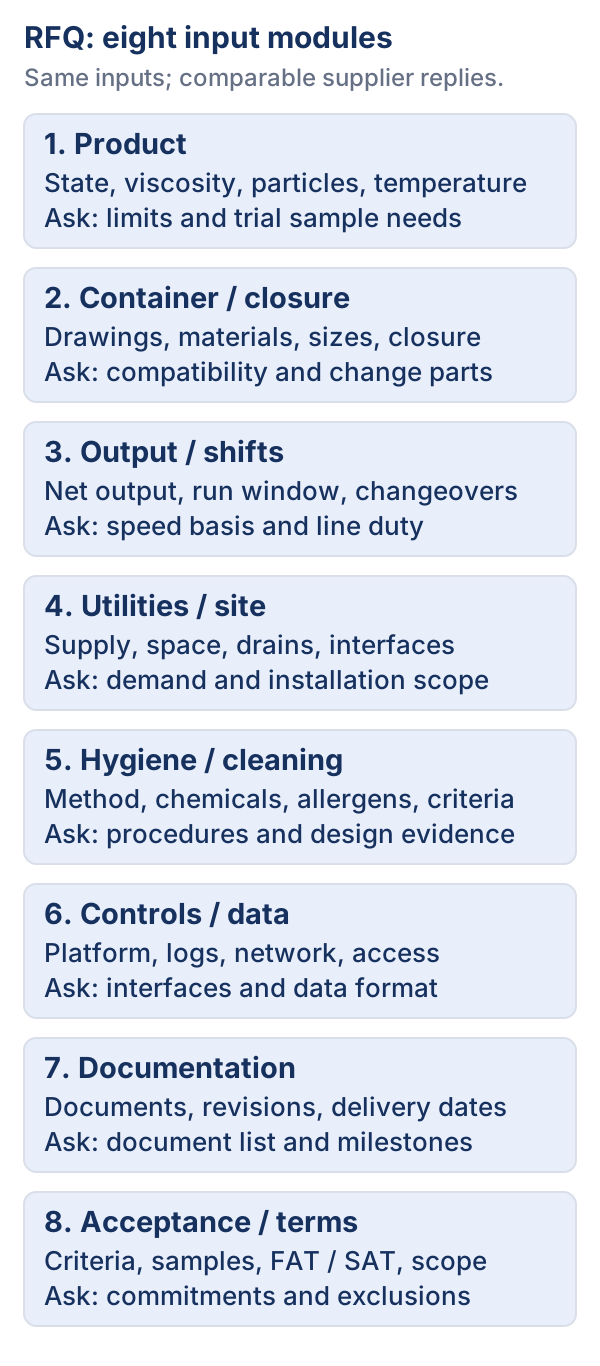
The PMMI OpX Leadership Network, an industry group of packaged goods companies and equipment makers, publishes free guidance on total cost of ownership and on factory acceptance tests. Its total cost of ownership guidelines list acquisition-cost topics such as project requirements, installation, initial training, validation and utilities. The modules below are written for a food or beverage buyer and overlap with those topics, but they are our own structure and do not reproduce the OpX template.
Module 1: Product data
A supplier cannot size a filler, sealer or conveyor without knowing the product. Fill in:
- Product name and category (still beverage, dairy, sauce, fruit preparation, and so on)
- Physical state: liquid, viscous, particulate, foaming, carbonated
- Viscosity range at filling temperature, and how you measured it
- Particle type and maximum size, if any
- Filling temperature and any hot-fill or chilled requirement
- Preservation route in the process (the process itself is yours to define; the RFQ states it)
- pH, water activity or other properties that affect material compatibility
- Allergens present on the line and in the plant
- Product samples available to the supplier for trials, and the quantity you can provide
Tell suppliers which property is a hard constraint and which is typical. If the product changes seasonally, say so.
Module 2: Container and closure
- Container type: bottle, cup, pouch, carton, other
- Material and grade, with the container supplier’s drawing
- Fill volume per container and acceptable tolerance
- Neck finish, cup rim or pouch fitment dimensions
- Closure type, liner or seal, and torque or seal requirements
- Label or print type, position and code location
- Number of formats now and expected in the future
- Drawings or physical samples supplied with the RFQ
If the format changes between bottle and pouch, read bottle vs pouch packaging first, since it changes which stations are in scope.
Module 3: Output and shifts
State the output you need, not the machine’s headline capacity.
- Required net output per hour, and the basis (containers per hour, volume per hour)
- Shifts per day, days per week, planned operating hours per year
- Planned changeovers per day or week, and the target time for each
- Number of SKUs and how they differ (volume, container, closure, label)
- Expected growth in output over the equipment life
- Whether the machine runs alone or must synchronize with upstream and downstream equipment
Ask each supplier for the assumptions behind its rated speed as well as the speed itself.
Module 4: Utilities and site
- Available electrical supply: voltage, phases, frequency, available capacity
- Compressed air quality and pressure available at the point of use
- Water, steam, vacuum, nitrogen or CO2 availability
- Drainage and floor conditions in the area
- Room dimensions, ceiling height, door and elevator sizes for delivery
- Existing conveyors and equipment to connect to, with heights and directions
- Ambient temperature and humidity, and any wash-down environment
- Permits or site-safety rules that apply to installation and contractors
The OpX total cost of ownership guidelines tell the equipment maker to state usage requirements at maximum and continuous consumption, and the buyer to calculate costs from local site conditions. Ask each bidder for a utility consumption table and calculate the cost yourself.
Module 5: Hygiene and cleaning
Under 21 CFR 117.40, equipment used with food must be designed, built and maintained so that it is adequately cleanable, with food-contact surfaces made of nontoxic, corrosion-resistant materials, and it must be installed so that it and adjacent spaces can be cleaned and maintained. Your RFQ should turn that into plant-specific terms.
- Cleaning method: manual disassembly, clean-in-place (CIP), clean-out-of-place, wet or dry cleaning
- Cleaning frequency and the maximum time allowed for cleaning
- Cleaning and sanitizing chemicals used in your plant
- Materials required for food-contact parts, and surface finish expectations
- Hygienic design standard you expect, if any
- Allergen changeover rules between products
- Documentation required for materials of construction
If you reference 3-A Sanitary Standards, ask whether the machine is designed to meet the criteria or is authorized to carry the 3-A Symbol. According to 3-A SSI, the Symbol identifies equipment that has passed third-party verification, and the two claims are different. Ask the supplier to state which one it makes and to provide the certificate or the design rationale.
Module 6: Controls and data
- PLC platform or preferred controller family, and the reason
- Operator interface language, user levels and password rules
- Recipe storage and format changeover handling
- Data to log: counts, rejects, alarms, parameters, batch or lot information
- Interface to your plant network, historian or MES, with protocol
- Remote support access rules and your IT security requirements
- Safety circuit and guarding requirements under your plant standards
- Spare parts for controls hardware and software backup procedure
Module 7: Documentation
- Language and format for manuals, drawings and parts lists
- Electrical, pneumatic and mechanical drawings, and their revision control
- Material certificates for food-contact parts
- Cleaning and sanitation procedures
- Operating, changeover and maintenance instructions
- Spare parts list with recommended on-hand quantities
- Software documentation and backup copies
- Delivery timing: with the quote, at FAT, at shipment, at SAT
Module 8: Acceptance and commercial terms
This module links the RFQ to the later FAT and SAT. Our guide to planning factory acceptance testing explains the protocol in detail. The RFQ only needs to commit the supplier to the structure.
- Acceptance criteria, written as measurable statements and tied to the requirements above
- FAT location, notice period, who attends, and what samples the buyer provides
- SAT and commissioning scope, and who supplies utilities, labor and materials
- Training scope, hours and level for operators and maintenance
- Installation scope: unloading, assembly, setup, service technicians
- Shipping terms and the point at which responsibility transfers
- Warranty scope and start date
- Spare parts and support availability after commissioning
- Payment milestones tied to FAT, shipment and SAT
- Required quote validity period and response format
Have your purchasing and legal teams review the terms. The PMMI total cost of ownership guidelines refer to the PMMI Model Sales Contract and Incoterms for shipment responsibility, which gives those teams a starting point.
Screening dairy packaging suppliers and other material suppliers
The machine RFQ above assumes that the container, film, closure and label already exist and are specified. In practice they come from separate packaging material suppliers, and the machine quotes are only as good as the drawings and samples those suppliers provide. Screening those suppliers in parallel with the machine RFQ prevents a common failure: a filler accepted at FAT on sample bottles that the production supplier later changes.
This section is about how to check a food packaging materials supplier with evidence you can request. It does not recommend or rank suppliers, and it is a purchasing aid, not a compliance determination. Food-contact status is for your regulatory or compliance specialist to confirm.
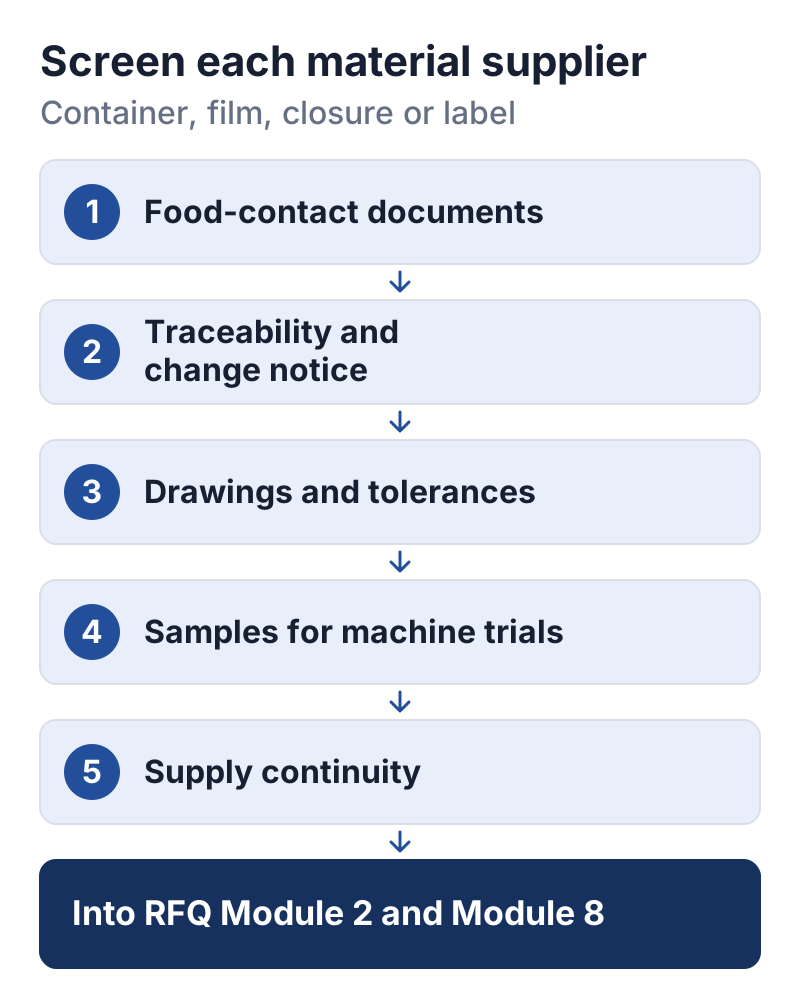
Scroll horizontally for any hidden columns →
| Check | What to ask the material supplier for | Why it matters to the machine RFQ |
|---|---|---|
| Food-contact documents | For the U.S., the specific sections of 21 CFR Parts 174 to 178 (or other FDA authorization) the supplier relies on for each food-contact layer, and the conditions of use they cover. For the EU, require a written declaration where the applicable specific measure or material rule requires it (including plastics under Regulation (EU) No 10/2011, at non-retail marketing stages); check applicable national rules. Separately label any extra buyer-requested documentation as a purchasing requirement. | A package that has to change after FAT can change the change parts, the sealing settings and the acceptance tests. |
| Traceability and change notice | Lot coding on the material, and a written commitment to notify you before changing resin, board, ink, adhesive or production site. | A changed material can behave differently on the filler, sealer or labeler even with the same drawing. |
| Drawings and tolerances | Neck finish, cup rim, carton blank or film reel drawings with tolerances, revision-controlled. | These are the inputs for Module 2; machine suppliers size change parts from them. |
| Samples for machine trials | Production-representative samples in the quantity the machine supplier needs for trials and FAT. | FAT results on non-representative samples do not transfer to production. |
| Supply continuity | Which items are single-source, how the supplier handles capacity limits, and where alternative sources would need requalification. | A machine tied to one package design is a supply risk if that package has one source. |
What the U.S. and EU rules say about the documents
In the United States, the FDA regulations for substances used in food-contact articles are listed as indirect food additives, starting with 21 CFR Part 174 (general provisions) and the parts that follow it: Part 175 covers adhesives and components of coatings, Part 176 paper and paperboard components, Part 177 polymers, and Part 178 adjuvants, production aids and sanitizers. The individual sections are narrow. For example, 21 CFR 176.170 deals with components of paper and paperboard in contact with aqueous and fatty foods, and 21 CFR 177.1520 deals with olefin polymers such as polyethylene and polypropylene, each subject to its own conditions. A useful supplier answer names the section and the food type and temperature it covers; a general statement that a material is “food grade” does not.
For food irradiated in its packaging, also check the applicable authorization under Part 179 or another valid authorization route. FDA explains that the food-contact packaging components must be authorized for those irradiation conditions, through 21 CFR 179.45, an effective food contact notification, or a threshold of regulation exemption. This is a use-specific check, not a blanket irradiation requirement for every dairy package.
In the European Union, Regulation (EC) No 1935/2004 requires food-contact materials not to transfer their constituents to food in quantities that could endanger health or bring an unacceptable change in the food (Article 3), requires a written declaration of compliance where specific measures apply (Article 16), and requires business operators to have traceability systems (Article 17). For plastics, Regulation (EU) No 10/2011 requires that written declaration at marketing stages other than retail (Article 15), and its scope includes plastic layers in multi-layer materials and plastic gaskets in caps and closures (Article 2). That makes carton laminates and cap liners part of the documentation request, not only the bottle or film.
Dairy example
A dairy plant changing from bottles to gable-top cartons screens two kinds of supplier at once: the carton material supplier and, often, the same supplier’s filling machine. Typical dairy packaging types (bottles, cartons, pouches and cups) each bring their own checks, which are described in the milk packaging guide and the yogurt packaging guide. For the carton case:
- Ask for the layer specification of the exact carton, the products and distribution temperatures it is specified for, and food-contact documentation for each layer that touches the milk.
- Ask for light-transmission information if the product will be displayed under retail lighting.
- For Grade A milk in the U.S., the Pasteurized Milk Ordinance also covers containers and closures, according to Penn State Extension. Ask your regulator which documentation it expects from the container and closure suppliers.
- Put the screening results into Module 2 (container and closure) and the trial-sample commitment into Module 8 (acceptance), so the dairy packaging machine quote and the material supply are tied to the same specification.
Making quotes comparable
Send the same package to every bidder, including answers to any question one of them asks, and require responses in a fixed format.
Build a scope matrix
List every line item you need in rows. Put each bidder in a column. For each cell, use one of four statuses: included, excluded, optional, or deviates. Add a note column for the supplier’s assumption.
Copy this blank matrix for each bidder. Enter Included, Excluded, Optional or Deviates in the status column and attach the scope evidence.
Scroll horizontally for any hidden columns →
| Scope item | Bidder / status | Included scope / exclusion | Option / deviation | Evidence / assumption |
|---|---|---|---|---|
| Main machine | ||||
| Change parts | ||||
| Infeed / outfeed conveyors | ||||
| Controls / HMI | ||||
| Installation / commissioning | ||||
| FAT / SAT | ||||
| Training | ||||
| Spares | ||||
| Documentation |
Illustrative example only: A, B and C below are placeholders with invented statuses to show the format; they are not supplier offers.
Scroll horizontally for any hidden columns →
| Scope item | Bidder A | Bidder B | Bidder C | Notes and assumptions |
|---|---|---|---|---|
| Main machine and frame | Included | Included | Included | |
| Change parts for all formats | Optional | Included | Excluded | Which formats are covered? |
| Infeed and outfeed conveyors | Excluded | Included | Optional | Heights, length, who integrates? |
| Controls cabinet and HMI | Included | Included | Included | Platform and language |
| Installation and commissioning | Optional | Included | Included | Days, number of technicians |
| FAT with buyer materials | Included | Included | Optional | Location and runs |
| Training | Included | Optional | Included | Hours and trainees |
| Spare parts package | Optional | Optional | Excluded | Criteria for recommendation |
| Documentation | Included | Included | Included | Language and format |
Takeaway: Resolve every exclusion or deviation against the common RFQ before comparing totals.
Require exclusions, options and assumptions in writing
Ask each bidder to submit three separate lists: items excluded from the price, priced options, and assumptions about your site, your product and your materials. A low price that assumes a utility you do not have, or a product that is easier than yours, is a different offer from the one you asked for. Where a quote deviates, record the deviation and ask for the price to bring it to the baseline. Technical sign-off on any deviation belongs with engineering, not purchasing alone.
Separate price from technical compliance
Score each requirement as compliant, deviating or needing clarification before opening the price sheet. Record the reasoning, especially if you do not select the lowest price. UC San Diego’s guidance says a source justification is needed when the lowest-priced supplier is not selected. It is good practice to document the same reasoning for capital equipment.
Ask for the whole cost picture
The OpX total cost of ownership guidelines say buyers should weigh acquisition and operating costs, not only price. Ask for utility consumption, wear-part lists with replacement intervals, recommended spares and cleaning time. Our packaging line cost guide shows how to collect those into a project budget.
Questions to ask suppliers
- Which items in your quote depend on information we have not given you?
- What have you assumed about our product, our containers and our site?
- Which formats and sizes are covered by the change parts in the price?
- What does your FAT include, and what materials do you need from us and in what quantity?
- Which documents do you deliver, in what format, and at which milestone?
- What do you need from us before installation can begin?
- What is excluded from your scope: conveyors, guarding, integration, utilities, rigging?
- Which components are single-source, and what is the recommended spares list?
For the filler itself, the filling machine selection guide lists the technical data that belongs in Modules 1 to 3.
What needs project-specific validation
An RFQ cannot prove that a machine will run your product. These points need trials, drawings or acceptance tests:
- Fill accuracy, seal or closure quality, and cleaning effectiveness with your product and containers.
- Real changeover time with your operators.
- Interface behavior with existing conveyors, controls and data systems.
- Utility consumption at your site conditions.
- Compliance with your plant’s hygiene, safety and electrical standards.
Write each as an acceptance criterion in Module 8 so that it carries into the FAT and SAT.
Pre-send review
Start here: Copy the eight-module RFQ and the blank scope matrix, then check the following before sending them to suppliers.
- All eight modules are complete, or marked “not applicable” with a reason.
- Drawings and samples of containers and closures are attached.
- The same package goes to every bidder.
- A scope matrix template is attached for bidders to fill in.
- Exclusions, options and assumptions are requested as separate lists.
- Acceptance criteria are written as measurable statements.
- Engineering, quality, maintenance, EHS and purchasing have all reviewed the draft.
- A contact person and a deadline for supplier questions are given.
Sources and method
This article is based on documentary research of the sources listed. It is not a hands-on equipment test. Supplier statements and editorial judgement are identified in the text.
- Price Rationale and Source Justification Supports: the distinction that a request for quotation selects on price only, while a request for proposal weighs qualifications and approach, and that RFPs and RFQs are forms of formal competition.
- Total Cost of Ownership (TCO): Packaging and Processing Machine Guidelines Supports: the acquisition-cost topics a request should cover, including project requirements, installation, initial training, validation, utilities, spares, FAT, SAT, documentation, and shipping responsibility.
- Revamped industry tool allows manufacturers to understand total cost of machinery purchase Supports: the OpX position that buyers weigh acquisition and operating costs, not only the price, and the availability of a customizable workbook.
- OpX Leadership Network offers updated FAT guidance Supports: the existence of published OpX guidance on FAT criteria and expectations, and that it covers responsibilities of both OEMs and end users.
- 21 CFR 117.40 Equipment and utensils Supports: the regulatory background that food equipment must be designed and built so it can be adequately cleaned, with food-contact surfaces of nontoxic, corrosion-resistant materials, and installed so it can be cleaned and maintained.
- About 3-A Supports: the description of 3-A hygienic design criteria and the distinction between equipment designed to the criteria and equipment authorized to carry the 3-A Symbol after third-party verification.
- 21 CFR Chapter I, Subchapter B: Food for Human Consumption (Parts 174 to 179) Supports: Part 174 general provisions for indirect food additives; Part 175 adhesives and components of coatings; Part 176 paper and paperboard components, including 176.170 components of paper and paperboard in contact with aqueous and fatty foods; Part 177 polymers, including 177.1520 olefin polymers; Part 178 adjuvants, production aids and sanitizers; Part 179 irradiation in the production, processing and handling of food, including packaging conditions in 179.45. Checked 2026-10-06.
- Regulation (EC) No 1935/2004 on materials and articles intended to come into contact with food Supports: Article 3 general requirement that materials not transfer constituents to food in quantities that endanger health or bring an unacceptable change; Article 16 written declaration of compliance where specific measures apply; Article 17 traceability systems, with national declaration rules possible under Article 16(2). Checked 2026-10-08.
- Commission Regulation (EU) No 10/2011 on plastic materials and articles intended to come into contact with food Supports: Article 2 scope including plastic layers in multi-material multi-layer materials and plastic gaskets in caps and closures; Article 15 written declaration of compliance at marketing stages other than retail.
- The Grade "A" Pasteurized Milk Ordinance Supports: the PMO is the national reference for Grade A milk and covers standards for containers and closures.
Next reading

Packaging Line Cost: Building a Project Budget Beyond the Machine
Build a packaging line budget from nine components, from machines and change parts to FAT, SAT, training and contingency, and learn how to collect each figure.
Read the guide
Factory Acceptance Testing for Packaging Equipment: Planning the Checks
Finding defects after shipment can delay installation. Prepare a FAT protocol, representative materials, raw test records and an agreed punch list.
Read the guide
How to Choose a Liquid Filling Machine for Food and Beverages
A buyer's framework for choosing a liquid filling machine: project inputs, filling approaches compared, what to validate with samples, and supplier questions.
Read the guideMore in Buying Guides

Bottle vs Pouch Packaging: What Changes on the Production Line?
Moving a liquid product between rigid bottles and flexible pouches changes filling, closing, conveying, changeover and cases. Use this guide to scope the work.
Read the guide
Food Packaging Costs: Materials, Quotes and Cost per Pack
Build a food packaging cost worksheet for materials, conversion, printing, freight and waste, with qualitative PLA and dairy-container examples.
Read the guide