
Compostable Packaging: Industrial Composting, Home Composting and Collection Systems
Compostable food packaging explained: bio-based vs biodegradable vs compostable, ASTM D6400 and BPI certification, FTC claim rules and the collection gap.
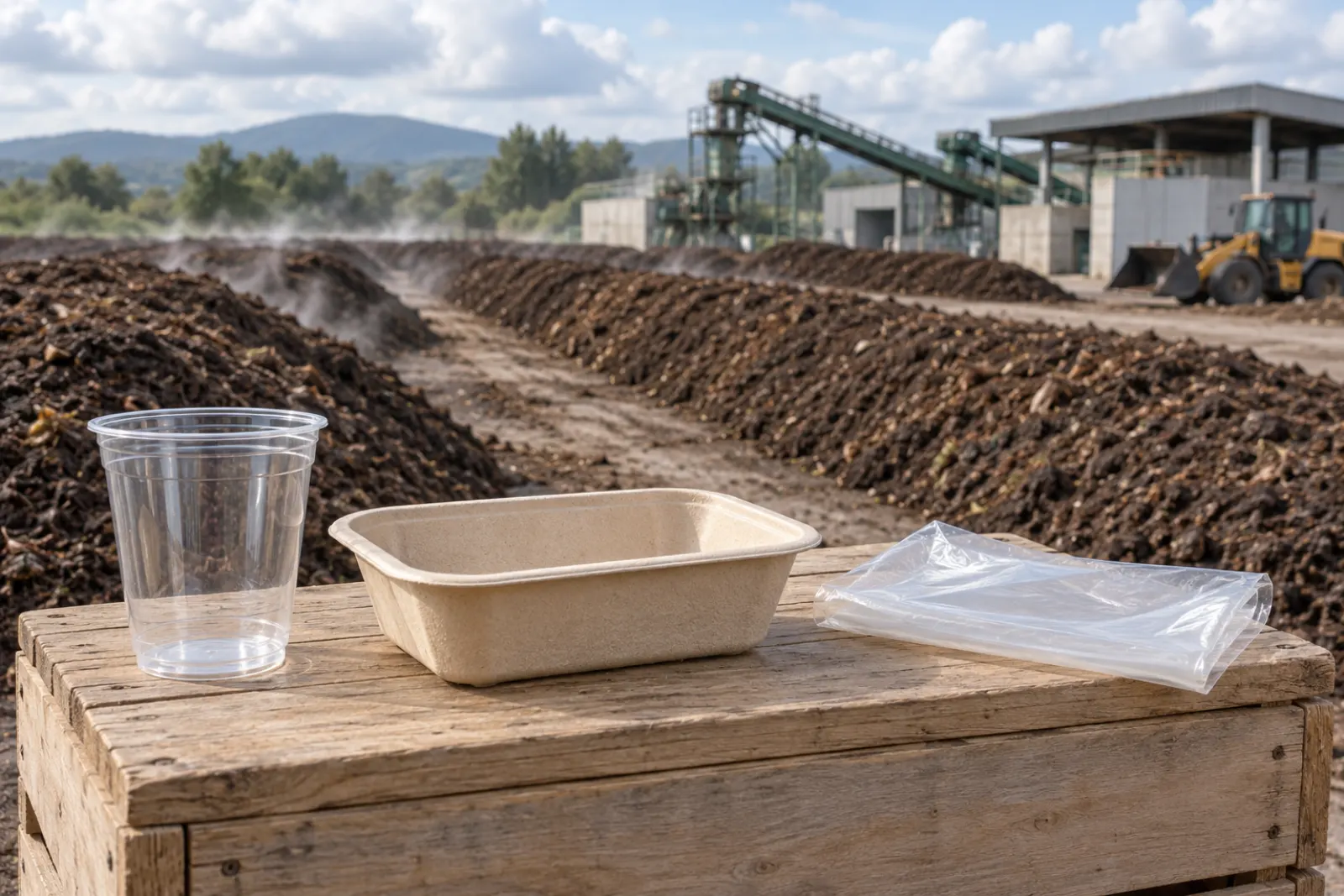
What this article covers
This guide helps packaging buyers and brand managers separate four terms that are often mixed up (bio-based, biodegradable, industrially compostable and home compostable), and shows what evidence a compostable claim needs. It does not give legal advice.
Covered
- Definitions of bio-based, biodegradable, industrially compostable and home compostable
- ASTM D6400, ASTM D6868, EN 13432 and BPI certification in outline
- FTC Green Guides rules for compostable claims
- Collection and facility acceptance as a condition of any claim
Not covered
- Legal advice on specific claims or state laws
- Material performance or filling line compatibility
- Brand or certifier recommendations
A compostable claim can mislead customers when the finished package lacks supporting evidence or the local collection system rejects it. Check material construction, finished-item evidence, collection and facility acceptance before deciding the wording.
- Material: identify every substrate, coating and polymer; select the applicable industrial or home route.
- Finished item: obtain evidence for the complete SKU. This page recommends third-party certification as procurement evidence; it is not a universal legal requirement across markets.
- Collection: identify a route customers can actually use in each sales area.
- Acceptance: obtain the receiving facility’s current rules for that item, not merely its address.
These are procurement checks. Market-specific rules may separately require certification; the FTC section below describes the U.S. Green Guides’ substantiation and qualification approach, without replacing claim review.
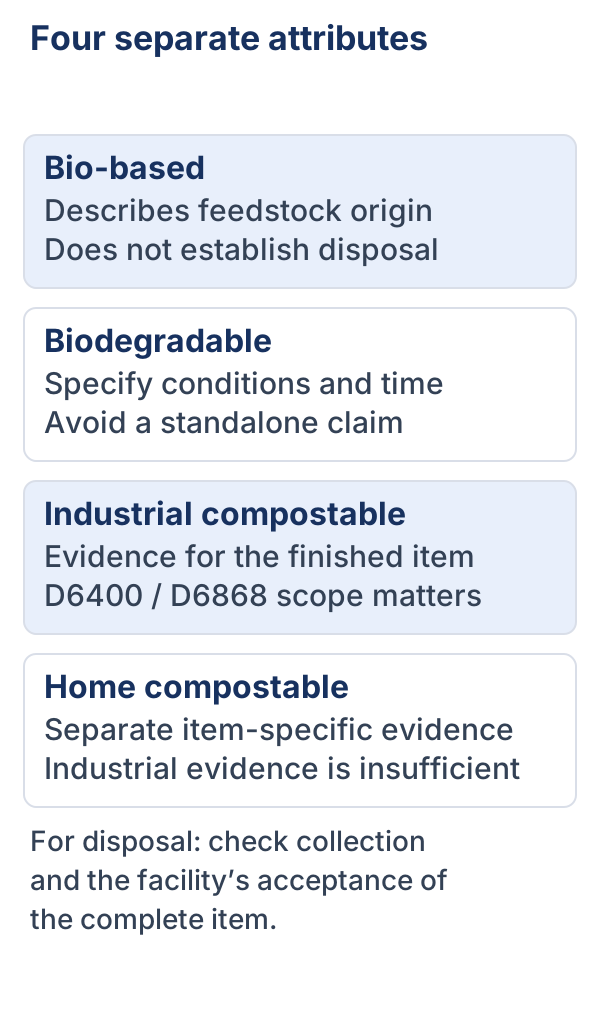
Four terms that are not interchangeable
Scroll horizontally for any hidden columns →
| Term | What it describes | What it does not tell you |
|---|---|---|
| Bio-based | The origin of the carbon (plant feedstock rather than fossil) | Whether it biodegrades, composts or recycles |
| Biodegradable | That microorganisms can break the material down | How fast, under what conditions, or into what |
| Industrially compostable | Meets a standard for aerobic composting in municipal or industrial facilities | That a facility near the customer accepts it |
| Home compostable | Breaks down in a home compost pile or device | Anything about industrial facilities; conditions vary by household |
EPA states that plastics made from plant materials can be structurally identical to petroleum-based plastics and are not necessarily biodegradable. It also says that plastic that is compostable is biodegradable, but not every biodegradable plastic is compostable. BPI cautions that the word “biodegradable” is problematic in sales and marketing for single-use items. For procurement documents, the safe approach is to avoid “biodegradable” as a standalone claim and to write exactly which attribute you mean.
Degradation also depends on conditions. A peer-reviewed review of PLA notes that biodegradation of bio-based thermoplastics can occur only under particular conditions, and that the rate depends on temperature, moisture, crystallinity, molecular weight and other factors. A package that disintegrates in a hot, managed pile may sit intact in a cool backyard bin.
Standards and certification
ASTM D6400 and D6868
The official catalogue lists D6400-26 and D6868-21 as active editions, checked October 8, 2026. Both concern aerobic municipal or industrial composting under thermophilic conditions; neither establishes home compostability.
Scroll horizontally for any hidden columns →
| Standard / construction | Procurement use |
|---|---|
| D6400-26: plastics and products made from plastics | Review finished plastic packaging against this scope |
| D6868-21: end items incorporating polymer film, coatings or binders with paper or other substrates | Review the whole coated / laminated / composite item, not only its polymer layer |
The scopes overlap in their reference to coatings and binders. Use the complete construction and the certifier’s scope decision, rather than assuming that material names alone choose the standard. This outline uses the public catalogue scopes; it does not reproduce the paid test criteria. Record both standard edition and certificate coverage for the actual SKU.
EN 13432
EN 13432 is the European standard for packaging recoverable through composting and biodegradation. Suppliers often cite it alongside ASTM D6400, as in NatureWorks’ statement that its resin is certified under EN 13432 and ASTM D6400/BPI. If you sell in Europe, ask which standard and which certification body apply to the finished item in the EU market. This guide does not summarize the standard’s criteria.
BPI
BPI describes its certification as third-party verification of ASTM standards for compostable products in North America. According to BPI, certified products must meet ASTM compostability standards, satisfy eligibility rules tied to food scraps and yard trimmings, stay within total fluorine (PFAS) limits and carry the BPI mark. A certificate is a useful document, but it applies to the product listed on it. Check the certificate’s product name, manufacturer and scope against what you are buying.
Resin certificates are not item certificates
NatureWorks’ documentation states that all final products made from its resin must undergo their own compostability testing. The same principle applies to any resin: thickness, additives, inks, coatings, adhesives and closures can change how an item behaves. A certified resin is a starting point. You cannot pass its claim on to the finished package.
Industrial composting vs home composting
EPA states that unless a label says a product is acceptable for home composting, you should not try to compost it at home, and that industrial facilities operate at higher temperatures and different conditions than backyard bins. EPA also says there are no ASTM standard test methods for evaluating the ability of a plastic to compost in a home environment. So if a package carries a “home compostable” claim, ask what test method and evidence support it, since no ASTM method exists for plastics in this setting.
An industrially compostable package is not automatically fit for a backyard bin. The FTC Green Guides recognize this. If the item cannot be composted safely or in a timely manner in a home pile, a marketer should clearly and prominently qualify the claim. The Guides’ own example describes a package that will break down in municipal facilities but not in a home pile, and says the manufacturer should disclose that it is not suitable for home composting.
What the FTC Green Guides require
The Green Guides at 16 CFR 260.7 say, in summary, that:
- It is deceptive to misrepresent that a product or package is compostable.
- A marketer claiming compostability should have competent and reliable scientific evidence that all the materials will break down into usable compost in a safe and timely manner, in approximately the same time as the materials they are composted with, in an appropriate facility or a home pile.
- The claim should be clearly and prominently qualified if the item cannot be composted safely or in a timely manner in a home pile, or if the claim misleads about benefits when landfilled.
- The claim should be clearly and prominently qualified if municipal or institutional composting facilities are not available to a substantial majority of consumers or communities where the item is sold.
The Guides give wording such as “Appropriate facilities may not exist in your area” in one example. EPA, citing the Guides, also states that it is deceptive to make an unqualified degradable claim if an item does not fully decompose within a year of normal disposal. This guide summarizes the rules for procurement purposes and is not legal advice. Check claims with counsel before printing them.
Collection and facility acceptance
Buyers most often skip collection. A compostable package needs a route from the customer’s hands to a facility that will take it. NatureWorks’ documentation says the number of composting facilities is currently limited and may not be available near you. A given facility may also decide for its own reasons not to accept compostable plastics at all, even where certified items exist.
Three scenarios show how this plays out:
- Closed-loop service: a venue sells food in compostable packaging and the same operator hauls the waste to a composter that has agreed to accept it. The claim is plausible, because every link is controlled.
- Retail sale with curbside organics: consumers could place the item in a municipal organics bin, but only if that municipality accepts compostable packaging. Acceptance varies by location.
- Retail sale nationally: if facilities are not available to a substantial majority of consumers where the item is sold, the Green Guides call for a qualification.
A related risk is cross-contamination. EPA states that compostable plastics are not intended for recycling and can contaminate and disrupt the recycling stream. APR’s PLA guidance states that PLA is not currently considered recyclable in North America under its definition. A compostable-looking bottle placed in a recycling bin is a sorting problem, and a bottle placed in a compost bin that does not accept it is a facility problem. See the PLA vs PET bottles comparison for the PET stream issue.
Wording for buyers
Prefer statements that name the attribute and the condition. Examples of structure, to be adapted with legal review:
- “Certified industrially compostable to ASTM D6400 (certificate no. ____). Accepted only where commercial composting facilities accept it. Check locally.”
- “Not suitable for home composting.”
- “Made partly from plant-based material.” (Only if the bio-based share has been documented.)
Avoid: “biodegradable” without conditions, “eco-friendly,” and any statement that the package is better for the environment, unless you have the evidence and the conditions are stated.
Record for a compostable claim
Copy one record per SKU and sales area. Blank entries are unresolved checks, not a supported claim.
Scroll horizontally for any hidden columns →
| Check | Record / evidence |
|---|---|
| Finished package | SKU ____; manufacturer ____; construction/components ____ |
| Claim and applicable market rule | Exact wording ____; industrial/home/bio-based ____; rule reviewed ____ |
| Certificate / other substantiation | Issuer and number ____; standard edition ____; evidence date ____ |
| Components covered | Body, coating, ink, adhesive, closure and label ____; excluded parts ____ |
| Sales area and collection | Country/locality ____; customer route and hauler ____ |
| Receiving facility | Name ____; accepted SKU/category ____; restrictions ____ |
| Check date and follow-up | Date ____; confirmation document ____; unresolved items / owner ____ |
| Label and claim review | Disposal instructions ____; qualification ____; review record ____ |
Common question about disposal
How do I dispose of compostable packaging?
Check the local program’s acceptance rules for the complete item. A nearby composter can still reject packaging; a certificate does not create collection access. If the program rejects it, ask the waste operator about an accepting drop-off route instead of putting it in plastic recycling. EPA’s plastics FAQ gives that disposal sequence.
What needs project-specific validation
Four things need checking on your own project:
- Certification scope: whether your exact item, including the closure and decoration, is covered.
- Local acceptance: whether facilities in your markets accept the item, and whether they accept food-soiled packaging.
- Home composting claims: whether any evidence exists, and which method was used, given that EPA reports no ASTM method for plastics in this setting.
- Product protection: whether the compostable material meets barrier and heat needs. See PLA food packaging and beverage bottle materials for the trade-offs.
Questions to ask suppliers
- Which standard and edition (for example ASTM D6400 or EN 13432) does the finished item meet, and who issued the certificate?
- Does the certificate cover the full item, including coatings, inks, adhesives, closures and liners?
- Is the item certified for home composting? If so, what test method and evidence support the claim?
- What are the BPI (or equivalent) eligibility conditions for this item, and how are fluorine limits addressed?
- Which composting facilities in my markets have confirmed acceptance of this item?
- What labeling do you recommend, and does it include the qualification needed where facilities are limited?
- What happens to the item in a recycling stream, and how will that risk be communicated to customers?
- Which statements in your documentation are your own claims, and which come from third-party certificates?
- What are the performance trade-offs (heat, barrier, strength) compared with a conventional package for my product?
- Can you provide a written statement of the conditions under which any environmental claim holds true?
For a historical example of how disposal claims were reported for a bottled product, see the case study Green Bottle Spring Water, which separates what was reported then from what a buyer can verify now.
Sources and method
This article is based on documentary research of the sources listed. It is not a hands-on equipment test. Supplier statements and editorial judgement are identified in the text.
- 16 CFR 260.7 Compostable claims (FTC Green Guides) Supports: substantiation requirement for compostable claims, qualification when home composting is not possible, and qualification when facilities are not available to a substantial majority of consumers or communities.
- Frequently Asked Questions About Plastic Recycling and Composting Supports: definitions of bio-based, biodegradable and compostable; ASTM D6400 and D6868 as the specifications for compostable labels; no ASTM method for home composting of plastics; contamination of recycling streams.
- ASTM D6400-26 Standard Specification for Labeling of Plastics Designed to be Aerobically Composted in Municipal or Industrial Facilities Supports: scope of D6400 for plastics and plastic products in thermophilic municipal/industrial aerobic composting. Official catalogue lists D6400-26 active; checked October 8, 2026. Public scope only, not a full-standard review.
- ASTM D6868-21: End items incorporating plastics or polymers with paper and other substrates Supports: end items incorporating polymer film, coatings or binders with substrates; entire item intended for thermophilic aerobic municipal/industrial composting. Listed active; public scope checked October 8, 2026.
- BPI certification Supports: BPI describes its certification as third-party verification of ASTM standards for compostable products, with eligibility rules and fluorine limits; it cautions about the word biodegradable.
- Composting (Ingeo end-of-life opportunities) Supports: According to NatureWorks' documentation, resin certification does not carry over to finished goods, and composting facilities are limited and may not be available locally.
- PLA Design Guidance Supports: PLA is not currently considered recyclable in North America under APR's definition, so mixed-up disposal routes matter.
- A review on bio-based polymer polylactic acid potential on sustainable food packaging Supports: biodegradation of bio-based polymers depends on conditions such as temperature, moisture and crystallinity.
Next reading
PLA Packaging for Food and Beverages: Uses, Constraints and Buyer Questions
PLA food packaging explained for buyers: where polylactic acid fits, its heat and barrier limits, end-of-life conditions, and what to request from suppliers.
Read the guide
Beverage Bottle Materials: Comparing PET, HDPE, Glass and PLA
Compare beverage bottle materials (PET, HDPE, glass and PLA) by weight, breakage, heat tolerance, gas barrier and recycling infrastructure, with a requirements checklist.
Read the guide
Green Bottle Spring Water: A Historical Packaging Case Study
A source-based case study of Green Bottle Spring Water, a PLA-bottled water of 2008 to 2011: dated company claims, evidence limits and open questions.
Read articleMore in Materials

PLA vs PET Bottles: A Practical Comparison for Beverage Packaging
Compare PLA vs PET bottles by fill temperature, barrier, carbonation, shelf life, line compatibility and disposal route, and see what to verify before replacing PET.
Read the guide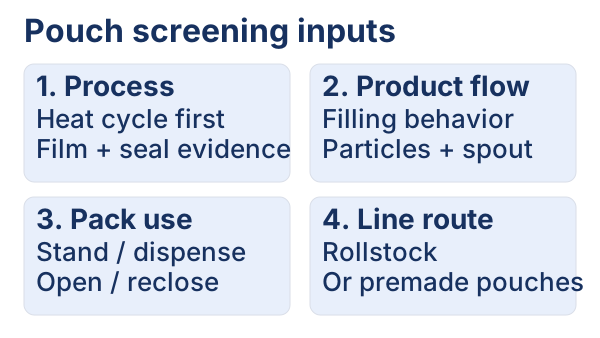
Pouch Packaging for Food: Stand-Up, Retort, Spouted and Pillow Pouches by Product
A pouch unsuited to heat processing can fail. Select by preservation route, product flow and use, then check film, fitment and filling compatibility.
Read the guide
BASF Paper Coating Dispersions: Carbon Claims and Food-Pack Checks
BASF’s reduced-PCF paper coating announcement needs two reviews: product carbon data and the intended food-pack application. Check the boundaries before switching.
Read the guide