
Green Bottle Spring Water: A Historical Packaging Case Study
A source-based case study of Green Bottle Spring Water, a PLA-bottled water of 2008 to 2011: dated company claims, evidence limits and open questions.
What this article covers
This case study looks at Green Bottle Spring Water, a bottled water sold in PLA bottles by the historical Naturally Iowa (renamed Totally Green, Inc. in 2010) between 2008 and 2011. It lays out what the company and press said about the product, bottle and disposal, what the record does not show, and what a modern reader could research.
Covered
- Product background and container material as described in dated sources
- Disposal and environmental claims as the company made them, including how the archived wording changed
- Evidence limits and questions worth researching today
Not covered
- Any current product, price, availability or ordering information
- Any explanation of why or when the product ended, which the sources do not give
- Independent verification of the company's environmental claims
Claim changes at a glance
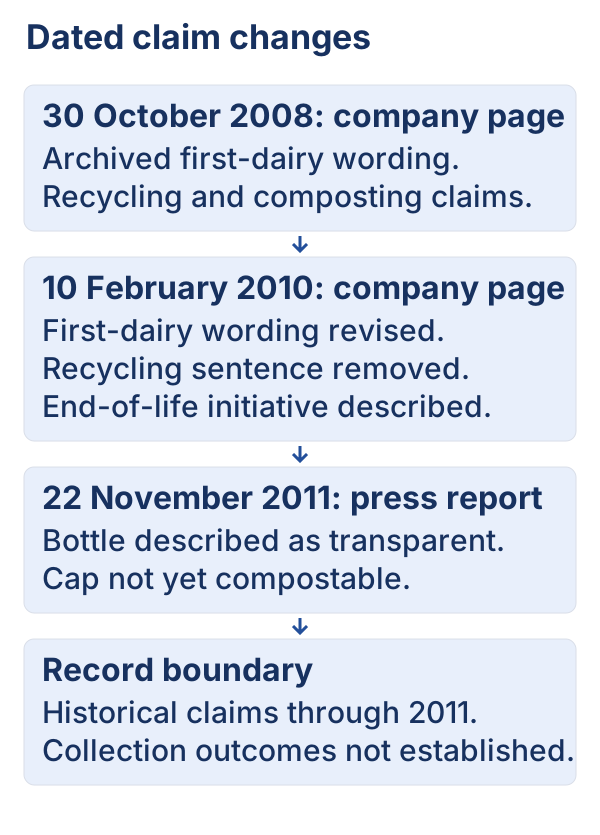
The dated record below stops at the November 22, 2011 report; it does not establish when the product ended. Use it to compare historical claim wording and identify evidence needed for a modern packaging claim.
Scroll horizontally for any hidden columns →
| Date and source type | Wording change to examine |
|---|---|
| October 30, 2008 company-page capture | First-dairy, composting and recycling claims |
| February 10, 2010 company-page capture | First-dairy wording revised; recycling sentence removed; end-of-life initiative added |
| November 22, 2011 press report | Transparent bottle; cap described as not yet compostable |
What this page is
Green Bottle Spring Water was a bottled water that the historical Naturally Iowa sold in bottles made from a corn-derived plastic. This page is a case study written by Naturally Iowa Packaging Review, a DeltaSpark publication that is not affiliated with that company. It is not a product page: it lists no prices, availability or ordering routes, and it does not recommend the original supplier.
This page records what dated sources said about the product and its packaging, marks which statements were company claims, and shows where the record ends. For the company as a whole, see the source-based overview of Naturally Iowa’s history. For the dairy side of the story, see the historical PLA packaging FAQ.
Historical product background
According to the company’s product page, captured by the Internet Archive on October 30, 2008, Green Bottle Spring Water came from “a source 600 feet beneath an organic farm near Alton, Virginia.” A company release later published by Packaging Digest said the water was “bottled at Grand Springs Organic Farm in Alton, Virginia.” An archived company page also placed the spring “east of the Shenandoah Mountains.”
The 2008 page presented the product as an extension of the company’s dairy bottle work. It said Naturally Iowa, “in partnership with NatureWorks™ PLA, is the first dairy in the world to introduce a new type of dairy container.” These are company statements, and we did not verify the “first” claims.
Customer reports followed. A September 24, 2008 Omaha World-Herald story, reposted by IATP, reported that the U.S. House of Representatives’ dining facilities would switch to Virginia spring water packaged in Naturally Iowa bottles. Packaging Digest, in an item whose displayed 2014 date is a site-migration date and whose real date is roughly September 2008, described the water as “the only bottled water available in the House Cafeteria, the Longworth Café.” A separate company release, undated and published after September 2008, said the U.S. Department of Agriculture had chosen the water for its headquarters and that the company had been “granted the status of ‘BioPreferred Supplier.’” We found no independent confirmation of that release, and its date is unknown.
In October 2010, GlobeNewswire reported that Naturally Iowa, Inc. would be known as Totally Green, Inc. The release mentioned “Green Bottle Spring Water and ORCA Green™ Machine.”
Container material
The bottle was described as NatureWorks’ Ingeo bottle, made from PLA. The 2008 company page said “Ingeo™ bottles are returned to nature by composting.” The September 2008 World-Herald story reported that the resin “comes from a Blair, Neb., plant run by a subsidiary of Cargill.”
The bottle changed over time. On November 22, 2011, Food Ingredients First reported that the “100% compostable bottle is now totally transparent,” having changed “from green in color to transparent.” In the same report, president Nate Baker said: “Although the Green Bottle Spring Water cap is still not yet compostable.” The report is the only source we have for the cap statement, and it gives no material details for the cap.
Claims about disposal at the time
The sources made several environmental claims. We present them as claims; this publication has not independently verified any of them.
- Closed-loop collection: the 2008 company page said the water was “only available through partners that agree to collect empty bottles on site in special receptacles to ensure the bottles do not end up in landfills.” Packaging Digest, reporting on the House supply, described “‘Closed Loop’ environments, where there is a plan to collect all empty bottles and return them to nature.”
- Other routes: Packaging Digest wrote that “the bottles can be incinerated, or ground up and used again.” The 2008 company page said the bottles “can also be recycled.”
- Composting and decomposition: the 2008 company page said the bottles are returned to nature by composting. The September 2008 World-Herald story said they are “biodegradable in less than a year.” The undated USDA release stated, “Unlike older-style plastic bottles, the INGEO bottle is fully compostable.”
- Energy: the archived company page asserted an energy saving for the bottle resin. The underlying study was not available for this review, so no percentage is reproduced.
Scroll horizontally for any hidden columns →
| Statement | Company page, Oct. 2008 capture | Company page, Feb. 2010 capture | Press report, Nov. 2011 |
|---|---|---|---|
| Who introduced the bottle | “the first dairy in the world to introduce a new type of dairy container” | “in partnership with NatureWorks™, introduced the Ingeo™ bottle” | n/a |
| Recycling | Bottles “can also be recycled” | Sentence removed; a recycling initiative for plant-based plastics described as in progress | n/a |
| End of life | “returned to nature by composting” | Adds the aim to “provide an acceptable end of life solution for the bottles” | Bottle described as “100% compostable” |
| Closure | Not addressed | Not addressed | Cap “still not yet compostable” |
The wording changed over time. The archived company page changed between 2008 and 2010. By the February 10, 2010 capture, the “first dairy in the world to introduce” line had become “in partnership with NatureWorks™, introduced the Ingeo™ bottle.” The page added that the company aimed to “provide an acceptable end of life solution for the bottles,” dropped the statement that the bottles can also be recycled, and said the company was working to establish a recycling initiative for plant-based plastics. The 2011 statement that the cap was not yet compostable is another qualification. The archived pages show these changes but do not say why they were made.
Evidence limits
- No end date: we found no source stating when or why Green Bottle Spring Water ended. We do not speculate.
- Undated USDA release: the Packaging Digest item based on the company’s USDA release carries no reliable date. Its date is unknown; the record suggests it postdates the House switch in September 2008, but we cannot confirm that.
- Migration dates: Packaging Digest pages show 2014 dates that reflect a website migration, not the original publication dates.
- Company-sourced claims: most disposal and energy statements come from the company’s own pages or releases. Press coverage largely repeats them, so agreement between outlets is not independent confirmation.
- Conflicting decomposition claims: the sources variously say composting, “less than a year,” or, in a June 2007 Radio Iowa report on the dairy bottles, “about 100 days.” The company’s own dairy FAQ said composting required commercial conditions. We do not choose among these claims, and we present each as a dated statement, not a measured result.
- Real-world outcomes: we found no record of how many bottles were actually collected, composted or recycled.
Editorial analysis: questions worth researching today
This section is our own analysis, not a statement from the historical sources.
A case like this shows how packaging claims can outrun the evidence available to a reader. A modern buyer or researcher could ask:
- What would substantiate a compostable claim now? Certification, a collection route and a facility that accepts the item all matter. Today’s claims must also meet the FTC Green Guides. See compostable packaging.
- How do closures and labels fit the claim? The 2011 cap statement shows that a bottle and its cap can differ. Ask for the status of every component.
- How does a PLA water bottle compare with PET? Barrier, heat tolerance, shelf life and recycling streams differ. See PLA vs PET bottles.
- What does the filling line require? Container handling, filling temperature, capping and labeling all need trials. See bottled water packaging line.
- Is there evidence of what happened after use? Collection rates and composting outcomes would matter more than a claim about intent, and the sources we found report neither.
- Can an energy claim be traced? An energy-saving statement needs the original study, comparison scope and date before it can be evaluated.
Sources and method
This article is based on documentary research of the sources listed. It is not a hands-on equipment test. Supplier statements and editorial judgement are identified in the text.
- Green Bottle Spring Water (company product page, 2008 capture) Supports: first-dairy wording, spring source, partner collection requirement, composting and recycling statements, energy-saving claim (underlying study not available).
- Green Bottle Spring Water (company product page, 2010 capture) Supports: changed wording on partnership, end-of-life and recycling.
- Our water bottling plants (company page) Supports: the spring's location 'east of the Shenandoah Mountains' (company statement).
- U.S. House uses Iowa bottles made from corn Supports: House dining facilities switching, 'less than a year' biodegradation claim, resin source.
- U.S. House of Representatives Chooses Eco-Friendly Bottled Water Brand Supports: Longworth Café, closed-loop collection, incineration and regrind statements. The real publication date is approximately September 2008.
- USDA Chooses 'Green' Bottled Water Brand for Headquarters Supports: company release on USDA headquarters, BioPreferred Supplier status, Virginia bottling site, 'fully compostable' claim.
- Naturally Iowa, Inc. Becomes Totally Green, Inc. Supports: renaming, ORCA machine, mention of Green Bottle Spring Water.
- New Green Bottle Spring Water Bottle and Label Supports: change from green to transparent bottle and the statement that the cap was not yet compostable.
- Iowa company uses milk bottles made from corn Supports: the 'about 100 days' decomposition claim as reported in June 2007.
Related modern guides
Compostable Packaging: Industrial Composting, Home Composting and Collection Systems
Compostable food packaging explained: bio-based vs biodegradable vs compostable, ASTM D6400 and BPI certification, FTC claim rules and the collection gap.
Read the guide
PLA vs PET Bottles: A Practical Comparison for Beverage Packaging
Compare PLA vs PET bottles by fill temperature, barrier, carbonation, shelf life, line compatibility and disposal route, and see what to verify before replacing PET.
Read the guide
Bottled Water Packaging Lines: From Prepared Containers to Packed Cases
Plan a bottled water packaging line from container supply to palletizing: rinsing, filling, capping, labeling, coding and the interfaces between stations.
Read the guide
Naturally Iowa’s Dairy and Packaging History: A Source-Based Overview
A source-based timeline of the historical Naturally Iowa dairy and its PLA bottles, 2002 to 2011, marking what is reported, claimed or unknown.
Read articleMore in History
Naturally Iowa and PLA Dairy Packaging: A Historical FAQ
A source-based historical FAQ on Naturally Iowa's PLA milk bottles, with dated company and press claims kept apart from what buyers must verify today.
Read article