
Pouch Packaging for Food: Stand-Up, Retort, Spouted and Pillow Pouches by Product
A pouch unsuited to heat processing can fail. Select by preservation route, product flow and use, then check film, fitment and filling compatibility.
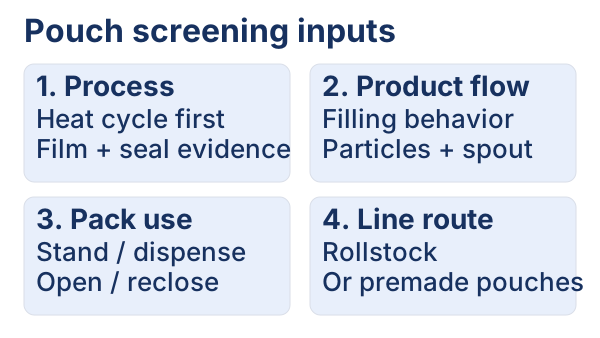
A pouch chosen for appearance can fail if its structure is unsuited to the planned heat treatment. Select first by preservation route, then product flow, then how the pack will be used, and check the proposed filling line against those inputs.
What decides the pouch type for a food?
Record these inputs before selecting samples; the preservation route screens material suitability before shape or fitment.
Scroll horizontally for any hidden columns →
| Input | Why it changes the pouch | Where the answer comes from |
|---|---|---|
| Preservation route and when heat is applied: chilled, frozen, hot fill, or retort after sealing | Sets the temperature the film and seals must survive and at which step | Your process definition and the person who sets your process |
| Product flow: liquid, viscous, with particles, free-flowing dry, fragile or irregular pieces | Sets the filling method and whether a spout or wide opening is practical | Your product specification and samples |
| Use: single use, reclose, dispense in portions | Sets zipper, spout or tear-open | Your customer, retail or foodservice |
| Line route: vertical form-fill-seal, horizontal rollstock, or premade pouches | Sets which pouch styles are practical on the line | Your existing equipment, or the supplier quotes you are comparing |
The bottle vs. pouch guide explains how a pouch line differs from a bottle line if the container decision is still open.
Takeaway: Resolve the heat-processing requirement before requesting pouch samples.
The four pouch types and what defines each
Each type is defined by a different thing: shape, fitment or process. That is why the names overlap; a retort pouch can also be a stand-up pouch.
Scroll horizontally for any hidden columns →
| Pouch type | What defines it | How it is made and filled in the sources | Foods named in the sources |
|---|---|---|---|
| Pillow pouch | A flat bag with a back seam and end seals, sometimes with gussets | Formed from rollstock on a vertical form-fill-seal machine and filled, usually by gravity (Paxiom) | Ground coffee and whole beans (Paxiom); Paxiom names powders, rice, coffee and snacks for vertical machines |
| Stand-up pouch | A bottom that lets the pouch stand; Bartelt describes the DOY style as having a circular or half-moon bottom seal | Bought premade and filled on a premade pouch machine, or formed from rollstock on a horizontal machine (Paxiom, Bartelt) | Snacks, baked goods, specialty flours and mixes, cheese products (Bartelt); whole-bean coffee in zipper pouches (Paxiom) |
| Spouted pouch | A fitted spout, at the center or top, or inverted so the pouch stands on its cap | Premade pouches with the spout inserted, then filled and capped (Matrix); spout applied in line on a rollstock machine (Mespack); or formed on a vertical machine (Sealed Air) | Sauces, condiments and dairy products (Mespack); foodservice condiments (Sealed Air) |
| Retort pouch | A structure built for heat processing after sealing, described by Amcor as an alternative to metal cans | Filled, sealed and then processed; Amcor describes the conventional structure as PET, aluminum foil and PP | Wet cat food (Nestlé, first commercial use of Amcor’s recyclable version); Amcor’s planned categories: ready meals, pre-cooked soups, sauces and baby food |
A pillow pouch filled with a pourable or free-flowing food is a different route from a pillow pack sealed around one solid item; the guide to which foods are flow wrapped covers that second case.
Takeaway: Describe shape, fitment and processing suitability separately in the specification.
Which pouch suits which food? The matrix
The sources pair sauces and condiments with spouted pouches, wet pet food with retort pouches and dry goods with pillow and stand-up pouches; for soups, ready meals and baby food they name retort or hot fill as routes. The table keeps three things apart: the pouch style, the preservation route, and supplier equipment examples. Combined rows are screening candidates; evidence types remain separate in the final column.
Scroll horizontally for any hidden columns →
| Food category | Pouch styles named in the sources | Preservation route named in the sources | Supplier equipment examples (compatibility to confirm) | Type of evidence |
|---|---|---|---|---|
| Sauces and condiments | Spouted, including inverted spouts (Mespack); spouted squeeze pouches for foodservice (Sealed Air) | Hot fill for high-acid, flowable sauces and salsas (ePac); retort named as a target category (Amcor) | Rollstock with in-line spout application (Mespack); vertical form-fill-seal (Sealed Air); premade spouted pouch fillers (Matrix) | Applications shown by suppliers; process description; target category |
| Soups, purees and baby food | Not specified by style in these sources | Hot fill for high-acid, flowable products (ePac); retort named as a target category (Amcor) | To be confirmed | Process description; target category |
| Ready meals | Retort pouch | Retort, named as a target category (Amcor) | To be confirmed | Target category |
| Juices, teas and other drinks | Spouted pouches, which ePac says appear in the hot-fill category | Hot fill for high-acid, flowable drinks (ePac) | Premade pouch fillers for liquids exist (Matrix); hot-fill suitability to confirm | Process description; equipment example |
| Dairy products | Spouted pouches, including inverted spouts (Mespack) | Set by the product; see the milk and yogurt guides | Rollstock with in-line spout application (Mespack) | Category named by a supplier |
| Coffee, flour, mixes, rice and snacks | Pillow and gusseted bags; stand-up, flat-bottom and zipper pouches | Not stated in these sources | Vertical form-fill-seal for free-flowing products (Paxiom); premade or horizontal rollstock for stand-up styles (Paxiom, Bartelt) | Applications shown by suppliers |
| Wet pet food | Retort pouch | Retort (Nestlé, Amcor) | To be confirmed | Application shown |
| Larger pet food packs | Large-format stand-up pouches | Not stated in these sources | Horizontal rollstock machines that list pet food among their uses (Bartelt) | Category named by a supplier |
| Frozen foods | Premade pouches | Frozen storage | Premade pouch fillers listed for dry or frozen products (Matrix, Paxiom) | Category named by suppliers |
What none of these sources gives is a barrier level for a food. That comes from the film supplier, against inputs only you can provide: how sensitive the product is to oxygen, moisture and light, how it is stored and distributed, and the shelf life you intend to establish. Ask the supplier which grade it proposes, what barrier data it has for that grade, and under which test conditions the data were measured.
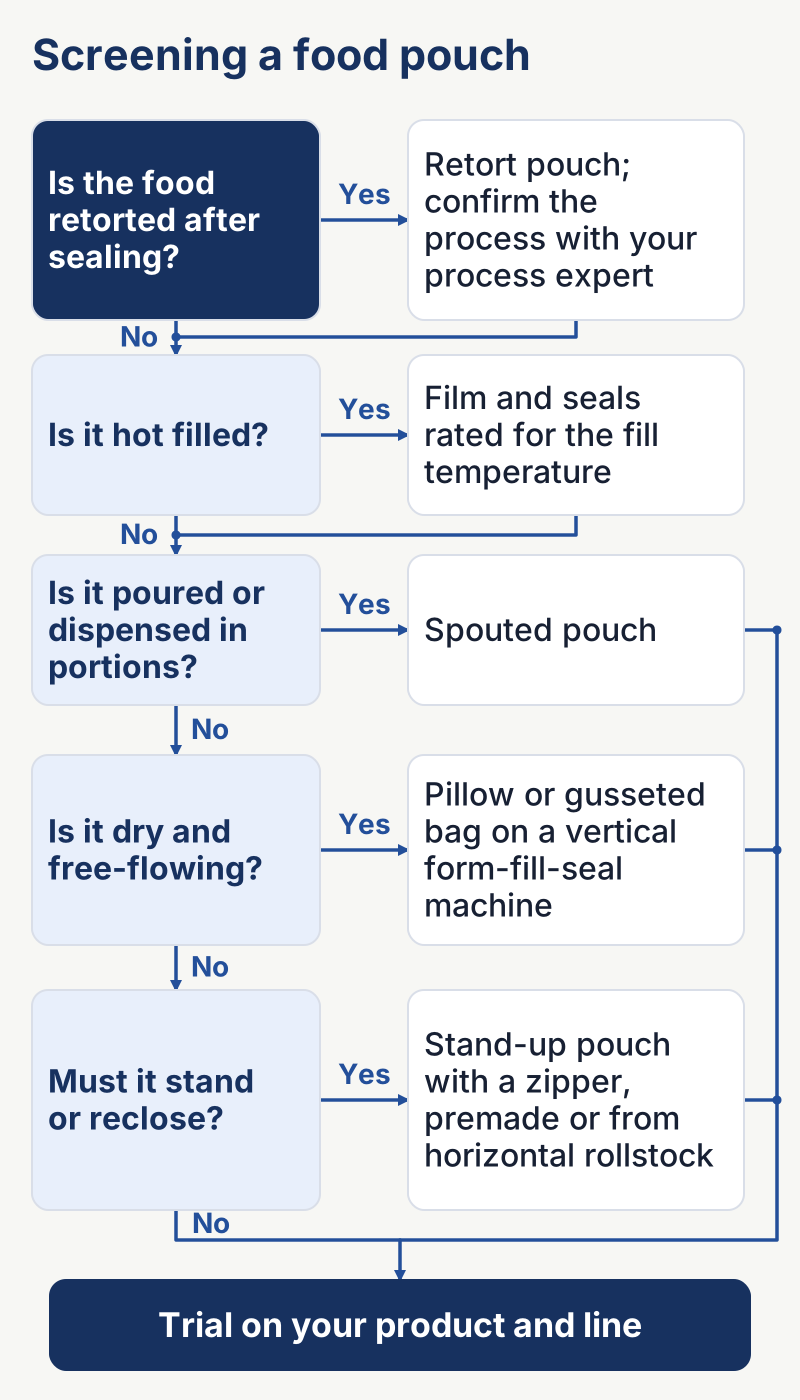
Takeaway: Match the selected food row to a documented film grade and filling route.
Hot fill, retort or chilled: what the pouch has to survive
The routes put heat into the pack at different steps. In hot fill the hot product heats the pouch during filling and holding; in retort processing the sealed pouch is heated afterward. Chilled and frozen products ask less of the film’s heat resistance and more of cold-chain handling. In every case the pouch supplier states what its film is rated for, and the processor decides the process.
Hot fill. ePac, a pouch converter, describes the sequence as heat, fill, hold, then rapid cool: the product is filled hot, the pack is sealed and held so the heat reaches every surface, then cooled. It states that hot fill suits only high-acid, flowable products and that low-acid or non-pourable products fall outside the method. For pouches, its checklist asks that the film’s rated maximum meets or exceeds the actual fill temperature, that the seal holds through cooling and handling, and that the format runs on the filling and sealing equipment. It gives juices, iced teas, sauces, salsas, soups, purees and baby food as examples of hot-filled products. Whether your own recipe qualifies is for the processor to confirm before any film is chosen. The juice packaging guide explains why the preservation approach is chosen before the container.
Retort. In a 2020 Packaging Digest interview, Amcor described retort pouches as a modern alternative to metal cans and the conventional retort structure as PET, aluminum foil and PP, which it said was not recyclable anywhere at the time. Its PP-based alternative used a thin silicon oxide barrier coating and was first used for Nestlé’s Felix wet cat food in the Netherlands. Amcor also explained the difficulty: soft-plastics recycling streams accept polyolefins, which have much lower heat resistance than PET. For a US thermally processed low-acid food, have the process owner review the applicable FDA requirements in 21 CFR Part 113, which includes processing provisions for flexible containers. Confirm the applicable process and filing requirements with the processor’s specialist rather than selecting them from a pouch description.
Chilled. For milk and yogurt, the dairy guides on this site set out why heat treatment, cold chain and light exposure come before the format.
Takeaway: Have the process owner define the thermal cycle and obtain material and seal evidence for that cycle.
Common mistakes when choosing a food pouch
Most mistakes come from picking a pouch by how it looks and checking the process and the line afterward. Use these editorial checks when reviewing the proposal:
- Choosing the shape before the preservation route. A stand-up pouch that looks right fails if the food is retorted and the structure is not built for it.
- Assuming a high-barrier pouch is recyclable. ePac cautions that a high-heat, high-barrier laminate will not automatically be recyclable, and Amcor described conventional retort pouches as not recyclable. Ask what an end-of-life claim rests on before printing it.
- Treating the spout as an add-on. Mespack describes designing the spout’s geometry and material for its sealing process and giving inverted spouts a wide, flat base so the pouch stands. Spout, film and machine have to be specified together.
- Ignoring particles. Record the largest particles and ask the fitment and filling suppliers to assess passage, blockage and dosing in a product trial.
- Picking the line route last. Paxiom describes vertical machines as needing former changes for size changes and suiting long runs of one format, and premade pouch machines as handling stand-up, zipper and spouted styles. If you will run many sizes or styles, that changes which pouch types are practical.
What to send a pouch or film supplier
Write these down for every product before asking for samples or quotes, and send the same sheet to each supplier:
Scroll horizontally for any hidden columns →
| Input to copy into your brief | Your record |
|---|---|
| Food description, particles and largest particle size | ____ |
| Preservation route and process owner | ____ |
| Filling temperature and post-seal heat cycle | ____ |
| Product flow and fragility | ____ |
| Oxygen, moisture and light sensitivity; intended shelf life | ____ |
| Fill quantity and pouch size range | ____ |
| Single use, reclosure or dispensing | ____ |
| Storage and distribution conditions | ____ |
| Vertical, horizontal rollstock or premade line | ____ |
| Intended end-of-life claim and supporting documents | ____ |
Then send representative product samples with the process conditions, and ask the film, fitment and machine suppliers to state together which trials they need on your product and line, what they will record, and which results would count as acceptance. Choose the pouch type after those results, not before. The product and container modules of the packaging machine RFQ checklist give a format for sending these facts alongside a machine request.
Common questions
How long do retort pouches last?
There is no shelf-life value supplied by the pouch name. Ask the process owner for the product’s validated storage period and conditions, supported by evidence for the actual formulation, thermal cycle, sealed pack and distribution route. A supplier’s barrier description or a pouch appearance cannot establish that period. The FDA regulation cited here addresses thermal processing; it does not supply a shelf life for your recipe.
Scope and method
The matrix combines supplier pages from Bartelt, Matrix Packaging Machinery, Paxiom, Mespack and ePac, two Packaging Digest articles, and FDA’s thermal-processing regulation in 21 CFR Part 113. Original sources were read on October 6 or 7, 2026; ePac and the eCFR source were rechecked October 8, 2026. The additional question wording comes from Google People Also Ask, retrieved October 8, 2026. Supplier pages describe what those companies offer and which foods they name; they do not show that a pouch will work for a particular product, rows that combine sources are our compilation, and no supplier is ranked. The page gives no temperatures, barrier values, shelf-life figures or prices, and it makes no food safety or regulatory determination. Other material guides in the materials section follow the same order: product, process, distribution, end of life, then supplier evidence.
Sources and method
This article is based on documentary research of the sources listed. It is not a hands-on equipment test. Supplier statements and editorial judgement are identified in the text.
- Nestlé's New Recyclable Retort Pouch is the Cat's Meow Supports: Amcor's description of retort pouches as an alternative to metal cans, the conventional PET, aluminum foil and PP structure, a PP-based recyclable alternative first used for wet cat food, and its target food categories.
- 21 CFR Part 113: Thermally Processed Low-Acid Foods Packaged in Hermetically Sealed Containers Rechecked October 8, 2026. Supports: scheduled-process requirements and processing provisions for flexible containers; not a shelf-life specification. Replaces an unavailable FDA guidance link.
- Hot Fill Process: Everything You Need to Know Supports: supplier description of the hot-fill sequence, its limit to high-acid flowable products, its examples, the film and seal checks for hot-fill pouches, and its caution that high-heat laminates are not automatically recyclable.
- Pre-filled Pouches Take the Prep Out of Foodservice Condiments Supports: Sealed Air's description of a spouted foodservice condiment pouch formed on a vertical form-fill-seal system.
- Mespack Introduces the H360 FED Inverted Spout Solution Supports: supplier description of inverted spouted pouches, the categories it names, and spout application on a rollstock machine.
- FL 2.7 / 3.2 / 4.2 HFFS Inline Rollstock Carousel Machine for Large Format Pouches Supports: supplier description of large stand-up, spouted and sachet formats made from rollstock on horizontal machines, for food, beverage and pet food.
- DOY Stand-Up Pouch Supports: definition of the DOY stand-up pouch bottom and the foods the supplier names for it.
- Pacraft Pre-Made Pouch Systems Supports: premade pouch fillers listed for dry or frozen products and for liquids, and spouted pouch filling for center and top spouts.
- Coffee Packaging Machinery Supports: pillow and gusseted bags made on vertical machines and premade stand-up, flat-bottom and zipper pouches for coffee.
- VFFS vs Premade Pouch Filling Supports: supplier description of the pouch styles and products suited to vertical form-fill-seal and to premade pouch filling.
Next reading
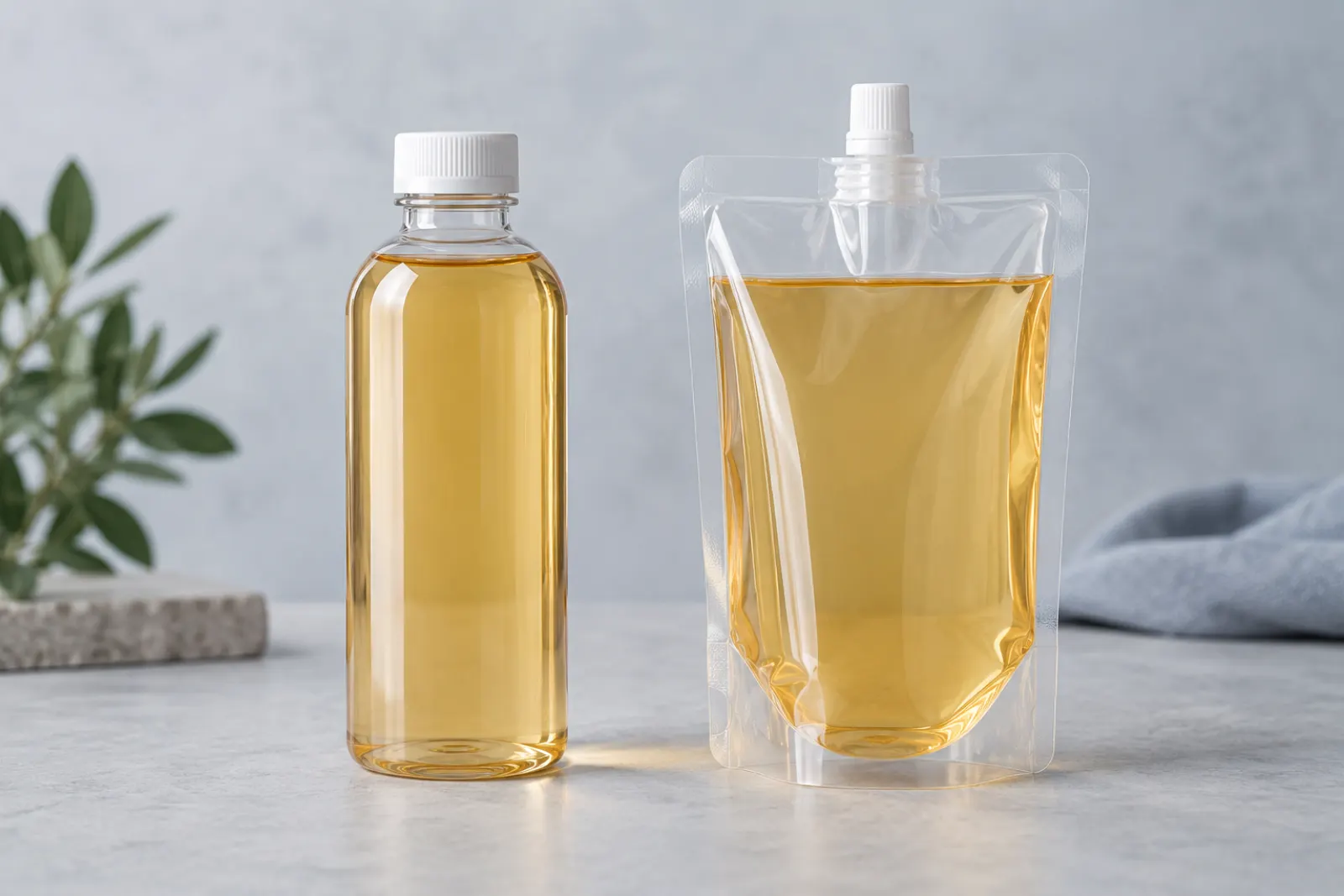
Bottle vs Pouch Packaging: What Changes on the Production Line?
Moving a liquid product between rigid bottles and flexible pouches changes filling, closing, conveying, changeover and cases. Use this guide to scope the work.
Read the guide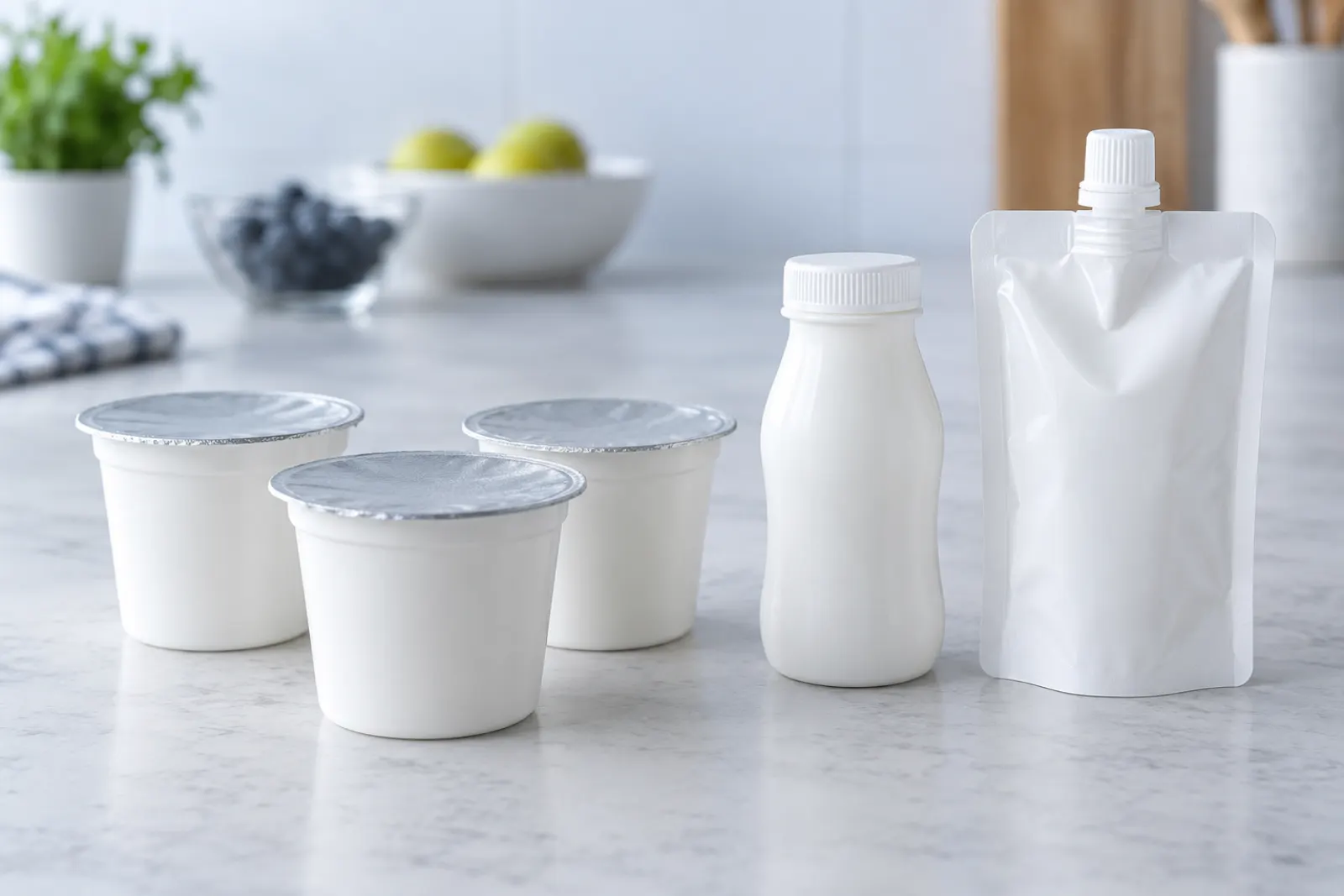
Yogurt Packaging: Cups, Bottles and Pouches for Different Products
Match yogurt packaging to product type: set, stirred, drinkable or squeeze. Compare cups, bottles and spouted pouches and their filling and sealing needs.
Read the guide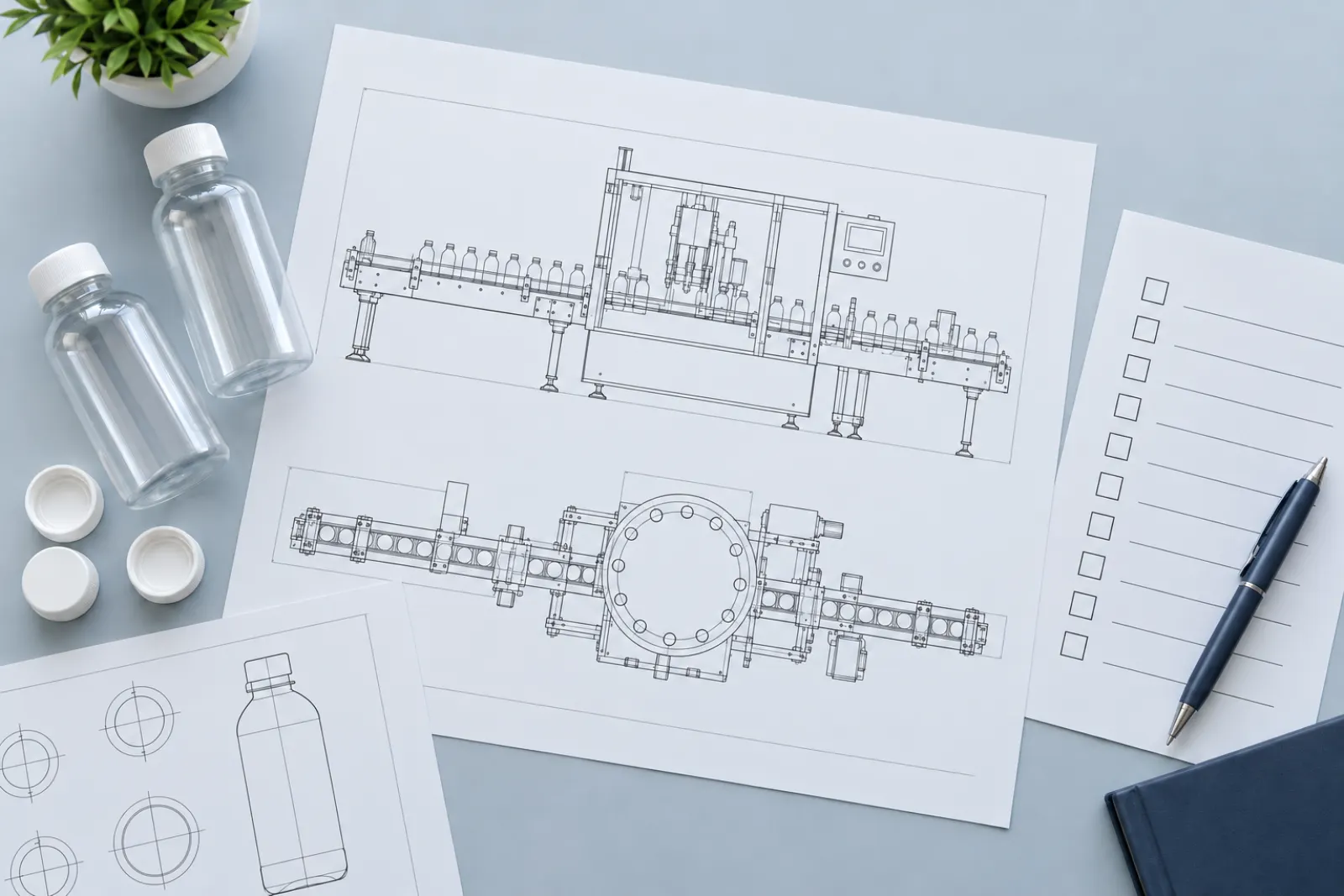
Packaging Machine RFQ Checklist for Food and Beverage Buyers
A copy-ready request-for-quotation structure for packaging machines, with eight modules of fields to fill in and a method for comparing quotes line by line.
Read the guideMore in Materials
PLA Packaging for Food and Beverages: Uses, Constraints and Buyer Questions
PLA food packaging explained for buyers: where polylactic acid fits, its heat and barrier limits, end-of-life conditions, and what to request from suppliers.
Read the guide
PLA vs PET Bottles: A Practical Comparison for Beverage Packaging
Compare PLA vs PET bottles by fill temperature, barrier, carbonation, shelf life, line compatibility and disposal route, and see what to verify before replacing PET.
Read the guide
Compostable Packaging: Industrial Composting, Home Composting and Collection Systems
Compostable food packaging explained: bio-based vs biodegradable vs compostable, ASTM D6400 and BPI certification, FTC claim rules and the collection gap.
Read the guide