
PLA Packaging for Food and Beverages: Uses, Constraints and Buyer Questions
PLA food packaging explained for buyers: where polylactic acid fits, its heat and barrier limits, end-of-life conditions, and what to request from suppliers.
What this article covers
This guide helps equipment buyers and plant managers decide whether polylactic acid (PLA) is a realistic option for a food or beverage package, and which documents and trials to request before committing. It does not rank PLA against other materials in general.
Covered
- What PLA is and how it is made
- PLA packaging types, including film, and the limit to check for each
- Common food and beverage uses and the constraints that limit them
- Common PLA packaging problems, their likely causes and the checks that confirm them
- Where PLA ends up in composting, landfill, water and recycling, including published microplastics findings
- Documents and trials to request from suppliers
Not covered
- Consumer-facing sustainability claims or life-cycle scores
- Filling machine selection for specific products
- Supplier or brand recommendations
An unverified PLA package can soften, lose product protection or carry an unsupported disposal claim. Check heat exposure, barrier, food-contact documentation and an accessible disposal route before committing to the finished package.
Copy this four-check record for the proposed resin grade and complete packaging construction. It is a decision aid compiled from public sources, not our test report.
Scroll horizontally for any hidden columns →
| Check / input | Evidence or record to enter | Next action |
|---|---|---|
| Heat: fill, process, transport, storage and use ____ | Grade limits ____; temperature log with time/location ____ | Trial the actual exposure cycle |
| Barrier: product, gas/moisture sensitivity and shelf life ____ | Finished-structure permeation test conditions/results ____ | Plan a product storage study |
| Food contact: resin, additives, inks, adhesives and components ____ | Finished-package documents and intended-use coverage ____ | Resolve missing component / use coverage |
| Disposal: sales markets, complete item and route ____ | Item evidence ____; accepting facility/hauler ____; confirmation date ____ | Match claim and instructions to the accessible route |
What PLA is
PLA is a thermoplastic polyester built from lactic acid. The lactic acid is commonly produced by fermenting plant sugars and is then converted to resin. The diagram below shows the simplified path from feedstock to packaging and the end-of-life routes that may or may not be available.
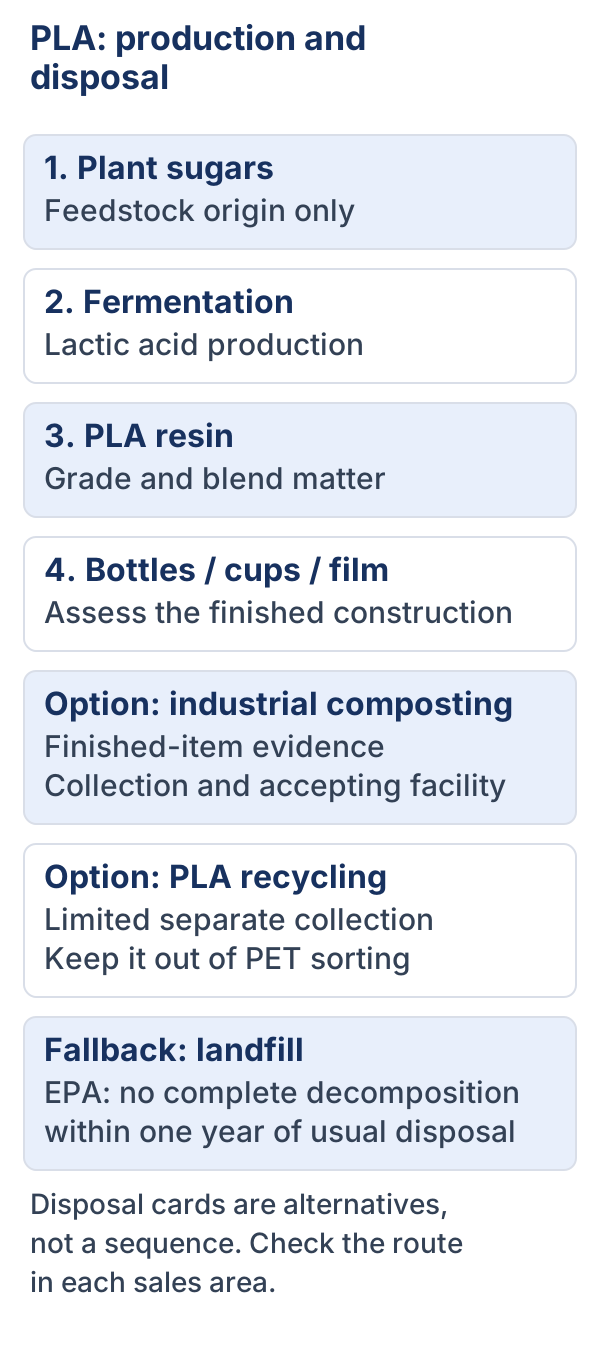
A plant-derived feedstock tells you where the carbon came from. It does not tell you how the package behaves in a composting facility, a recycling sorter or a landfill. EPA states that plastics made from plant materials are not automatically biodegradable and can be designed to be structurally identical to petroleum-based plastics. Feedstock, material properties and disposal route are separate questions.
When a supplier says “PLA packaging material” or “PLA-based packaging”, ask what that means for the item in front of you. It can mean a container made from PLA resin alone, a blend of PLA with other polymers or additives (the review cited below notes that blends are common because neat PLA is brittle), or a pack in which only some components are PLA, such as a PLA cup with a lid or label made of another material. Each one behaves differently in a composting facility or a sorting line, so the material description on the specification should name every layer and component. PLA is a polyester, as PET is, but it is a different polymer; a container that looks like PET is not PET, which is why the sorting questions in the end-of-life section below matter.
PLA packaging types and typical uses
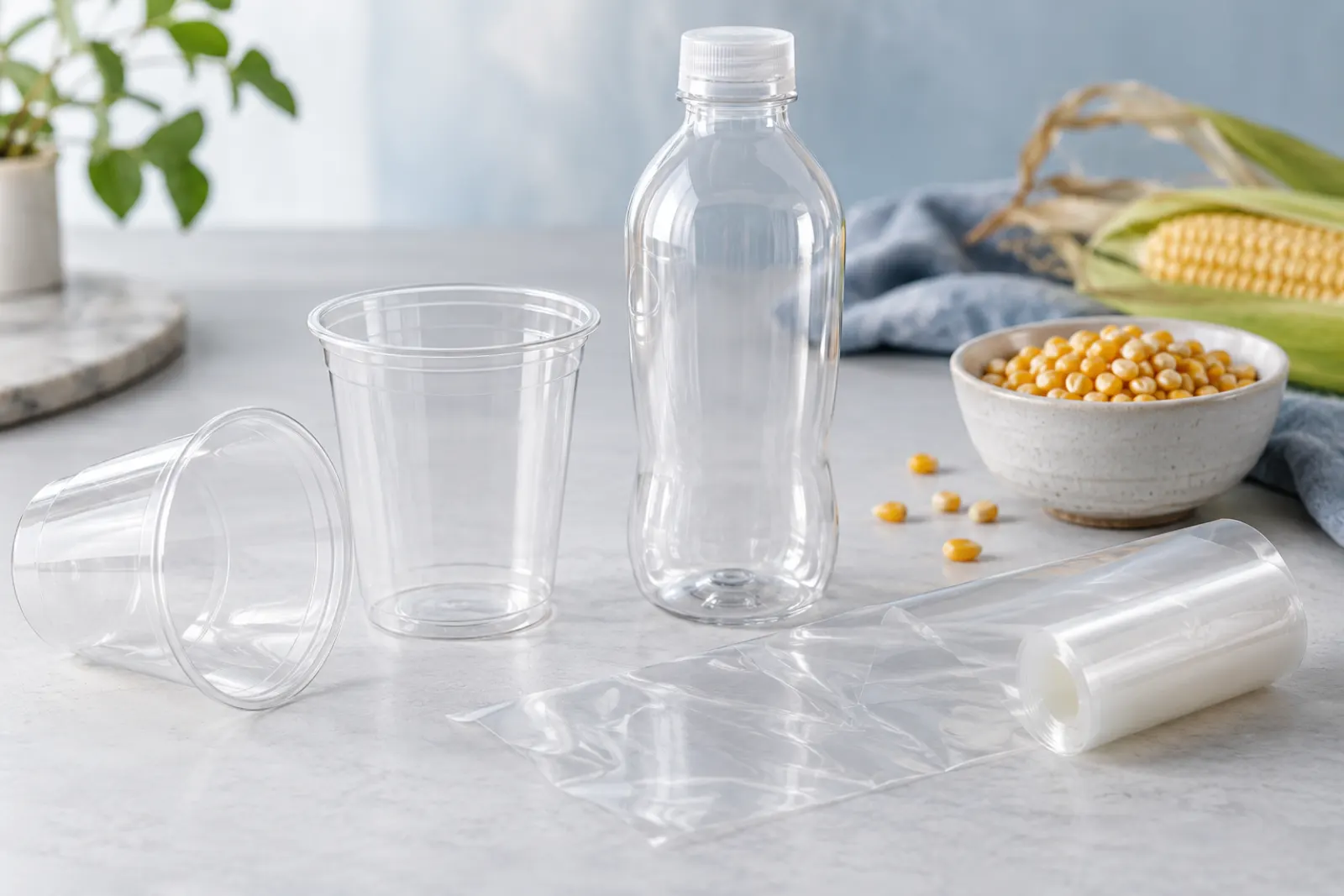
Published reviews list films, cups, containers, disposable utensils and bakeware among food packaging formats, in both rigid and flexible forms. The table groups the forms buyers usually meet by the use each suits and the limit to check first. It is qualitative; temperature limits depend on grade and processing, so the column names the condition to confirm rather than a number.
Scroll horizontally for any hidden columns →
| PLA packaging type | Typical food and beverage use | Limit to check first | Ask the supplier for |
|---|---|---|---|
| Cups and lids | Cold drink cups, some dairy or dessert cups | Warm storage and display; lid and cup seal | Maximum recommended storage temperature for the grade |
| Thermoformed clamshells and trays | Room-temperature or chilled produce and bakery items | Stiffness and stacking under warm conditions | Top-load and drop data on the actual design |
| Films and labels | Overwrap, labels and compostable-format flexible packs | Heat sealing window and moisture barrier | Film grade data sheet and seal conditions |
| Bottles | Chilled, short shelf life beverages, commonly stretch blow molded as PET is | Gas and moisture barrier, heat in distribution | Permeation data for your product and conditions |
| Foodservice items | Cutlery, straws | Use with hot food or drinks | Grade and intended use temperature |
PLA packaging film
Film is the form where supplier statements matter most, because PLA film grades differ widely. According to NatureWorks’ documentation for its film grades, its range runs from heat-sealable films to oriented films, with different stated usage temperatures for each type, and it describes its films as clear, with shrink, twist and deadfold, and a barrier to flavor, grease and oil. These are the resin supplier’s claims for its own grades, not independent test results. They do not tell you how a converted film, a laminate or a printed pack performs on your product.
For a buyer, three points decide whether a PLA film is workable. First, the moisture and gas barrier of the finished structure: the review cited below reports constraints on PLA’s permeability for some beverage uses, and a dry snack or a moist product will test that differently. Second, the sealing window on your packaging machine, because a heat-seal layer and an oriented film are different materials. Third, the disposal route of the whole pack, including inks, adhesives and any non-PLA layers. Ask for the grade data sheet of every layer and a trial on your own machine before approving a film.
Whether PLA fits depends on the product and the supply chain. A cold-chain beverage with a short shelf life puts few demands on PLA. A carbonated drink, a hot-filled juice or a product stored in a warm warehouse puts several.
Constraints that limit most projects
Heat
PLA has a relatively low glass transition temperature, the range at which the amorphous part of the polymer starts to soften. The peer-reviewed review cited below gives about 58 °C for semicrystalline PLA and describes the glass transition as the upper limit of practical use for amorphous PLA. It also lists constrained heat resilience as one of PLA’s drawbacks. For a buyer, what matters is the hottest realistic condition in the life of the package, which can include:
- the filling temperature of the product;
- warm washdown, hot product contact or sterilization steps;
- trucks, trailers and warehouses in summer;
- display cases and other warm points of sale.
Any one of these can be the limit. A grade that works for a chilled drink on a refrigerated route can fail on an unrefrigerated one. The comparison article on PLA vs PET bottles works through this against PET.
Barrier
The same review states that PLA’s permeability to carbon dioxide, oxygen and water vapor imposes constraints on its use in certain beverage bottles, whereas petroleum-based polymers such as PET are described as efficient barriers. Published values differ between studies because grade, crystallinity, orientation and test conditions differ, so this guide does not quote a single permeability figure. Ask the resin or container supplier for grade-specific data measured under conditions that match your product, and treat any comparison to PET as unverified until you have that data for both materials.
Mechanical behavior
The review also describes inherent brittleness and poor impact strength in neat PLA, which is why blends and additives are common. This affects drop performance, cap and closure design, and conveyor handling on a high-speed line. Tell your equipment supplier the material, because transfer points, grippers and capping torque settings behave differently on a more brittle container.
Food-contact status
In the United States, a substance expected to migrate into food has to be authorized through one of several pathways: an indirect food additive regulation in 21 CFR 174-179, GRAS status, a prior sanction, a threshold of regulation exemption or an effective food contact notification. FDA also notes that the regulatory status of a material depends on every substance in it, and that each authorization covers a specific identity, specification and condition of use. A general statement that PLA is a food-contact material is therefore not enough for a purchase file. You need the status of the particular resin grade, colorants, additives, inks, adhesives and coatings in the finished package, for your product type, fill temperature and storage conditions. A letter of guaranty from the manufacturer is one way FDA says customers can document this.
PLA packaging problems: likely causes and what to check
The constraints above show up as a small number of recurring problems. The table links each one to the cause the cited sources describe and to the check that confirms or rules it out on your own package. It is a diagnostic aid, not a set of test results.
Scroll horizontally for any hidden columns →
| Problem seen | Likely cause described in the sources | What to check |
|---|---|---|
| Containers soften, distort or lose shape after filling or in transit | Low glass transition temperature (about 58 °C for semicrystalline PLA in the review cited) and limited heat resilience | Fill temperature and logged temperatures in trucks, warehouses and display, against the grade’s documented limits |
| Shorter shelf life than the same product in PET, such as flavor loss, oxidation or loss of carbonation | PLA’s permeability to oxygen, carbon dioxide and water vapor | Grade-specific permeation data under your conditions, then a storage trial on your product |
| Cracked containers, broken flanges or closure failures on the line | Brittleness and poor impact strength of neat PLA | Drop, top-load and torque-retention data on the actual design, plus a run on your conveyors and capper |
| Weak or inconsistent film seals | Heat-sealable and oriented PLA films are different grades with different stated usage temperatures | The film grade data sheet and a sealing trial on your packaging machine |
| PET-looking PLA bottles end up in PET bottle collection | PLA sinks with PET in float-sink sorting and degrades recycled PET | Whether the package will be sold into PET bottle collection, and how it is identified |
| A compostable claim cannot be supported in a market | No certificate for the finished item, or no accepting facility where it is sold | Certification of the finished item and facility acceptance in each market |
The property data that settle most of these rows come from the supplier, not from general literature: the documented glass transition and maximum recommended storage temperature for the grade, permeation rates measured under stated conditions, impact and drop data for the design, and seal conditions for films. Published values vary with grade, crystallinity, orientation and test method, so ask for each figure with its test conditions and compare grades only on the same basis.
End-of-life: where PLA packaging ends up
Is PLA biodegradable? Under the controlled heat, moisture and microbial activity of an industrial composting facility, a finished PLA item that has been certified as compostable can break down, if the facility accepts it. Outside those conditions the published evidence points the other way: ordinary PLA is not considered home compostable (the tested PLA/PCL blend exception is described below), and EPA gives a one-year decomposition boundary for customary landfill disposal, and a study across soil and water environments found that most of the biodegradable polymers it tested fell short of ISO and ASTM biodegradation standards. The practical question for a buyer is therefore which of the five settings below the package will actually reach in the markets where it is sold.
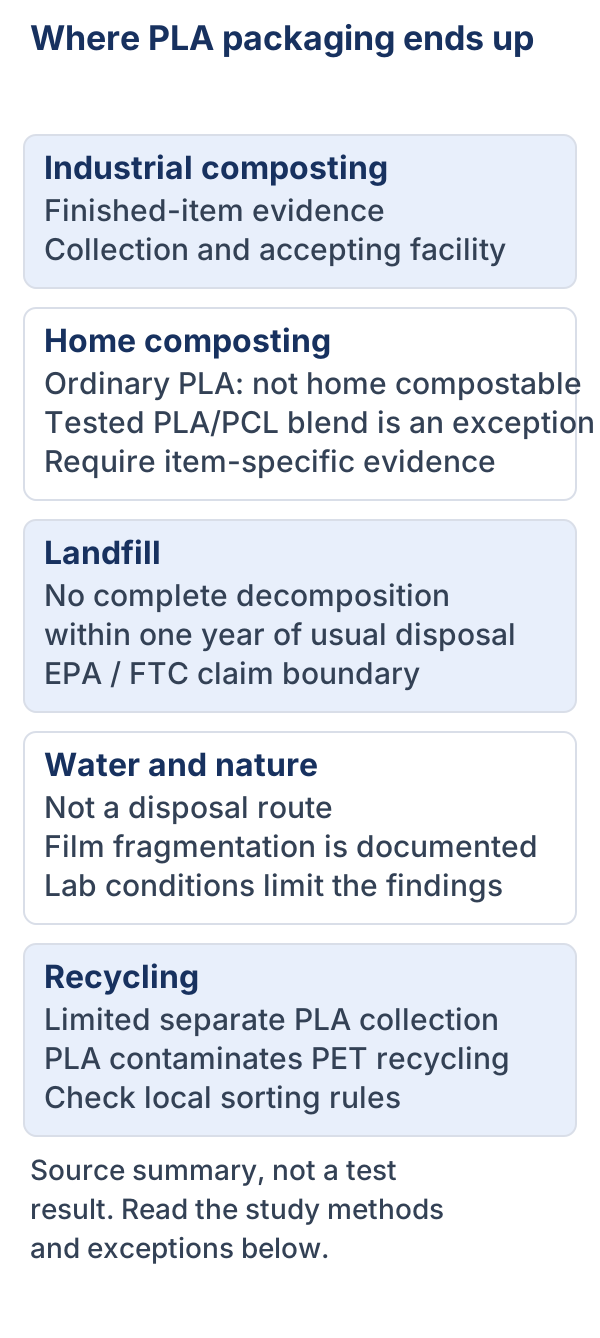
Industrial composting
According to NatureWorks’ documentation, certain PLA-based end products compost in municipal or industrial facilities under ISO, ASTM and EN standards, the number of such facilities is currently limited, and all final products made from its resin need their own compostability testing. The FTC Green Guides (16 CFR 260.7) say a marketer should clearly qualify compostable claims if composting facilities are not available to a substantial majority of consumers or communities where the item is sold. The companion article on compostable packaging claims and collection systems covers the standards and claim wording in more detail.
Home composting
EPA notes that no ASTM test method exists for evaluating whether a plastic composts in a home environment and advises not to compost products at home unless the label says it is acceptable. A 2018 peer-reviewed study that tested biodegradable polymers across seven managed and unmanaged environments states plainly that PLA is not home compostable, although the authors also report that PLA blended with polycaprolactone (PCL) became home compostable in their tests. That finding applies to the blend they tested, not to PLA packaging in general.
Landfill
EPA’s plastics FAQ quotes the FTC Green Guides: landfills, incinerators and recycling facilities do not present conditions in which complete decomposition will occur within one year, so unqualified degradable claims for items customarily disposed of there are deceptive. In most regions landfill is the practical fallback for PLA. That does not rule PLA out, but a package should not be described as better for the environment, or as breaking down in a landfill, without stating the conditions and the evidence.
Water and the natural environment
Water and soil are not disposal routes. Buyers are still often asked what happens to PLA that escapes collection. The same 2018 study reports that, while some polymers biodegraded well in soil and water, most of the polymers and blends it tested failed to reach ISO and ASTM biodegradation standards, and some showed none, leading the authors to warn that release into the environment can cause plastic pollution. A 2024 laboratory study on thin PLA packaging film found that in warm, lit freshwater and seawater at 28 °C the film became brittle, shed microparticles within five weeks and lost its integrity by twelve weeks, while in cold, dark water at 4 °C no microparticles were observed over twelve weeks. The authors note that bioplastics can be highly persistent in cold deep water. Neither result supports a claim that PLA is safe to lose in water.
Microplastics: what the studies show and what they do not
The 2024 study is direct evidence that PLA film can fragment into microparticles, mostly through abiotic breakdown rather than microbial action, under the conditions it tested. It is also limited: a thin blown film in laboratory flasks, a lamp in place of sunlight, and particle shapes identified by optical microscopy rather than counted. Studies that compare PLA with conventional plastics use different products and aging methods, and this guide has not reviewed them closely enough to say whether PLA releases more or fewer microplastics than PET or polypropylene. What a buyer can say with support is narrower: PLA is not exempt from fragmentation, and the question of microplastics depends on keeping the package in a managed route.
Recycling
The Association of Plastic Recyclers states that PLA is not currently considered recyclable in North America under its definition, because collection systems are limited. The APR design guide for PET lists PLA among materials that sink with PET in the float-sink step and degrade recycled PET even in very small amounts. Compostable plastics are, in EPA’s words, not intended for recycling and can contaminate and disrupt the recycling stream. If your customer collects PET bottles in a recycling program, a PLA bottle that looks like PET is a sorting risk, not a recyclable item. Labels, closures and shrink sleeves matter here too: APR also lists PET attachments on PLA, and PLA attachments on PET, as problems.
Environmental comparison boundaries
Plant-derived feedstock describes carbon origin; it does not determine the disposal outcome. Use the setting-specific evidence above rather than repeating it as a general environmental score. This page does not summarize life-cycle assessments: an environmental comparison needs study boundaries, energy sources and end-of-life assumptions matching the package and markets.
Comparing PLA with common alternatives
Scroll horizontally for any hidden columns →
| Question | PLA | PET | What to verify |
|---|---|---|---|
| Heat during fill and distribution | Low glass transition temperature; limited heat resilience | Higher; heat-set grades exist for hot fill | Highest temperature at fill, in transit and in storage |
| Gas and moisture barrier | Constraints reported for some beverage uses | Widely used for carbonated drinks | Grade-specific permeation data for your product |
| Food-contact paperwork | Depends on grade and additives | Depends on grade and additives | Written status for the finished package |
| Recycling in existing programs | Treated as a contaminant in PET recycling | Established collection | Local acceptance rules |
| Industrial composting | Possible where facilities accept it | Not applicable | Certification of the finished item plus facility acceptance |
| Line compatibility | Settings differ from PET; confirm with the equipment supplier | Reference case | Equipment supplier confirmation and a trial |
This table is a qualitative overview, not a specification. For a full bottle comparison, see beverage bottle materials.
A historical example
The site documents earlier use of PLA in dairy packaging. The Naturally Iowa PLA dairy FAQ in our history section shows how PLA milk bottles were described at the time. It records what was said then. It is not a technical conclusion about what any resin or machine does today, and any current project needs its own specification and trial.
Before specifying PLA
Complete the four-check record at the top of the article. Include the label, sleeve, closure and every film layer in the construction, then add the mechanical and line results: drop/top-load behavior, torque retention, label adhesion and a sealing trial for film. The FAT checklist helps define the trial samples and acceptance rules.
What needs project-specific validation
General material descriptions do not settle shelf life or line behavior. Use a study on the actual formulation, headspace, package and storage conditions, plus a run on production-representative equipment. The record above keeps temperature logs, permeation results, finished-item documents and facility confirmations together; blanks remain open checks.
Questions to ask suppliers
- Which resin grade is the container made from, and what is the manufacturer’s documented glass transition and maximum recommended storage temperature for that grade?
- What is the highest filling temperature the container supports, and what was the basis for that limit?
- What permeation data (oxygen, carbon dioxide, water vapor) exist for this container, and under what test conditions?
- What is the food-contact status of the finished package, including additives, colorants, inks and adhesives, and can you provide a letter of guaranty?
- Is the finished item certified to ASTM D6400 or an equivalent standard, and can you provide the certificate for the item rather than the resin?
- What disposal route do you recommend, and where is it available for my markets?
- How should labels, sleeves and closures be selected so that they do not undermine the disposal route?
- What changes are required on the filler, capper and conveyors compared with a PET container of the same size?
- What drop, top-load and torque-retention data can you share, and which of those were measured on this exact design?
- Which statements in your documentation are your own claims, and which are from third-party certificates or standards?
For how this fits a milk line, see milk packaging formats and equipment.
Sources and method
This article is based on documentary research of the sources listed. It is not a hands-on equipment test. Supplier statements and editorial judgement are identified in the text.
- A review on bio-based polymer polylactic acid potential on sustainable food packaging Supports: PLA's glass transition behavior, limited heat resilience, gas and water vapor permeability constraints for some beverage bottles, and typical food packaging formats.
- APR Design Guide: PET Rigid Supports: PLA and PVC sink with PET and degrade recycled PET quality. Also consulted APR archived PLA Design Guidance for North American collection limits and PET attachments on PLA; archived URL retained in the rework evidence record.
- Frequently Asked Questions About Plastic Recycling and Composting Supports: bio-based does not mean biodegradable; compostable plastics are not intended for recycling; no ASTM method for home composting of plastics; EPA's quotation of the FTC Green Guides that landfills do not present conditions in which complete decomposition will occur within one year.
- Composting (Ingeo end-of-life opportunities) Supports: According to NatureWorks' documentation, composting facilities are limited, and finished products need their own compostability testing.
- 16 CFR 260.7 Compostable claims Supports: marketers should qualify compostable claims when facilities are not available to a substantial majority of consumers or communities.
- Biodegradable Plastic Blends Create New Possibilities for End-of-Life Management of Plastics but They Are Not a Panacea for Plastic Pollution Supports: the authors' statement that PLA is not home compostable, that they tested biodegradation across seven managed and unmanaged environments, and that most of the polymers and blends tested failed ISO and ASTM biodegradation standards in those tests.
- Generation of Microplastics from Biodegradable Packaging Films Based on PLA, PBS and Their Blend in Freshwater and Seawater Supports: laboratory results that thin PLA films in warm, lit freshwater and seawater (28 °C) generated microparticles within 5 weeks and lost integrity by 12 weeks, mostly by abiotic degradation, while no microparticles were observed in cold, dark water (4 °C) up to 12 weeks.
- 4 Series for Films & Cards Supports: according to the supplier, its PLA film grades range from heat-sealable films to oriented films with different stated usage temperatures, and the films offer clarity, shrink, twist and deadfold and a barrier to flavor, grease and oil.
- Determining the Regulatory Status of Components of a Food Contact Material Supports: the five pathways for legal use of food contact components and the role of a letter of guaranty.
Next reading
PLA vs PET Bottles: A Practical Comparison for Beverage Packaging
Compare PLA vs PET bottles by fill temperature, barrier, carbonation, shelf life, line compatibility and disposal route, and see what to verify before replacing PET.
Read the guide
Compostable Packaging: Industrial Composting, Home Composting and Collection Systems
Compostable food packaging explained: bio-based vs biodegradable vs compostable, ASTM D6400 and BPI certification, FTC claim rules and the collection gap.
Read the guide
Milk Packaging Formats: Bottles, Cartons and Pouches
How to choose a milk packaging format by heat treatment, cold chain and light exposure, and what bottle, carton and pouch formats mean for filling equipment.
Read the guide
Naturally Iowa and PLA Dairy Packaging: A Historical FAQ
A source-based historical FAQ on Naturally Iowa's PLA milk bottles, with dated company and press claims kept apart from what buyers must verify today.
Read articleMore in Materials
Beverage Bottle Materials: Comparing PET, HDPE, Glass and PLA
Compare beverage bottle materials (PET, HDPE, glass and PLA) by weight, breakage, heat tolerance, gas barrier and recycling infrastructure, with a requirements checklist.
Read the guide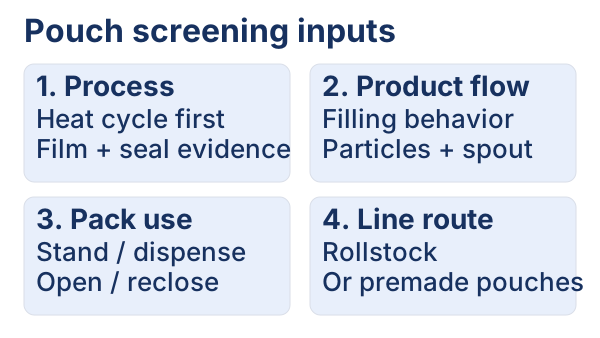
Pouch Packaging for Food: Stand-Up, Retort, Spouted and Pillow Pouches by Product
A pouch unsuited to heat processing can fail. Select by preservation route, product flow and use, then check film, fitment and filling compatibility.
Read the guide
BASF Paper Coating Dispersions: Carbon Claims and Food-Pack Checks
BASF’s reduced-PCF paper coating announcement needs two reviews: product carbon data and the intended food-pack application. Check the boundaries before switching.
Read the guide