
BASF Paper Coating Dispersions: Carbon Claims and Food-Pack Checks
BASF’s reduced-PCF paper coating announcement needs two reviews: product carbon data and the intended food-pack application. Check the boundaries before switching.
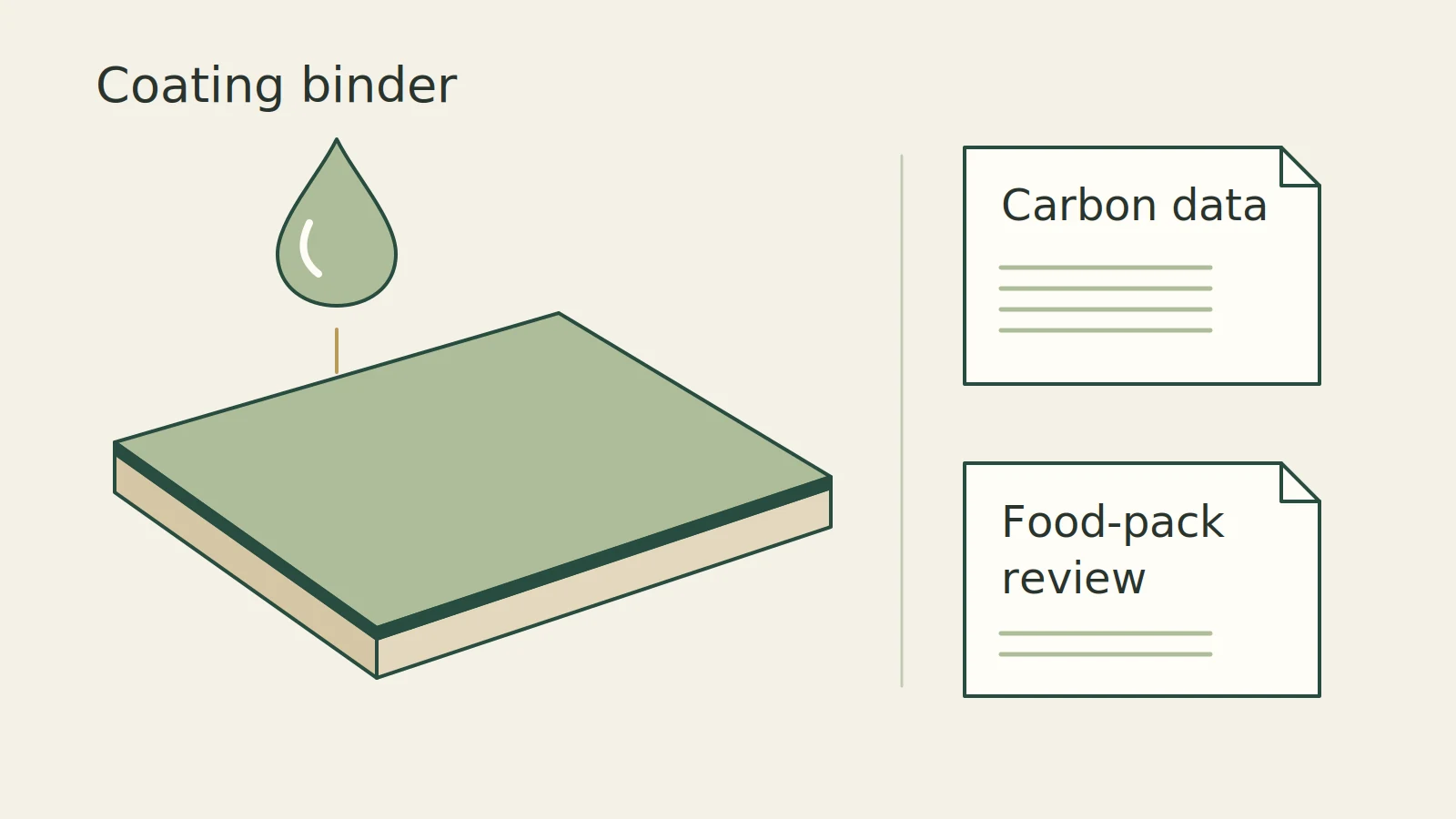
What this article covers
Separate BASF’s mass-balance carbon accounting announcement from paper coating performance, food-use documentation and US supply confirmation.
Covered
- BASF announcement and carbon-data scope
- Food-packaging application review
- Scope 3 data and procurement questions
Not covered
- Certified customer emissions reductions
- Food-contact approval or automatic requalification waiver
- US availability, prices and grade-specific reductions
A coating change can cause rework if a carbon-footprint claim is mistaken for approval of the finished food pack. BASF has announced reduced-PCF paper coating dispersions; review the product’s carbon-data boundary separately from its intended food use and your change-control requirements.
For food-packaging teams reading the BASF paper coating dispersions news, the practical question is whether the proposed binder comes with the right documentation for both decisions. A lower supplier product footprint is not automatically a lower complete-pack footprint, a new barrier specification or an accepted customer emissions claim. This review explains the announcement and offers separate carbon and food-application records. The food packaging materials guides place it within a broader selection process.
- BASF’s range applies case by case against its corresponding conventional product.
- The carbon boundary is cradle to gate, not the pack’s whole life cycle.
- Mass balance allocation and physical batch composition are different evidence questions.
- Food-use review and US supply confirmation remain project tasks.
What did BASF announce?
BASF’s September 23, 2026 release P-26-158 describes paper coating binders produced at Ludwigshafen with approximately 20%–45% lower product carbon footprints than corresponding conventional BASF products. The release defines that comparison case by case on a cradle-to-gate basis. These are BASF’s statements, not independently verified reductions for a finished food package.
Scroll horizontally for any hidden columns →
| Announcement item | Stated scope | Avoid extending it to |
|---|---|---|
| Reduced-PCF dispersion | Specific supplier product comparison | Every coating grade or complete food pack |
| Production site | Ludwigshafen Verbund | Confirmed US inventory or delivery |
| Drop-in description | BASF says the manufacturing process is unchanged | Automatic waiver of customer checks |
| Method certification | TÜV Rheinland conformity of BASF’s calculation method with TfS guidance | Certification of each reduction or food-use approval |
BASF says the products are available at the stated production site and describes switching without requalification. Keep that description attributed to BASF. It is a reason to ask about a matching grade and supporting documentation, not a conclusion that your finished package needs no review.
Takeaway: The announcement concerns a supplier material and calculation method; it does not approve a customer’s packaging change.
What does the reduction mean for a food-pack record?
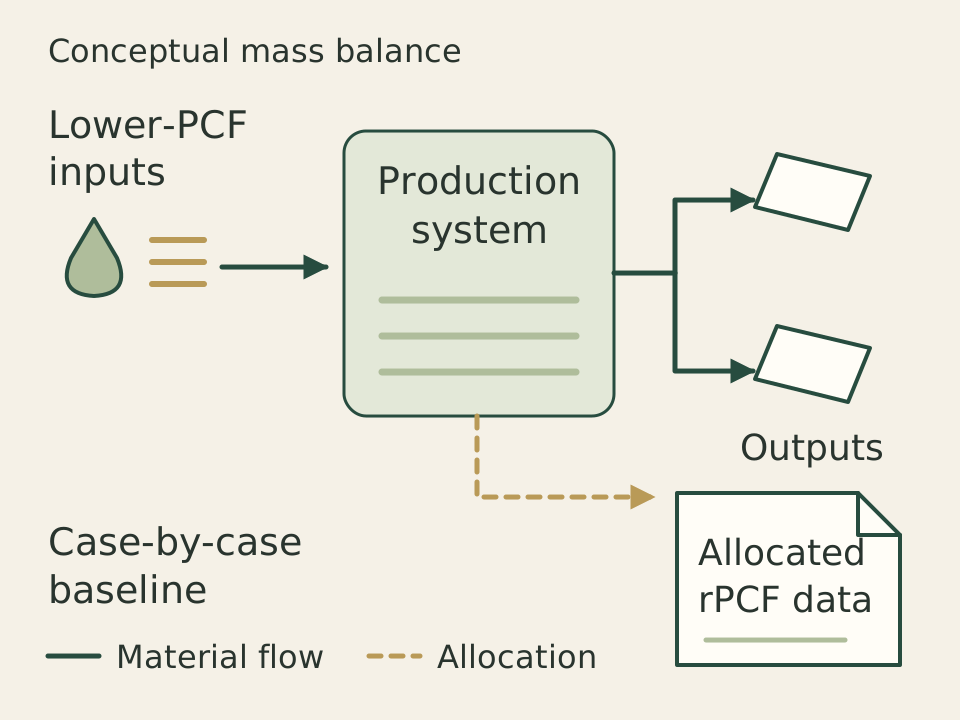
Record the compared grade, system boundary and allocation method before carrying the supplier figure into any packaging assessment. BASF describes lower-PCF raw materials, renewable electricity and lower-PCF steam, with shares allocated through mass balance. That accounting description does not identify the physical contents of every delivered batch or establish an identical reduction for every grade.
Scroll horizontally for any hidden columns →
| Carbon-data field | What the buyer should obtain | Why it changes the interpretation |
|---|---|---|
| Product identity | Exact proposed grade and conventional comparator | The portfolio range is not the grade’s result |
| Declared unit | Unit and material basis used in the PCF record | Prevents comparing unlike quantities or formulations |
| Boundary | Included stages through the supplier’s gate | A supplier boundary is not a whole-pack life cycle |
| Allocation | Mass-balance method and associated records | Explains how the reduction is assigned |
| Period and method version | Data period, methodology and certificate scope | Makes the comparison reproducible |
Our reading is to treat the carbon data as one input to a broader packaging record. Substrate, converting, transport, other components and end-of-life sit in whatever boundary your team defines; the announcement does not establish their combined result. An appearance change from plastic to paper, or a binder purchase change, does not by itself supply that calculation.
The compostable packaging guide helps distinguish material identity from disposal claims. The PLA packaging guide similarly illustrates why a material label is not a complete application decision. Neither page is evidence that BASF’s dispersion is compostable or PLA based.
Common mistake: Applying the portfolio’s highest quoted percentage to the full food package without a grade-specific value and matching boundary.
Takeaway: Carry the supplier data with its grade, comparator and allocation boundary intact.
Who is affected by the announcement?
Coaters and converters reviewing purchased binders are the direct technical audience. Food brands are downstream users of the resulting pack and carbon records. Our recommendation is to assign separate owners to coating performance, intended food use and environmental reporting, so one team’s document does not silently answer another team’s question.
Scroll horizontally for any hidden columns →
| Reader or team | Decision to revisit | Evidence owner |
|---|---|---|
| Paper or board coater | Whether a corresponding binder fits the current formulation | Technical team with material supplier |
| Packaging converter | Whether the substrate/coating system meets the intended package task | Converter and brand packaging team |
| Food technical team | What documentation and checks cover actual food use | Responsible food team with supplier |
| Sustainability and procurement | Whether the data fit the chosen reporting boundary and purchasing record | Reporting owner, supplier and reviewer |
BASF’s general US paper-coatings page includes food-packaging and barrier applications, but does not identify which specific grades in this new portfolio are available for your project. Keep that distinction visible when forming an early shortlist. The food pouch formats guide offers a useful example of matching packaging construction to the actual food and process rather than selecting by material headline.
Takeaway: Name the decision owner for each document instead of treating carbon, coating and food-use checks as one approval.
How should food-packaging validation be kept separate?
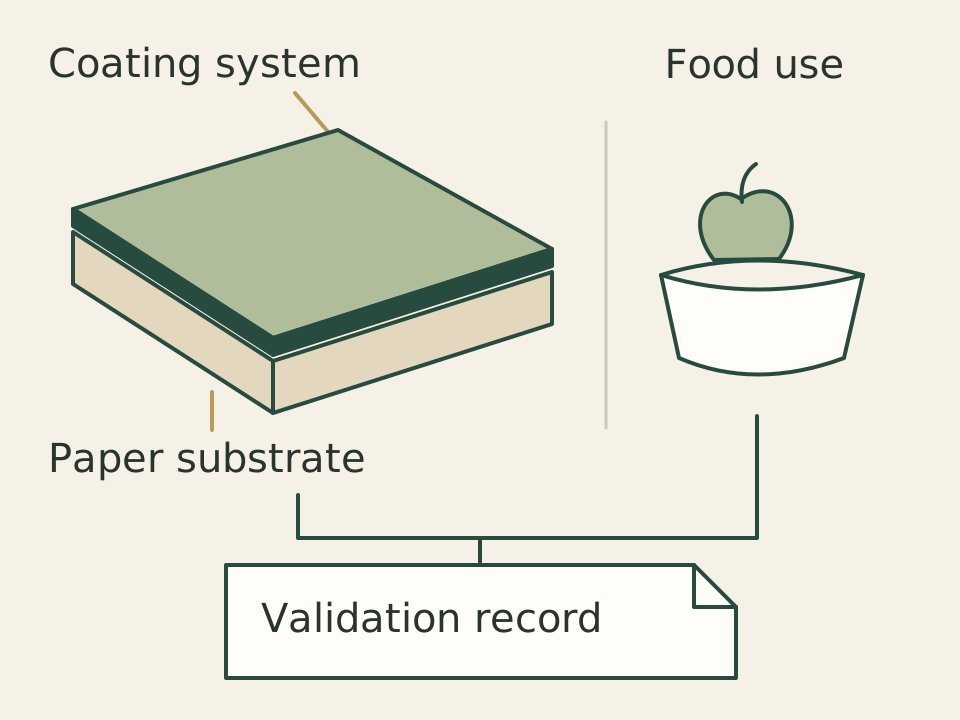
Evaluate the actual coated article and its intended conditions, not just the binder’s footprint record. This is our suggested application check: identify substrate, coating system, contact arrangement, food and distribution conditions, then ask the responsible technical team which documents or trials address those conditions. The release provides no project-specific acceptance limits.
Scroll horizontally for any hidden columns →
| Application question | Record to compile | What the announcement cannot settle |
|---|---|---|
| Which substrate and formulation? | Current and proposed material identities | Formulation-specific equivalence |
| What packaging function is required? | Stated barrier, print or handling task | Measured finished-pack performance |
| How is food contact arranged? | Intended-use description and supplier documentation | Approval of an unspecified use |
| Which production change is planned? | Written change-control review | Whether local checks can be omitted |
| What will be evaluated? | Agreed trial conditions and evidence owners | Shelf life or compliance of the final pack |
Review a food-specific guide when defining the task: milk packaging for liquid dairy systems, yogurt packaging for cups or other formats, and flow-wrapped foods for supported products and wrapper functions. Those pages help phrase the questions; they do not validate this material.
For line work, the packaging FAT checklist offers documented trial planning. Keep the distinction between a machine demonstration and a coated-material review. The goal is a traceable record for the intended change, with unknowns assigned to reviewers before the material is released to production.
Takeaway: Carbon documentation accompanies the material; it does not replace the food and finished-pack review.
When should US buyers act?
Clarify the proposed grade and supply route before assigning a conversion date. BASF’s “available” statement concerns the named Ludwigshafen production context. The public release does not provide a US delivery calendar, sample lead time or price. An early document review is possible without claiming US market availability.
Scroll horizontally for any hidden columns →
| Milestone | Date or status | Buyer action |
|---|---|---|
| BASF release | September 23, 2026 | Identify the announced scope |
| Supplier describes availability | In the September release | Confirm grade and destination-specific supply |
| This review | October 8, 2026 | Separate carbon and food-use questions |
| US sample/order schedule | Confirm with supplier | Obtain written timing and scope |
| Plant change decision | Your documented review | Set after evidence and supply are resolved |
Use the packaging buying guides to organize that record. Any coating-line modification belongs in a project budget separate from the binder price. The announcement contains no figure supporting a payback calculation or a claim of identical price.
Takeaway: Start with grade and documentation questions; schedule a change against confirmed supply and review milestones.
What remains uncertain for Scope 3 and purchasing?
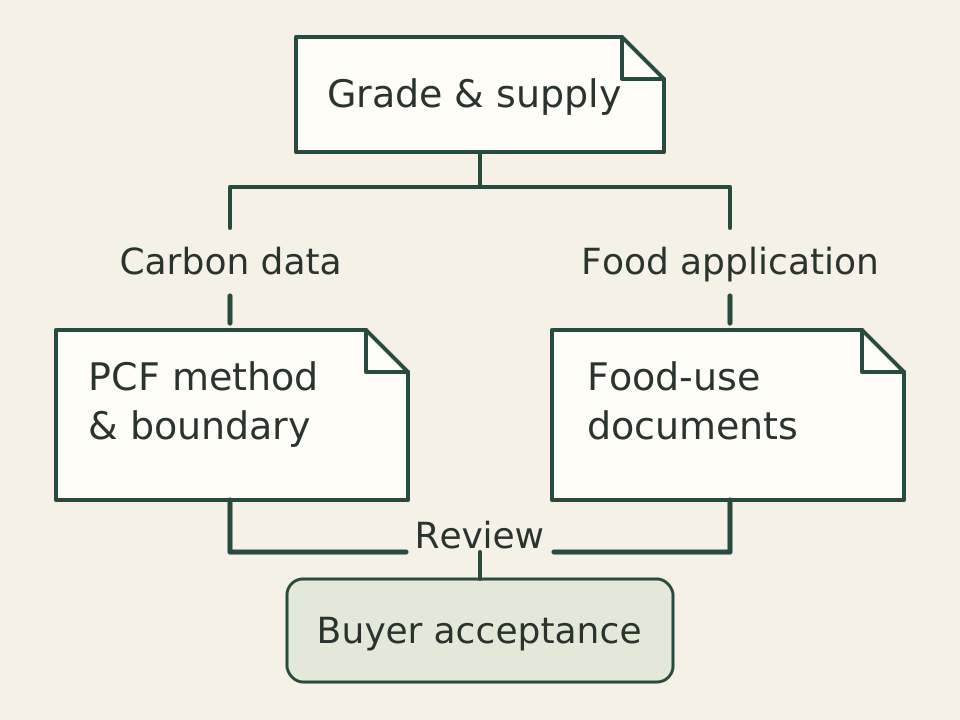
The GHG Protocol’s Category 1 guidance describes a supplier-specific approach using product-level cradle-to-gate inventory data. That provides context for requesting supplier data. It does not decide whether BASF’s allocated figures are accepted by your reporting policy, target framework, customer or auditor. Get that decision from the responsible reporting reviewer.
Scroll horizontally for any hidden columns →
| Unresolved item | Who can answer | Required record |
|---|---|---|
| Grade-specific reduction | BASF | Proposed and conventional grade PCF files |
| Allocation and certificate coverage | BASF | Method documentation and actual certification scope |
| Use in the buyer’s emissions report | Reporting owner and reviewer | Written treatment under the chosen framework |
| Food-use and change-control scope | Food technical team with supplier | Intended-use documentation and review |
| US supply, samples and price | Supplier’s relevant commercial team | Destination-specific written offer |
Common mistake: Calling the methodology certification proof that a customer’s own emissions reduction or food-contact use has been certified. State exactly whose method and which scope the certificate covers.
Takeaway: Supplier data and reviewer acceptance are separate steps, each requiring its own record.
When this does not apply
Do not use this review to claim that each physical batch contains an identified low-carbon share, that every grade achieves the portfolio range, or that a complete pack is lower carbon by the same amount. It also gives no recycling, compostability, food-safety or performance certification for the finished article.
The article is a document-review aid. For a current purchasing decision, check for a revised supplier data package and have your technical and reporting owners assess its actual scope. No grade names are proposed as confirmed rPCF variants.
Takeaway: Keep the material, carbon-data and finished-pack boundaries explicit throughout a switching decision.
FAQ
What is product carbon footprint?
For this BASF announcement, PCF means the product’s cradle-to-gate emissions, compared with its corresponding conventional BASF product. It is a supplier-product boundary, not a declared result for a complete food package through use and disposal.
How to find the carbon footprint of a product?
Start with a product-specific data file stating the unit, period, boundary and method. The GHG Protocol supplier-specific method uses supplier product-level cradle-to-gate data. For a complete pack, its reporting owner needs the remaining defined inputs and an accepted calculation approach.
What is the plastic coating on paper called?
There is no single polymer name. BASF’s general paper-coatings page describes acrylic/styrene and styrene-butadiene copolymer dispersions as binder examples. A binder is one ingredient, not the whole coating construction. Those categories do not identify which grades have new rPCF versions; check the actual specification.
Method and evidence boundaries
The event description follows BASF’s original P-26-158 release; its general paper-coatings page and GHG Protocol guidance add separate context. Checked October 8, 2026. The role matrix and document paths are editorial suggestions, not an approved audit treatment or performance evaluation. Media retellings are not counted as independent verification. Reference links are provided by the site’s Sources component below.
Sources and method
This article is based on documentary research of the sources listed. It is not a hands-on equipment test. Supplier statements and editorial judgement are identified in the text.
- BASF launches paper coating dispersions with reduced Product Carbon Footprint 2026-09-23 company release P-26-158; case-by-case cradle-to-gate comparison and mass balance allocation. Retrieved 2026-10-08.
- Paper and paperboard coatings General coatings applications; not US rPCF availability or a specific rPCF grade approval. Retrieved 2026-10-08.
- Category 1: Purchased Goods and Services Supplier-specific cradle-to-gate data method; does not approve BASF mass balance data for a buyer or target framework. Retrieved 2026-10-08.
Next reading
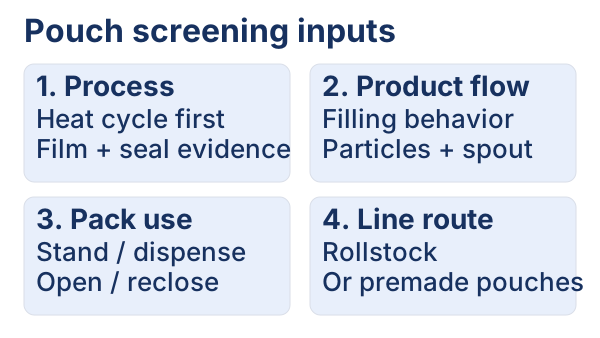
Pouch Packaging for Food: Stand-Up, Retort, Spouted and Pillow Pouches by Product
A pouch unsuited to heat processing can fail. Select by preservation route, product flow and use, then check film, fitment and filling compatibility.
Read the guide
Compostable Packaging: Industrial Composting, Home Composting and Collection Systems
Compostable food packaging explained: bio-based vs biodegradable vs compostable, ASTM D6400 and BPI certification, FTC claim rules and the collection gap.
Read the guide
Factory Acceptance Testing for Packaging Equipment: Planning the Checks
Finding defects after shipment can delay installation. Prepare a FAT protocol, representative materials, raw test records and an agreed punch list.
Read the guideMore in Materials

PLA Packaging for Food and Beverages: Uses, Constraints and Buyer Questions
PLA food packaging explained for buyers: where polylactic acid fits, its heat and barrier limits, end-of-life conditions, and what to request from suppliers.
Read the guide
PLA vs PET Bottles: A Practical Comparison for Beverage Packaging
Compare PLA vs PET bottles by fill temperature, barrier, carbonation, shelf life, line compatibility and disposal route, and see what to verify before replacing PET.
Read the guide
Beverage Bottle Materials: Comparing PET, HDPE, Glass and PLA
Compare beverage bottle materials (PET, HDPE, glass and PLA) by weight, breakage, heat tolerance, gas barrier and recycling infrastructure, with a requirements checklist.
Read the guide