
Which Foods Are Flow Wrapped? Bars, Bakery, Cheese and Produce Compared
Poor conveyor handling or a mismatched seal can damage food. Screen flow wrapping by solid unit, stack or tray, then check film and atmosphere.
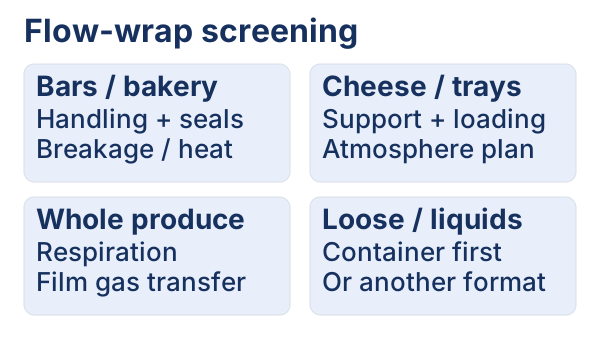
Choosing flow wrapping before checking presentation and seals can break the food during conveying or leave a failed package. Start with a solid item, stack or tray that travels as a unit, then match the seal, film and atmosphere to the product.
Scroll horizontally for any hidden columns →
| Food group | Starting check |
|---|---|
| Bars, biscuits and bakery | Unit or stack handling; heat sensitivity and breakage |
| Cheese and tray-supported poultry | Loading support, seal integrity and processor-approved atmosphere |
| Whole vegetables | Respiration, film permeability and storage conditions |
| Loose pieces or pourable foods | Add a tray or container, or compare bags, pouches and cups |
What is flow wrapping?
Flow wrapping, also called horizontal form-fill-seal (HFFS) or flow packing, forms flat film into a tube around a product carried horizontally, seals the long seam, then seals and cuts each end. Packaging Digest’s explainer by John R. Henry (2023) says the machines take their name from the way product flows through them.
The same explainer describes four sections: an infeed conveyor, a forming shoe where the film becomes a tube, a longitudinal seal, and an end sealer with a cutoff knife. The long seal usually runs under the product, though some machines place it on top. It also notes that a flow wrapper can pack a single product such as a candy bar, several products such as stacks of hamburgers, or a tray of products such as cookies. That range matters for food: an item that cannot travel well on its own can sometimes be flow wrapped once it is stacked or placed on a tray. ULMA describes the resulting package as a “three sealing pillow pack”, one long seam and two end seals, so “flow wrap” names the process and “pillow pack” the shape.
A variant, the inverted flow wrapper, feeds the film from below so the product is carried on the film instead of being pushed along. A Paxiom press release (June 2022) describes the Valtara SleekWrapper i65 this way and names soft baked goods, tortillas, fresh produce, meats and multi-pack trays as hard-to-handle products it is meant for.
This page stays with the food question. The machine and film detail matter only where they change whether a food can be flow wrapped.
Which foods are flow wrapped? The matrix
In the cited sources, bars, biscuits, bread, cheese blocks, whole vegetables and a range of frozen items are flow wrapped; cut, loose and pourable foods are shown in other formats. The table groups the foods by how they behave on a conveyor and what the pack has to do. “Shown flow wrapped” means at least one cited supplier or trade source presents that food in a flow pack. It is not a ranking, and it does not mean every product in the category will run well.
Scroll horizontally for any hidden columns →
| Food | Flow-wrap fit | Seal and atmosphere points in the sources | What to check for your product | Basis |
|---|---|---|---|---|
| Chocolate and candy bars | Shown flow wrapped | Both cold seal and heat seal are used for chocolate (Syntegon); Bostik names chocolate and cereal bars as cold seal applications | Barrier by recipe: nuts, wafers or seeds; fat content; white chocolate and light | Packaging Digest, Syntegon, Bostik |
| Biscuits and cookies | Shown flow wrapped, singly or on trays | Bostik lists biscuits and bakery among cold seal applications | Breakage: single packs, stacks or trays | Packaging Digest, Bostik |
| Bread, rolls and muffins | Shown flow wrapped, including with a modified atmosphere | ULMA shows baguettes in a flow pack with modified atmosphere | Soft items can deform if pushed; Paxiom offers inverted wrappers for soft baked goods and tortillas | ULMA, Paxiom |
| Cheese blocks | Shown flow wrapped with a modified atmosphere | ULMA shows cheese blocks in a hermetic flow pack with modified atmosphere | Use the cheese packaging guide for form and ripening checks | ULMA |
| Fresh poultry and meat | Shown in some formats | ULMA shows whole chicken on a tray in a flow pack with modified atmosphere and a shrink barrier film | Whether the product needs a tray; Paxiom lists meats among inverted-wrapper uses | ULMA, Paxiom |
| Whole vegetables such as tomatoes, peppers and mushrooms | Shown flow wrapped | Produce respires, so film permeability has to match it (Castellanos and Herrera) | Perforation, condensation, storage temperature | Paxiom, Castellanos and Herrera |
| Cut salads and diced vegetables | Shown in another format | Paxiom shows bagging for cut greens and diced vegetables, and container filling for diced vegetables | Bag or container choice | Paxiom |
| Frozen pizzas, burritos, sandwiches, waffles, burger patties and ice cream novelties | Shown flow wrapped | Ice cream is on Bostik’s cold seal list | Film and seal behavior at freezer temperature, confirmed with the film supplier | Syntegon, Bostik |
| Loose frozen vegetables and fruit (IQF) | Shown in another format | Syntegon lists vertical baggers for these | Bag style, or a tray or container if a wrapped pack is wanted | Syntegon |
| Liquids, sauces and other pourable foods | Container needed before wrapping (editorial inference) | The conveyor-unit definition implies a container for pourable food | Container choice | Packaging Digest (definition) |
Two patterns run through the table. Every food shown flow wrapped can be presented as a solid unit, a stack or a tray. The foods these suppliers show in other formats are the ones that pour, are cut into small pieces, or are packed as bulk blends. A loose product placed in a tray or container first can return to the flow-wrap assessment.
Takeaway: Choose the presentation to demonstrate—single unit, stack or tray—before comparing wrapper proposals.
Heat seal or cold seal: which foods need which?
Choose the seal that the product can tolerate at the jaws. Heat sealing fuses the film’s sealing layers with heated jaws. Cold sealing uses a coating on the film that bonds to itself under pressure alone. Chocolate, bars, biscuits and ice cream appear in a cold seal supplier’s application list because the seal forms without heat near the product.
Scroll horizontally for any hidden columns →
| Seal type | How it closes | Foods named in the sources | Trade-offs named in the sources |
|---|---|---|---|
| Heat seal | Heated jaws fuse the film’s sealing layers | Chocolate (Syntegon) | Syntegon says heat seals stay tight in hot or humid climates |
| Cold seal | A cohesive coating on the film bonds to itself under pressure | Chocolate and cereal bars, candy bars, biscuits, bakery, snacks, ice cream (Bostik) | Bostik says cold seal needs no heat or dwell time, which it gives as its main speed advantage over heat seal; Syntegon says cold seals allow high machine speeds |
Bostik, an adhesive supplier, describes cold seal as a cohesive water-based coating made from natural and/or synthetic latex. Specify the coating and film with the converter and the machine supplier; treat a seal change as a material-and-process trial. Syntegon (2022) adds the climate question: if the product will be sold in hot or humid markets, the seal’s behavior there belongs in the comparison.
The recipe then sets the barrier. Syntegon states that chocolate containing nuts, wafers or seeds needs a high barrier layer, that high-fat products need to withstand moisture and oxygen, and that white chocolate is more sensitive to light than dark chocolate and needs a higher light barrier. The same article says mono-PP films and bioplastics such as PLA, PHA, PBS and cellulose-based materials can be cold or heat sealed. Syntegon also describes a paper-ON-form retrofit kit for its form-fill-seal machines that, it says, produces paper-based barrier flow wraps for chocolate without wrinkles, creases or tears, developed with partners including Mondelez and Mars Wrigley. Whether a paper or bioplastic wrap gives enough barrier for a given product needs trials. If a wrapper is to carry a compostable claim, check what that claim requires first; the compostable packaging guide sets out the terms and conditions.
Takeaway: Agree on the converted film and sealing method before testing the product at the jaws.
When does a flow pack need a modified atmosphere?
When the food is perishable and the processor wants a gas composition around it other than air. There are two separate paths. Supplier examples for cheese, bread and whole chicken on a tray use hermetic flow packs, so the check is the seal and film barrier of the chosen pack. Fresh produce keeps breathing, so the check is whether the film’s gas transfer matches the produce’s respiration and storage conditions; a perforated film may be part of the answer.
ULMA describes its FM 300 as a flow wrapper that makes “a totally hermetic three sealing pillow pack for fresh food in modified atmosphere (MAP)” and shows it on cheese blocks and baguettes. It shows its ARTIC model, described in the same terms, on whole chicken on a tray packed with a shrink barrier film. For these hermetic examples, check seal integrity and film barrier against the preservation brief. Produce packs designed to exchange gas need a separate assessment; the processor sets and validates gas composition and shelf life.
Castellanos and Herrera (2017) define modified atmosphere packaging for fresh produce as changing the composition of the atmosphere around the product. Active MAP introduces a gas of different composition at sealing; passive MAP seals the pack with air. The authors call the distinction of limited use, because the final headspace depends on the produce’s metabolism and on gas exchange through the film. Four points from their chapter translate into checks for a flow-wrapped vegetable:
- Respiration rate: produce shelf life depends on it, and it differs by product, so the film has to be chosen for the specific vegetable.
- Film permeability: a high-respiration product needs a film with high permeability to oxygen and carbon dioxide.
- Perforation: micro- or macro-perforated polyethylene and polypropylene bags are used to compensate for respiration and transpiration when the film alone cannot transfer enough gas.
- Temperature and condensation: oxygen consumption and carbon dioxide production rise with temperature, film permeability changes with storage temperature, and in a saturated headspace the water the product loses condenses inside the pack.
Which foods need a different format?
Foods that cannot travel as a unit in the form you plan to sell them: pourable foods, small loose pieces and bulk blends. The supplier pages cited here show these in vertical-bagger bags, pouches or containers. That is a statement about the product’s current form, not its size: a loose product placed in a tray or container first can be wrapped as a unit. Soft or awkward foods are a middle case; they may still be flow wrapped on an inverted wrapper or on a tray.
- Loose frozen vegetables, fruit and blends: Syntegon lists vertical baggers, not flow wrappers, for IQF vegetables and fruits and for bulk blends.
- Cut salads and diced vegetables: Paxiom shows vertical form-fill-seal bagging for cut greens and diced vegetables, and container filling for diced vegetables and mushroom trays.
- Liquids, sauces and other pourable foods: the conveyor-unit definition implies a bottle, pouch or cup before any wrapping step. The bottle vs. pouch guide explains how pouches are formed, filled and sealed from rollstock or supplied premade.
- Products that need a rigid tray with a sealed lid for protection or presentation: the comparable format is tray sealing, covered in the tray sealing machine guide.
- Soft, sticky or irregular products: try an inverted wrapper or a tray before ruling out flow wrapping, and confirm with a sample run.
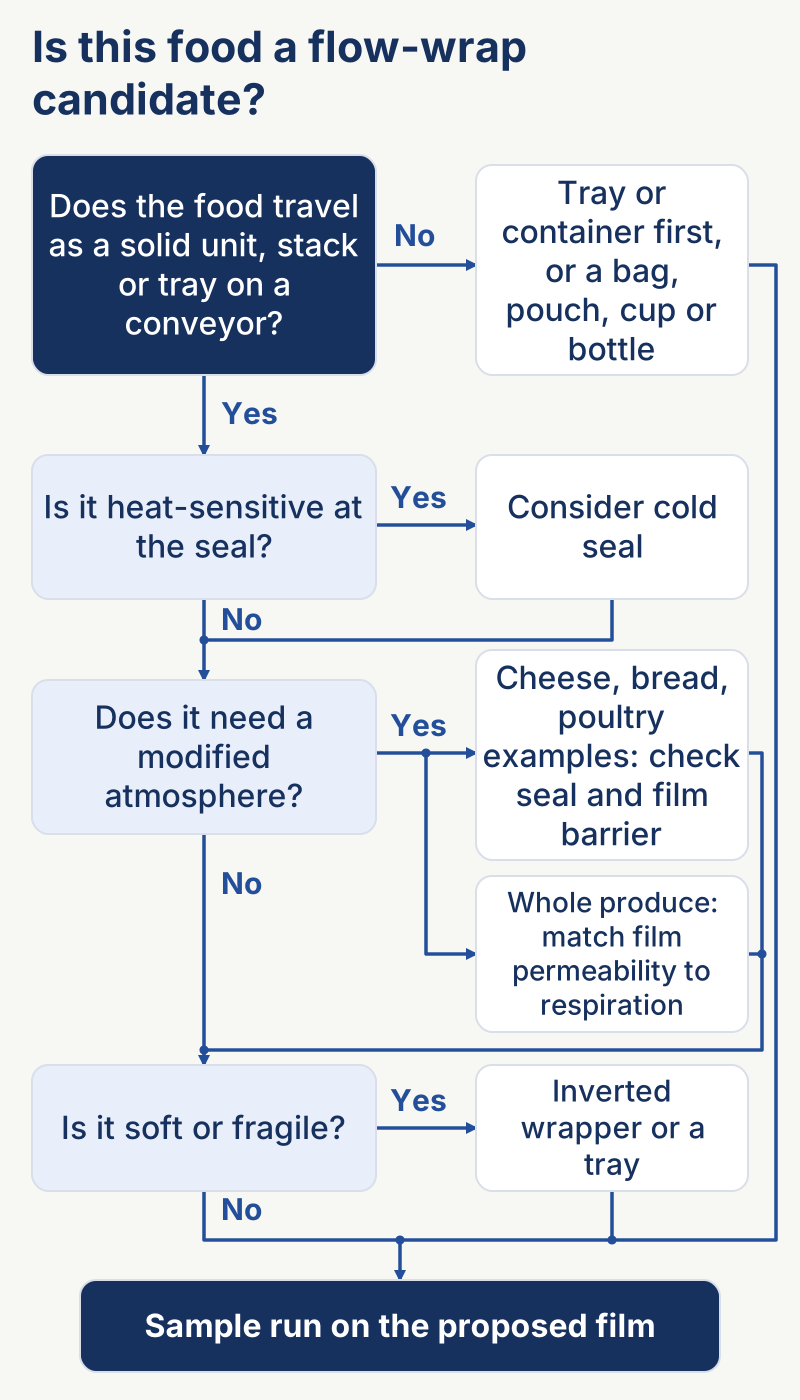
The matrix stops holding when a specific product differs from the category examples. A bar can still fail on size or stickiness, a bread on softness, a vegetable on respiration or condensation. Before contacting a film or machine supplier, write down the facts the matrix depends on:
Copy and complete this product record for each proposal:
Scroll horizontally for any hidden columns →
| Product input | Your record |
|---|---|
| Unit, stack or tray presentation | ____ |
| Dimensions, weight and fragility | ____ |
| Heat sensitivity at the seal | ____ |
| Atmosphere need and decision owner | ____ |
| Storage temperature and conditions | ____ |
| Distribution climate | ____ |
Takeaway: If the product cannot travel intact, settle its support or container first and use that presentation in the sample run.
The product data module in the packaging machine RFQ checklist gives a format for sending these facts to several suppliers in the same way.
Common questions
What are the disadvantages of using a heat sealer?
For a heat-sensitive food, assess exposure near the sealing jaws before changing from cold seal. Bostik’s public documentation distinguishes pressure-bonded cold seal from heat-based sealing. Ask the converter for a film suited to the proposed heat-sealing process, and have the equipment supplier demonstrate it with the product; changing jaw settings alone does not establish material compatibility.
Scope and method
The matrix combines one trade-press explainer, supplier application pages and articles from Syntegon, ULMA Packaging, Paxiom and Bostik, and one open-access research chapter on produce packaging. Original sources were read on October 7, 2026; Bostik was rechecked October 8, 2026. The additional question wording comes from Google People Also Ask, retrieved October 8, 2026. Supplier pages show what those companies offer and how they describe it; they are not evidence that a given food performs well in a flow wrap, and no supplier is ranked here. Conveyor and container checks are editorial inferences from the process definition. The page does not cover gas mixes, shelf life, food-contact compliance, film specifications, machine speeds or prices. Other guides in the applications section follow the same product-first order.
Sources and method
This article is based on documentary research of the sources listed. It is not a hands-on equipment test. Supplier statements and editorial judgement are identified in the text.
- The Ins and Outs of Versatile Flow Wrappers Supports: definition of flow wrappers as horizontal form-fill-seal machines, their four sections, seal position, and the examples of single products, stacks and trays.
- An Inverted Approach for Hard-to-Wrap Products Supports: supplier description of an inverted flow wrapper that feeds film from below, and the soft and hard-to-wrap foods it names.
- Optimum protection for chocolate Supports: supplier statements on cold and heat sealing for chocolate, barrier needs by chocolate type, mono-PP and bioplastic films, and paper-based flow wraps.
- Cold Seal Adhesives Supports: adhesive supplier description of cold seal as a cohesive latex coating that seals under pressure without heat, and its list of cold seal food applications.
- Frozen food packaging machine Supports: which frozen foods the supplier lists for flow wrappers and which for vertical baggers.
- Cheese packaging in flow pack wrapper (HFFS) in modified atmosphere (MAP) Supports: supplier example of cheese blocks in a hermetic flow pack with modified atmosphere.
- Baguette bread packaging in flow pack (hffs) with modified atmosphere (MAP) Supports: supplier example of bread in a flow pack with modified atmosphere.
- Chicken packaging in flow pack wrapper (HFFS) with modified atmosphere (MAP) using BDF shrink barrier film Supports: supplier example of whole chicken on a tray in a flow pack with modified atmosphere and a shrink barrier film.
- Vegetable Packaging Machines Supports: supplier allocation of whole vegetables to flow wrapping, and of cut greens and diced vegetables to bagging and container filling.
- Modified Atmosphere Packaging: Design and Optimization Strategies for Fresh Produce Supports: active and passive MAP, respiration rate and film permeability, perforated films, temperature effects and in-package condensation for fresh produce.
Next reading
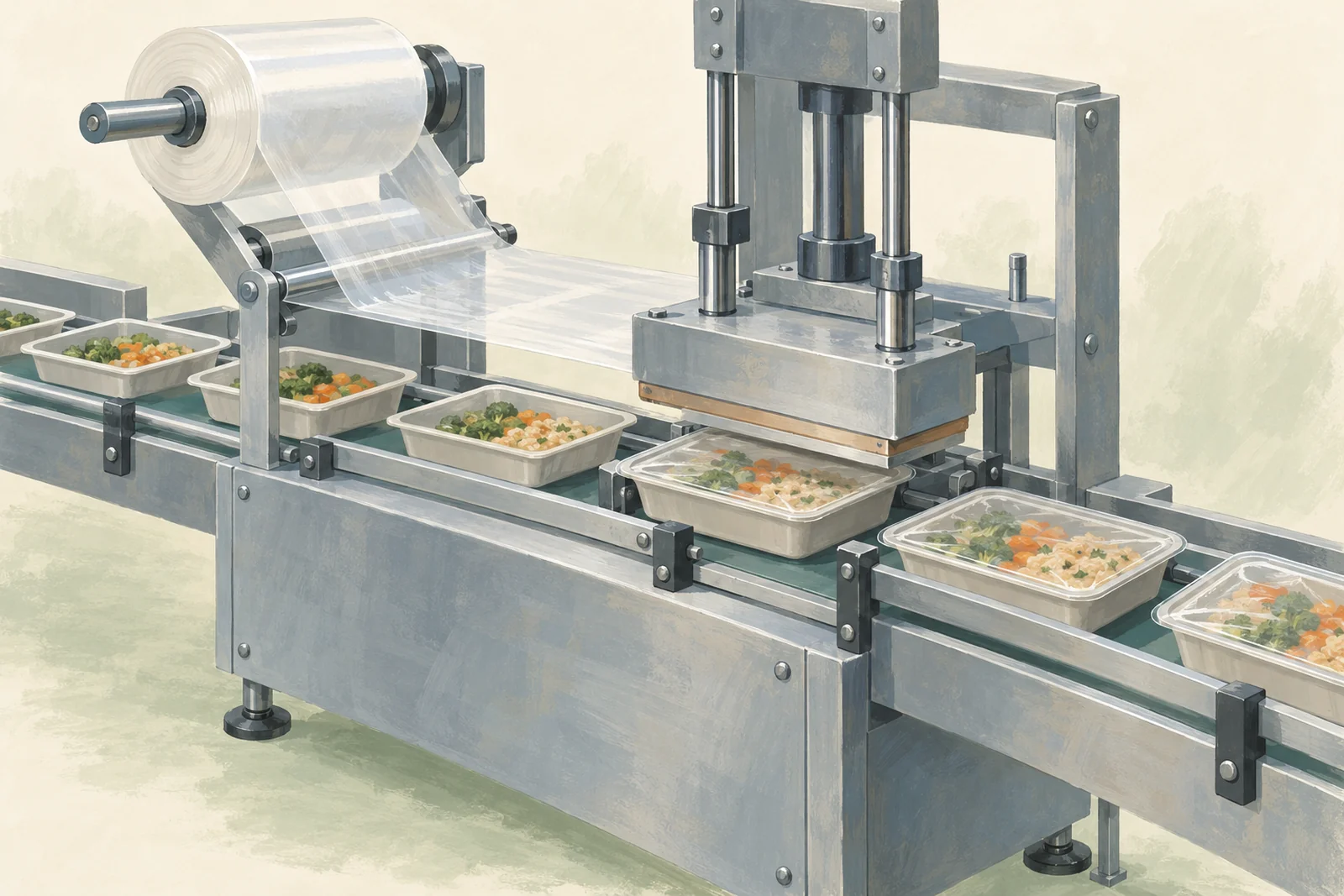
Food Tray Sealing Machines: How They Work and What to Check
A technical guide to selecting food tray sealers: manual vs inline automation, vacuum MAP gas flush technology, tray and lidding compatibility, and seal integrity validation.
Read the guide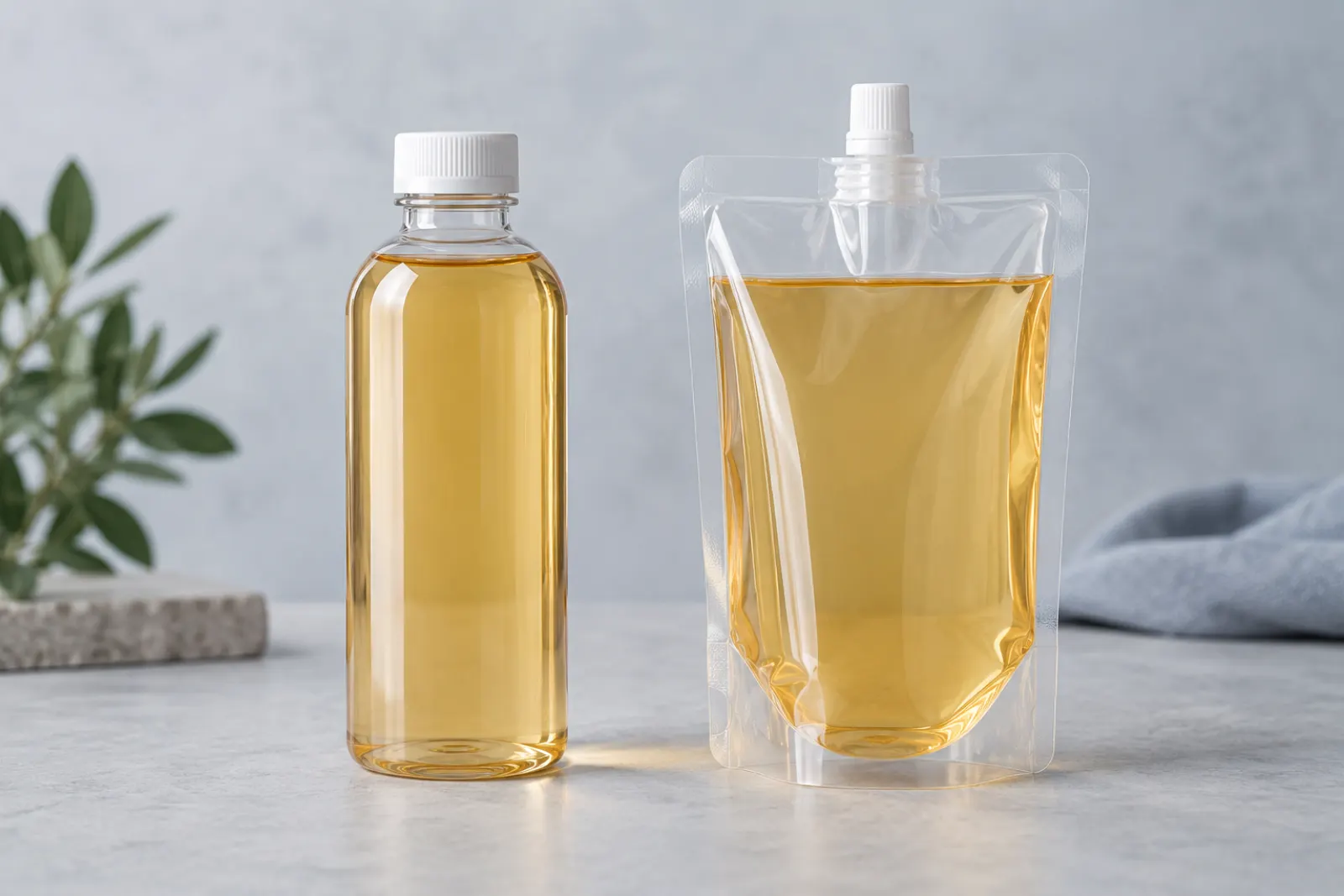
Bottle vs Pouch Packaging: What Changes on the Production Line?
Moving a liquid product between rigid bottles and flexible pouches changes filling, closing, conveying, changeover and cases. Use this guide to scope the work.
Read the guide
Packaging Machine RFQ Checklist for Food and Beverage Buyers
A copy-ready request-for-quotation structure for packaging machines, with eight modules of fields to fill in and a method for comparing quotes line by line.
Read the guideMore in Applications
Milk Packaging Formats: Bottles, Cartons and Pouches
How to choose a milk packaging format by heat treatment, cold chain and light exposure, and what bottle, carton and pouch formats mean for filling equipment.
Read the guide
Yogurt Packaging: Cups, Bottles and Pouches for Different Products
Match yogurt packaging to product type: set, stirred, drinkable or squeeze. Compare cups, bottles and spouted pouches and their filling and sealing needs.
Read the guide
Bottled Water Packaging Lines: From Prepared Containers to Packed Cases
Plan a bottled water packaging line from container supply to palletizing: rinsing, filling, capping, labeling, coding and the interfaces between stations.
Read the guide