
Cheese Packaging: Materials, Formats and Equipment
The wrong cheese pack can damage texture. Match cheese form and ripening needs to a package, then check the material and equipment together.
Scroll horizontally for any hidden columns →
| Screening input | Record first |
|---|---|
| Form and texture | Block, slices, shreds or spread; fragile or sticky surfaces |
| Ripening and gas behavior | Cheesemaker’s process and quality records |
| Pack and distribution | Drawing, net content and validated storage plan |
| Operating and acceptance needs | Product mix, cleaning schedule and trial criteria |
Quick specs to collect before choosing a pack
Collect product data before ordering material samples. A cheese name alone does not describe the surface, gas production or handling condition at packaging. Use the following inputs alongside the broader food packaging applications guide to separate the primary pack from its shipping case and transport protection.
Scroll horizontally for any hidden columns →
| Input or item | Typical value or source | Why it matters |
|---|---|---|
| Physical form | Actual block, slices, shreds, spread or brined portion | Sets handling and dosing needs |
| Ripening stage | Producer’s process specification | Establishes whether the pack must accommodate further maturation |
| Surface and texture | Representative product samples | Reveals compression, sticking and puncture concerns |
| Gas generation | Product development and quality records | Affects gas transmission and pressure management |
| Pack size | Dimensioned drawing and target net content | Defines package geometry and change parts |
| Distribution conditions | Validated storage and shipping plan | Defines the conditions for material and pack evaluation |
| Production pattern | Batch sizes, product mix and cleaning schedule | Allows comparison of manual and automated operations |
| Acceptance criteria | Producer-approved trial plan | States what counts as a satisfactory package |
Takeaway: Ask the cheesemaker and quality team to complete the product description before asking equipment suppliers for a recommendation.
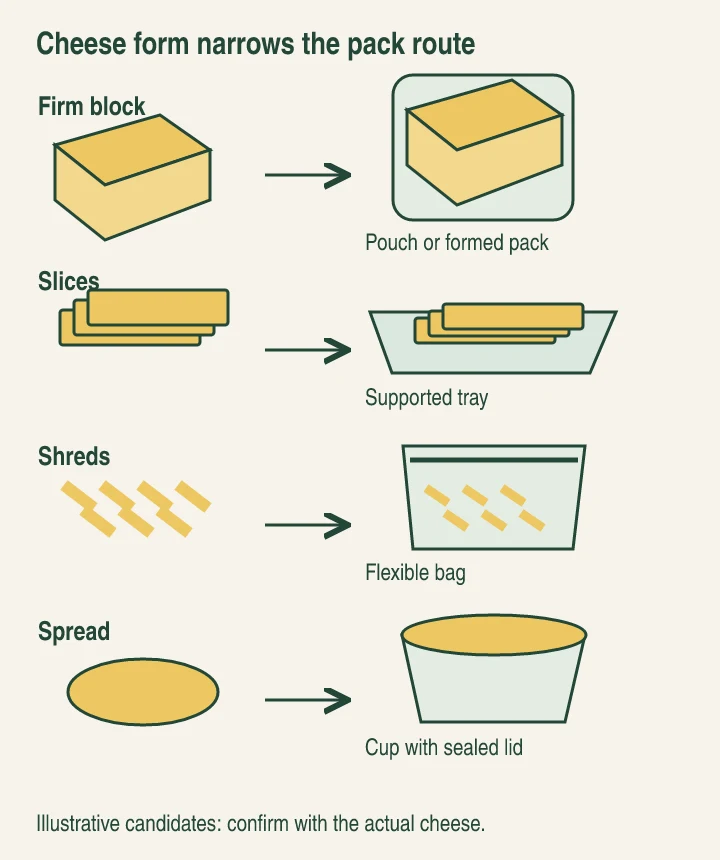
Match the cheese form to a candidate packaging route
Use product form to narrow the equipment family, then test the difficult handling step. A machine that forms an acceptable empty pack can still load a cheese badly. The matrix below organizes applications published by ULMA and BW Packaging; it adds editorial checks for comparing the routes without treating a catalog example as proof for your formulation.
Scroll horizontally for any hidden columns →
| Cheese form | Candidate pack | Equipment route to investigate | Decisive check |
|---|---|---|---|
| Firm blocks or wedges | Premade vacuum pouch or formed flexible pack | Vacuum sealing or thermoforming | Surface edges, pack fit and product deformation |
| Sliced cheese | Tray with lid or horizontal wrapped pack | Traysealing, thermoforming or flow wrapping | Stack transfer, slice separation and presentation after packing |
| Shredded or grated cheese | Flexible bag | Dosing with vertical form-fill-seal (VFFS) | Consistent feed and keeping loose pieces out of seals |
| Spreadable cheese | Preformed cup or formed container | Cup filling and sealing or thermoform-fill-seal | Product delivery to the container and a clean sealing rim |
| Fresh portions needing support | Rigid or supported pack | Traysealing or an evaluated forming route | Product movement, liquid management and seal integrity |
| Surface-ripened cheese | Product-specific wrapping or pack | Route chosen with the cheesemaker | Whether the package supports the intended rind and maturation |
The first five rows reflect published equipment applications, with candidate checks added by this publication. The last row follows the American Cheese Society’s explanation that wrapping affects maturation. It deliberately does not prescribe one material for every rind.
For blocks and slice stacks, the flow-wrapped foods guide explains conveyor presentation and sealing choices. A tray-sealing selection brief helps define a tray and lidding system. For spreadable products, the cup filling and sealing guide explains the stations involved; a yogurt application is not evidence that a particular cheese can run on the same configuration.
Common mistake: Ordering the machine from a photograph of the finished pack. Obtain a loading and sealing demonstration with the product, especially where pieces stick together or lose their shape.
Takeaway: Shortlist the package and loading method together; leave the machine model open until the sample trial resolves the handling risk.
Specify the material by its job, not just its polymer name
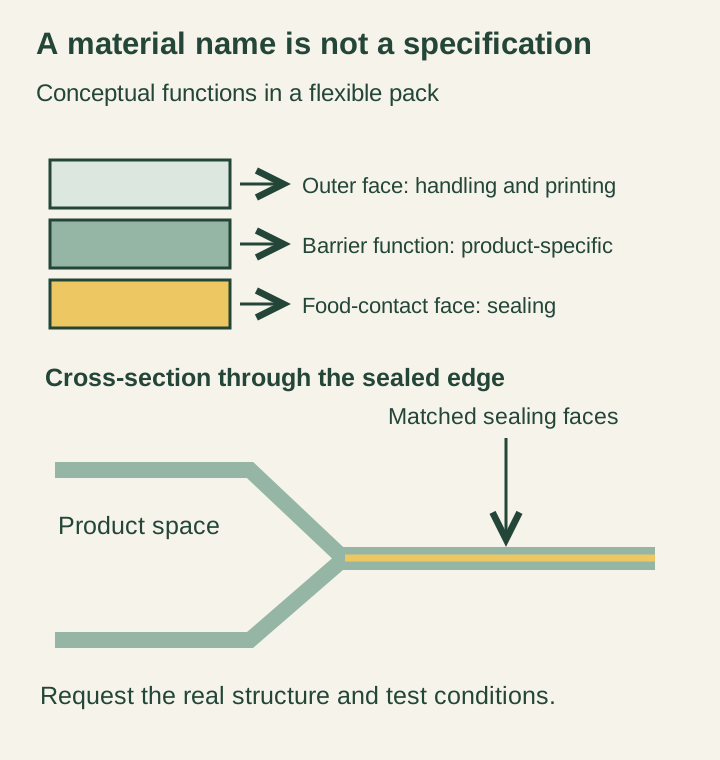
Ask a converter to describe the complete material structure and the conditions attached to its performance data. “Plastic bag” leaves out barrier layers, sealant, thickness and the behavior of the converted pack. “Paper wrap” may refer to one component of a coated or multilayer construction. Neither term is a purchase specification.
Scroll horizontally for any hidden columns →
| Material detail to request | What the buyer needs to establish |
|---|---|
| Food-contact face and full construction | Which layers touch the cheese, and which documents cover the intended use |
| Oxygen transmission rate (OTR) | Test method, units, temperature and humidity for the quoted result |
| Water vapor transmission rate (WVTR) | Test conditions and relevance to the product’s moisture-management plan |
| Gas transmission behavior | Suitability for the particular cheese’s gas generation and maturation |
| Sealant and sealing window | Compatibility with the other sealing surface and actual machine process |
| Mechanical behavior | Performance around edges, folds, handling and transport |
| Opening and reclosure features | How the consumer opens the pack and what the reclosure is intended to do |
There is no OTR or WVTR target in this article. Product development and packaging specialists must set those requirements from the actual cheese and storage plan. A quoted film result also needs to be distinguished from the performance of a sealed package with seams, corners and closures.
For US food contact use, FDA explains that the regulatory status depends on the component substances and their intended conditions of use. Ask the supplier for documentation that identifies the material and covers your application, including a letter of guaranty where appropriate. A general “food safe” claim leaves the buyer without that link.
The materials overview helps separate material families from finished constructions. If a brief introduces PLA or a compostability claim, use the PLA food-packaging guide and compostable-packaging guide to identify the additional questions; those labels alone do not establish cheese-pack suitability.
Takeaway: Compare documented constructions under matched conditions, rather than ranking materials by a single polymer name or barrier number.
Decide what vacuum or a modified atmosphere must accomplish
Vacuum packaging removes air before sealing, while modified atmosphere packaging (MAP) deliberately changes the gases inside the pack. These approaches affect the product and the package. The choice belongs in the preservation brief, alongside handling and material requirements, rather than being an optional accessory selected at the end of a machine quotation.
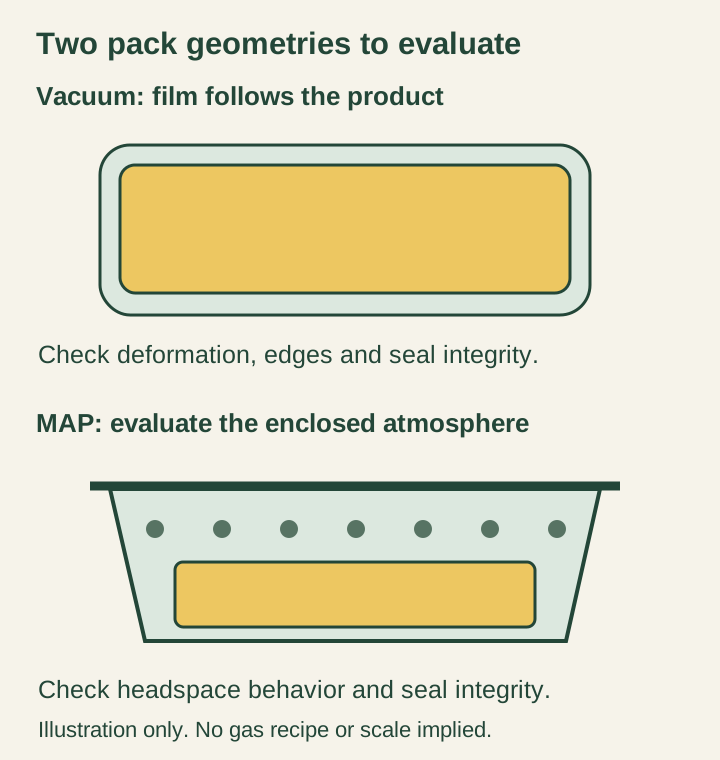
The American Cheese Society describes how barrier vacuum packaging changes surface development during aging. It also distinguishes cheeses that produce gas from those that do not. That makes a simple hard-versus-soft classification insufficient: the intended rind, stage of maturation and behavior of the specific cheese matter.
Linde describes carbon dioxide and nitrogen combinations for grated or sliced cheese, including the need to consider package collapse. That supplier example supports asking about headspace behavior; it does not establish a gas recipe for a new product. Record who will select the mixture, how the packed product will be assessed, and who can approve a change.
Common mistake: Carrying a gas setting or film specification from one cheese SKU to another because both products are shredded. Wipak’s July 2026 technical article specifically distinguishes gas-producing and non-gassing cheeses and calls for validation when products or packaging change.
Takeaway: Obtain a product-specific preservation decision before specifying vacuum, gas flushing or film permeability.
Evaluate small-scale options through the complete work cycle
A small producer should compare the labor and controls needed to make an acceptable pack, including preparation and cleaning. A bench-scale arrangement may be a candidate, but a low purchase price is not enough to establish that it suits the product or premises. Define the same finished-pack requirements before comparing levels of automation.
For a premade pouch route, account for preparing the cheese, loading the pouch, keeping the sealing area clear, sealing, inspecting and labeling. For a cup route, include container presentation, dosing, rim control, lid application and inspection. An automated proposal should show how those operations connect, including the work still performed by an operator.
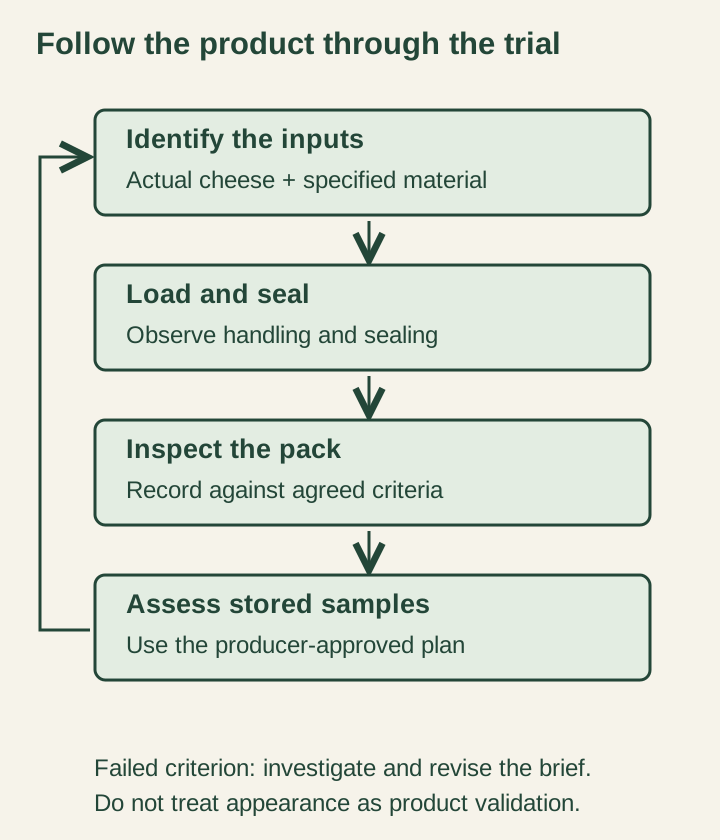
Use a representative batch that includes the awkward end of the product range: the widest portion, the fragile slice stack or the product that tends to adhere to handling surfaces. Record the actual samples and settings. Ask to see access for cleaning and changeover as well as a continuous production demonstration.
The machine RFQ checklist provides a place to organize inputs. The factory acceptance checklist helps separate a demonstrated equipment function from a food-product shelf-life decision. A packaging line cost scope can expose omitted dosing, labeling, installation or training items without inventing a standard cheese-line price.
Takeaway: Compare the complete operating cycle and its acceptance records, including work outside the sealer itself.
Compare suppliers using the same product brief
Request evidence for the proposed application, rather than a list of familiar cheese names. A film converter, machinery builder and systems integrator may each control different parts of the result. State who is responsible for compatibility and who will investigate when a pack fails a defined criterion.
Copy this checklist into a document and fill the final column for each proposal.
Scroll horizontally for any hidden columns →
| Item in the brief | Evidence to request | Decision it supports | Your record |
|---|---|---|---|
| Product form and condition | Written application assumptions and sample record | Whether the proposal covers the actual cheese | ____ |
| Pack drawing and material | Identified construction, tolerances and compatibility review | Whether machine and consumable proposals match | ____ |
| Cleaning and changeovers | Demonstration plan and access documentation | Whether the operating method fits the plant | ____ |
| Inspection and rejection | Agreed checks, records and rejected-pack handling | How unsuitable packs will be identified | ____ |
| Material supply | Lot identification and change-notification procedure | How specifications remain traceable after purchase | ____ |
| Trial responsibilities | Named owner for equipment, materials and product validation | Who resolves a failure before release | ____ |
Keep accepted samples and the version of the specification against which they were accepted. The American Cheese Society includes packaging-material inventory and lot records, supplier guarantees and product testing records among records to maintain. This comparison table is editorial procurement guidance, not an accreditation or supplier ranking.
Takeaway: A useful proposal ties an identified cheese and material to a documented trial and clear responsibilities.
When this does not apply
This guide supports equipment and material screening for commercial cheese packaging. It does not prescribe a food-safety plan, a ripening recipe, a sell-by date, gas percentages or storage temperatures. The producer and qualified specialists must establish those controls and verify applicable requirements before commercial release.
Do not use the matrix to approve a retail pack for ongoing maturation, to validate a new ingredient or to determine whether damaged food is safe to eat. Brined, surface-ripened and other specialist products need their own process review. A change of format can also change opening behavior and how customers handle the product after opening.
Takeaway: Use the route comparison to prepare decisions for validation, not to replace the producer’s product and safety controls.
FAQ: Questions buyers raise before changing cheese packaging
Could a recyclable pouch replace the current pack?
Treat it as a material change with a new evidence file. Confirm the complete construction, applicable collection route and performance with the cheese. Wipak advises validating packaging changes; a recyclability description does not establish equivalent sealing or product protection. Compare the proposed change against the current approved specification.
What should a producer do when a vacuum pack becomes loose?
Hold affected packs under the site’s quality procedure and preserve samples and lot records. Ask the material and machine suppliers to investigate the seal, physical damage and product behavior together. Simply resealing the pack removes useful evidence and does not establish product acceptability.
Does an inflated cheese pack prove a packaging failure?
Appearance alone cannot identify the cause or establish safety. Compare the observation with the product’s expected gas behavior and approved package specification, then have the quality team investigate. Record when the change appeared and the storage history; do not assume it is harmless because the film is intact.
Can a household storage vacuum bag be used for cheese?
Use packaging with documented suitability for the intended food-contact application. A bag sold for compressing clothes provides no such assurance. FDA’s guidance ties authorization to substances and conditions of use, so a vacuum-holding demonstration cannot substitute for material documentation.
Can a partly cut wheel be repacked for more aging?
Repacking creates a different product condition that belongs in the cheesemaker’s process review. The American Cheese Society discusses differences between aging whole pieces and smaller cuts. Do not transfer the original wheel’s aging or sale specification to cut pieces solely because a new bag seals successfully.
Does the primary cheese pack settle the shipping specification?
No. The sales pack and shipping system perform different jobs. Specify case protection, handling and temperature-management requirements for the actual delivery route. A sound primary seal is one input to that work; it does not demonstrate that a parcel or wholesale case can maintain the required distribution conditions.
Takeaway: Resolve material substitutions, unusual packs and repacking through the product’s quality process, using identifiable samples and records.
Sources and method
This article is based on documentary research of the sources listed. It is not a hands-on equipment test. Supplier statements and editorial judgement are identified in the text.
- Cheese packaging solutions Published equipment applications, used for candidate screening; archived October 6, 2026.
- Cheese Packaging Machines Manufacturer-described equipment routes; archived October 6, 2026.
- Best Practices Guide for Cheesemakers Wrapping and vacuum sealing for aging, printed pages 98–100; records, page 106.
- Determining the Regulatory Status of Components of a Food Contact Material Intended use, component authorization and supplier documentation.
- Five questions before changing cheese packaging Supplier discussion of gas-producing cheeses and material-change validation. FAQ origins are recorded separately; community replies are not used as technical evidence.
- Modified atmosphere packaging for dairy produce Supplier explanation of gas selection and package collapse; no gas recipe adopted.
Next reading
Food Tray Sealing Machines: How They Work and What to Check
A technical guide to selecting food tray sealers: manual vs inline automation, vacuum MAP gas flush technology, tray and lidding compatibility, and seal integrity validation.
Read the guide
Packaging Machine RFQ Checklist for Food and Beverage Buyers
A copy-ready request-for-quotation structure for packaging machines, with eight modules of fields to fill in and a method for comparing quotes line by line.
Read the guide
Factory Acceptance Testing for Packaging Equipment: Planning the Checks
Finding defects after shipment can delay installation. Prepare a FAT protocol, representative materials, raw test records and an agreed punch list.
Read the guideMore in Applications
Milk Packaging Formats: Bottles, Cartons and Pouches
How to choose a milk packaging format by heat treatment, cold chain and light exposure, and what bottle, carton and pouch formats mean for filling equipment.
Read the guide
Yogurt Packaging: Cups, Bottles and Pouches for Different Products
Match yogurt packaging to product type: set, stirred, drinkable or squeeze. Compare cups, bottles and spouted pouches and their filling and sealing needs.
Read the guide
Bottled Water Packaging Lines: From Prepared Containers to Packed Cases
Plan a bottled water packaging line from container supply to palletizing: rinsing, filling, capping, labeling, coding and the interfaces between stations.
Read the guide