
Food Tray Sealing Machines: How They Work and What to Check
A technical guide to selecting food tray sealers: manual vs inline automation, vacuum MAP gas flush technology, tray and lidding compatibility, and seal integrity validation.
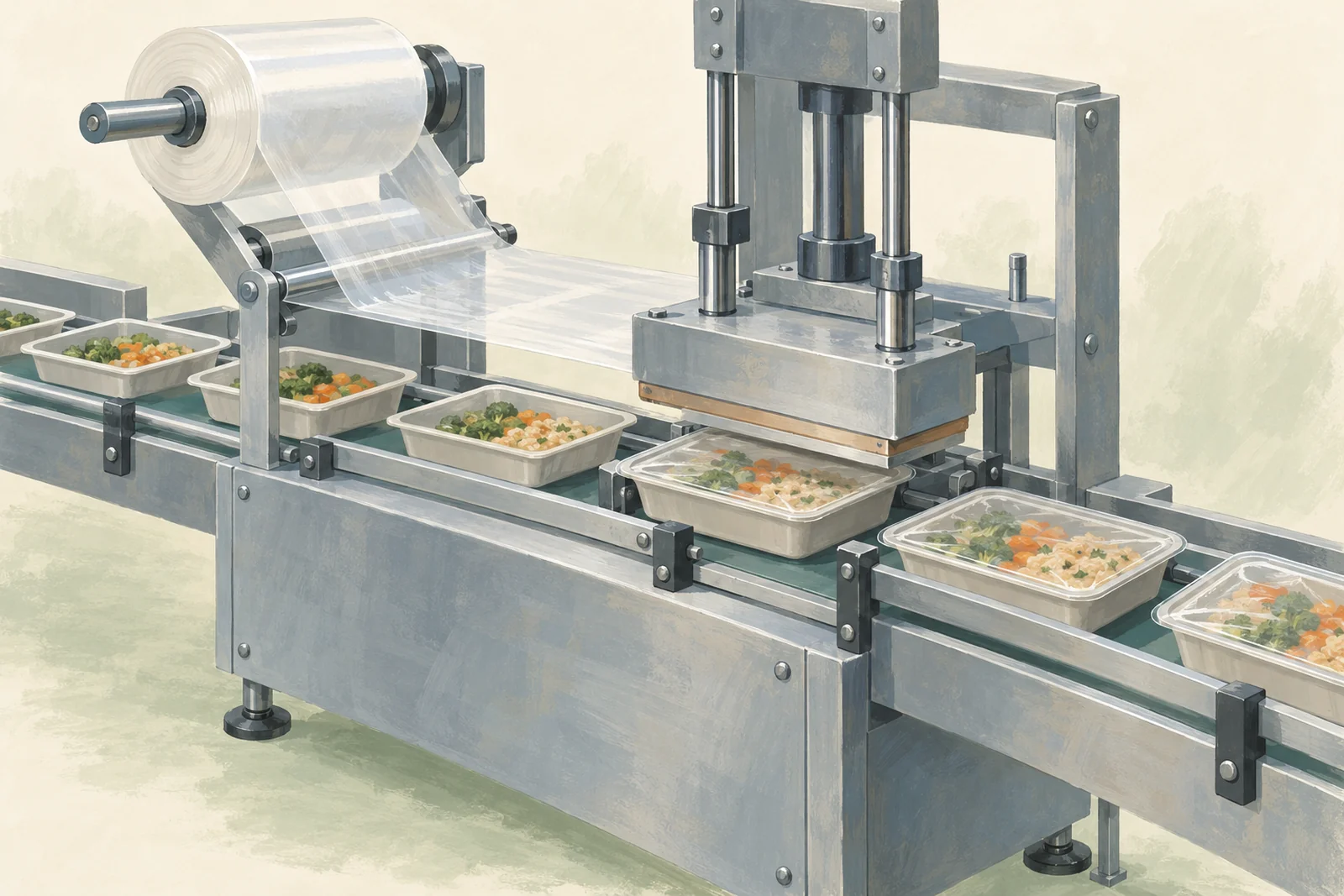
What this article covers
Choose the tray and film combination, sealing mode and automation level around the product and net-output target. Confirm the actual seal window, changeover and separate strength/leak results before accepting a machine.
Covered
- Tray sealing machine mechanics and automation tiers
- MAP and vacuum skin pack (VSP) chamber operations
- Tray substrate and lidding film seal compatibility
- Quality validation and supplier qualification
Not covered
- Thermoforming rollstock machine tool design
- Food recipe formulation and culture development
A mismatched film and tray can leave leaking seals; a machine chosen by brochure speed can miss the required good output. Start with the product, sealing mode, automation level and separate acceptance methods, then trial the actual tray/film combination.
This guide explains pre-formed tray sealing from public documents, not our equipment tests.
Scroll horizontally for any hidden columns →
| Input | Record / source | Selection use |
|---|---|---|
| Product | Food, preservation concept, storage and shelf-life target | Decide whether seal-only, MAP or VSP needs evaluation |
| Tray / film and mode | Actual SKU, flange drawing, sealant; supplier sealing window | Check material compatibility and required tooling |
| Automation | Good trays/shift; staffing; cleaning and changeover time | Compare sustained net output for this tray and mode |
| Validation | Strength and leak methods; MAP gas target if used | Agree test limits and records before FAT |
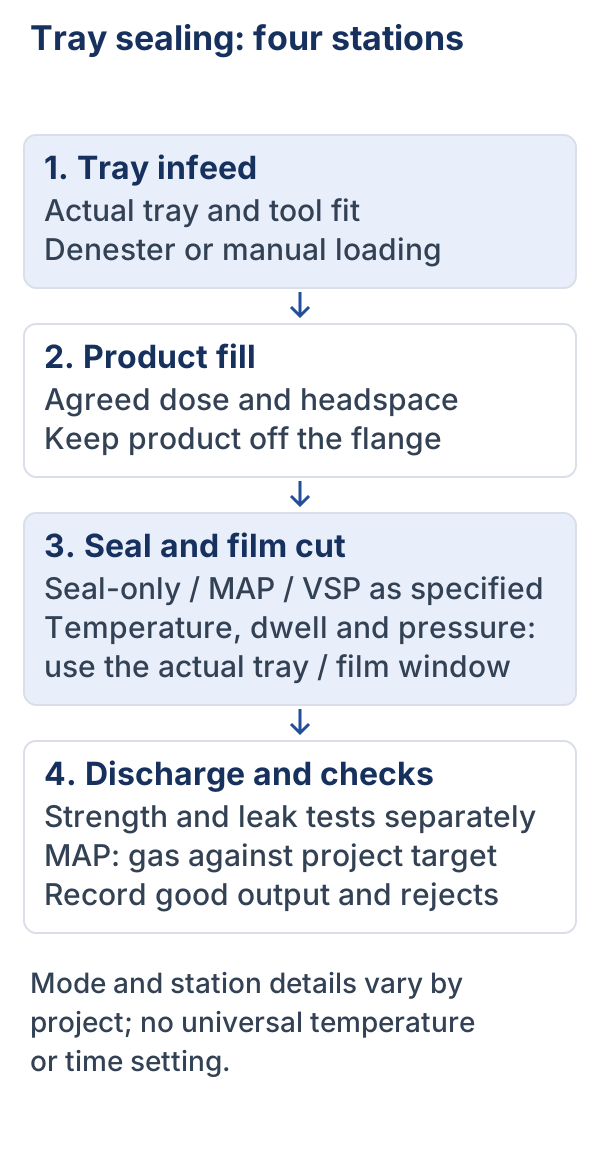
Machine Automation Tiers: Tabletop to Continuous Inline
Scroll horizontally for any hidden columns →
| Automation candidate | Operator / machine work | Check on this project |
|---|---|---|
| Manual / tabletop | Operator loads, starts the sealing cycle and unloads | Timed full cycle and repeatable good output |
| Semi-automatic | Operator loads/unloads; machine performs the configured cycle | Loading overlap, waiting and actual sealing mode |
| Automatic inline | Configured infeed and indexing with sealing/discharge | Tool cavities, tray handling and full-line bottleneck |
Throughput figures in brochures depend on tray size, tool cavities, product and whether vacuum and gas flushing are used; manufacturers often quote an “up to” cycle rate, and at least one notes that maximum output varies by machine model. Ask each supplier for the rated output for your tray and sealing mode, and confirm it at the factory acceptance test (see the packaging machine FAT checklist).
Sealing Modes: Seal-Only, MAP, and Vacuum Skin Packaging (VSP)
The preservation objective determines the tooling chamber technology:
Scroll horizontally for any hidden columns →
| Sealing Technology | Process Mechanics | Shelf-Life Impact | Typical Applications |
|---|---|---|---|
| Standard Heat Seal | Heated profile tool presses lidding film against tray flange under pressure. Temperature, dwell and pressure are set within the lidding film supplier’s sealing window for the tray material. | Closes the pack against contamination and spills; protection depends on seal integrity and the film and tray barrier. | Bakery goods, fresh cut produce, grab-and-go deli items. |
| Vacuum Gas Flush (MAP) | Chamber closes; vacuum pump removes air; food-grade gas mix (for example N2/CO2) is flushed in; heated seal and perimeter cut. | Can extend shelf life together with chilled storage and barrier tray and film. The residual-oxygen target and the shelf life must be set and verified for each product. | Fresh red meat, cooked pasta, fresh pasta, sliced hard cheeses. |
| Vacuum Skin Pack (VSP) | Lidding film is heated until soft, draped over product, and drawn tightly around contours using vacuum, sealing across the tray bed. | Film holds the product in place and follows its shape; any effect on purge, freezer quality or shelf life must be validated for the product. | Premium steaks, fresh fish fillets, ready-to-cook poultry. |
Material Compatibility: Trays & Lidding Substrates
Match the tray flange and the film’s sealant using documentation for the actual combination. A material name alone does not establish microwave, oven or compostability status.
- CPET: request intended-use conditions for the finished tray, plus the compatible lidding sealant and process window.
- PP: confirm any microwave claim for the chosen SKU and food/reheating conditions; trial the specified film rather than prescribing one sealant chemistry for every PP tray.
- Molded fiber / bagasse: identify the liner or coating, compatible film and finished-item disposal evidence. Fiber origin alone does not establish compostability.
Manufacturer-document examples, not recommendations. One manufacturer’s September 2023 brochure describes PP Oval Processor Tray SKUs 73080240D and 73080320D as microwave-safe for reheating and film-sealable, but supplies no time/power rating. Its April 2024 release describes Pulp 2S Produce and Pulp 3P Protein trays as commercially compostable and film-sealable. These claims concern those products; obtain current intended-use limits and certificate coverage for the chosen tray, lid and film. They are not our test results.
Use the bottle-material requirements guide for the distinction between heat, barrier and handling evidence, and compostable packaging for finished-item coverage and facility acceptance.
Buyer’s Qualification & Acceptance Checklist
Before issuing final purchase approval for a tray sealing machine, verify these technical parameters:
- Chamber Evacuation Speed: Confirm vacuum pump capacity (m³/hr) reaches the vacuum level your product and gas-flush specification require within the planned cycle time.
- Flange Seal Width: Verify the sealing profile gives a continuous seal of the width specified for your tray, without thin spots at tray corners.
- Clean Flange Protocol: Verify the filling setup keeps product off the sealing flange in representative runs; record splash, drip and reject checks.
- Tool Changeover Time: Measure total changeover time between different tray depths and footprints against the target in your purchase specification.
- Cleaning protection: Obtain the enclosure and washdown documentation for the exact machine and cleaning method; agree the applicable protection requirement for the project.
- Seal strength and leaks, separately: Agree a strength limit and a separate leak-test method and sample plan. For MAP, add residual gas checks against the project’s target.
Copy the acceptance results into the packaging machine FAT checklist, with a method, criterion, raw record and owner for each open check.
Common questions on changeover and checks
What is the changeover time between my tray formats, and what tooling does each format require?
Time the complete change between your tray formats, including tooling, film, recipe, cleaning and restart checks. A tooling-only demonstration does not establish the time until acceptable packs resume.
What are the disadvantages of modified atmosphere packaging?
For selection, MAP adds a gas/vacuum cycle and checks that seal-only output does not represent. Compare good output in the intended mode, and validate residual gas, seal integrity and product shelf life under the planned storage conditions. No universal gas target or shelf-life extension is established here.
How can I test for leaks in packaging material?
Ask the quality team or test lab for a method validated for this tray. ASTM D3078 covers gross leaks in flexible packs containing headspace gas; small leaks can escape detection and product can block a leak path. A pass does not prove hermeticity. F88 measures seal-separation force and failure mode, so it cannot replace the leak check.
Sources and method
This article is based on documentary research of the sources listed. It is not a hands-on equipment test. Supplier statements and editorial judgement are identified in the text.
- ASTM F88/F88M Standard Test Method for Seal Strength of Flexible Barrier Materials Supports: F88 measures the force required to separate a test strip containing the seal and records the failure mode. Seal strength supports closure but is not a leak test.
- ASTM D3078 Standard Test Method for Determination of Leaks in Flexible Packaging by Bubble Emission Supports: gross-leak bubble-emission testing of flexible packaging with headspace gas; small leaks can escape detection and product can block a leak path. Public scope re-read October 8, 2026.
- High-performance, premium-quality SKIN tray sealing Supports: tray sealer output is quoted as 'up to' a cycle rate and the manufacturer notes that maximum output varies by machine model; recipe-based parameter settings.
- Polypropylene Oval Processor Trays: September 2023 brochure Supports: PP SKUs 73080240D and 73080320D described as microwave-safe for reheating and film-sealable; no time/power limit is supplied. Read October 8, 2026.
- Pulp Produce and Protein Trays launch Supports: named Pulp 2S Produce and Pulp 3P Protein trays described as commercially compostable and overwrap/film-sealable. Does not establish coverage for a chosen lid/film. Read October 8, 2026.
More in Equipment

How to Choose a Liquid Filling Machine for Food and Beverages
A buyer's framework for choosing a liquid filling machine: project inputs, filling approaches compared, what to validate with samples, and supplier questions.
Read the guide
Liquid Filling Methods Compared: Gravity, Piston and Flowmeter-Based Systems
Compare liquid filling methods by metering principle, product feed and machine structure: gravity, overflow, piston and flowmeter systems and their limits.
Read the guide
Bottle Capping Machine Selection: Caps, Torque and Changeover
How to match a capping machine to the closure and bottle finish: cap types, application vs removal torque, heads, change parts and pre-purchase validation.
Read the guide