
SIG Neo Aseptic Carton Fillers: What Food Teams Should Check
Read SIG’s new carton-filler announcement through food category, pack format, catalog-speed baselines and the validation records still needed for a project.
What this article covers
Use the SIG Neo announcement to identify application questions, not to assume food safety, line capacity or US delivery.
Covered
- Announced models and food-team implications
- Conditional public-catalog comparison
- Validation and procurement timing
Not covered
- Independent performance validation
- Prices, lead times and US availability claims
- Prescriptive aseptic process settings
An expansion plan can waste time if a carton-filler headline is treated as a validated production specification. SIG has announced two new Neo aseptic carton fillers; food teams should match the announced carton families to their product and validation needs before using the speed figures in a line plan.
The SIG Neo aseptic carton filler news concerns separate single-serve and multi-serve formats, not a universal replacement for every filling process. For US dairy, beverage and liquid-food teams, our reading is that the immediate task is an application review: identify the food, the carton and the required evidence. The October announcement supplies machine-level claims, while a project still needs its own package, process and line documentation. Start with the equipment guides if the preservation route or equipment scope is still being defined.
- Identify single-serve versus multi-serve packaging before comparing models.
- Keep catalog rates separate from accepted finished-line output.
- Ask which comparison baseline supports the improvement headline.
- Establish US supply and project-validation milestones in writing.
What did SIG announce?
SIG’s October 1, 2026 release identifies Neo XSlim 32 Aseptic for single-serve XSlimBloc cartons and Neo Midi 15 Aseptic for multi-serve MidiBloc or MidiFit cartons. The following are announced specifications, attributed to SIG, rather than independently measured performance.
Scroll horizontally for any hidden columns →
| Announced model | Carton family | SIG’s stated rate | Size or format scope |
|---|---|---|---|
| Neo XSlim 32 Aseptic | XSlimBloc | 32,000 cartons per hour | Up to nine pack sizes |
| Neo Midi 15 Aseptic | MidiBloc or MidiFit | 15,000 cartons per hour | Two shapes, each with three pack sizes |
SIG also claims pack-size or format changes below 15 minutes without changing machine parts, waste below 0.5%, and up to 95% removal of air particles with Neo Shield in the bottom-sealing and pre-folding context. The changeover figure is not a recipe-change or full-cleaning time. Those are supplier claims. Request the measurement scope before using them as acceptance criteria.
The number of supported sizes does not identify their individual volumes. A buyer should list each intended SKU and ask which combinations the quoted configuration covers. The liquid-filling selection guide explains how to translate product and pack requirements into equipment questions.
Takeaway: Treat each model’s carton family and stated rate as the beginning of a specification review.
Who is affected, and what changes for the food team?
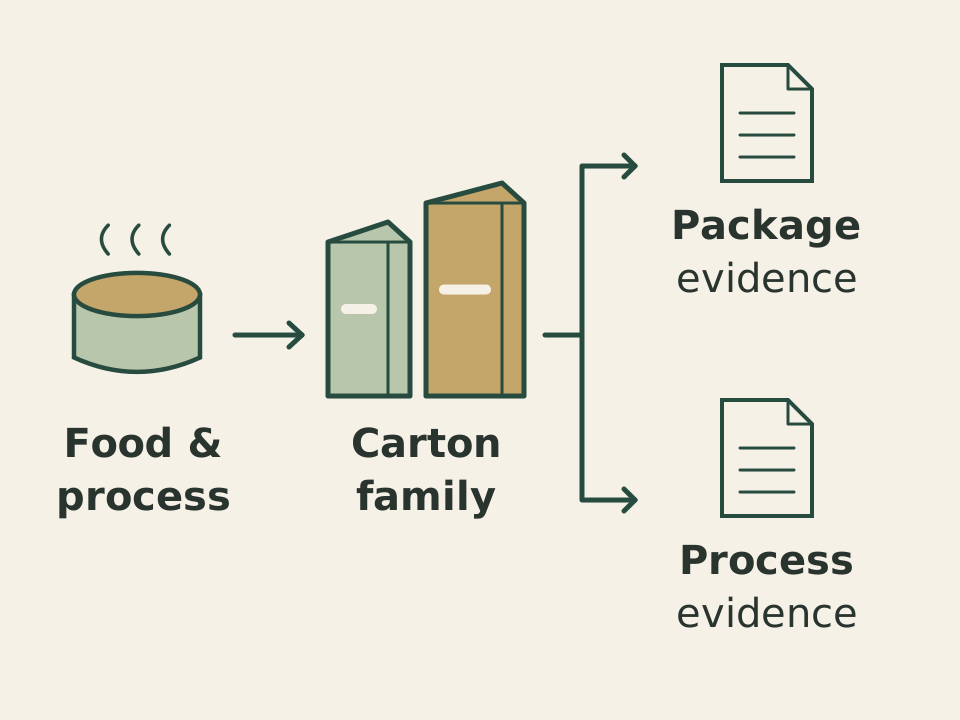
Teams evaluating sleeve-based aseptic cartons have a reason to revisit their shortlist. The application work starts with the food and preservation route, then the carton. SIG’s general filling-technology page names dairy and plant-based beverages, non-carbonated soft drinks and liquid foods for its standard systems; that context does not approve every recipe on the new models.
Scroll horizontally for any hidden columns →
| Food-team situation | Packaging decision to revisit | Project evidence to seek |
|---|---|---|
| Milk in single-serve cartons | Whether the target carton and product match the XSlim proposal | Product-specific process and package validation plan |
| Plant-based drink with several SKUs | Which recipes, sizes and changeovers the configuration covers | SKU matrix and agreed changeover demonstration |
| Juice in multi-serve cartons | MidiBloc versus MidiFit package requirements | Carton/closure specification and product trial scope |
| Soup or other liquid food | Whether the actual recipe falls inside the offered application | Written limits for the product and proposed configuration |
For milk, first separate the distribution and preservation routes described in the milk packaging guide. For juice, use the juice filling and packaging guide to identify the process questions before narrowing the carton machine. Neither a carton shape nor an aseptic label independently establishes shelf life for a particular recipe.
Our editorial recommendation is to carry a product matrix into the discussion: recipe identity, intended pack, processing route, distribution conditions and validation owner. Mark unresolved conditions explicitly. This prevents a procurement comparison from silently treating two distinct food projects as equivalent.
Common mistake: Selecting a filler because its carton count is higher before confirming that the proposed configuration covers the food and every intended SKU.
Takeaway: The relevant shortlist is product-and-carton specific; the headline alone cannot establish application suitability.
What does the capacity comparison actually show?
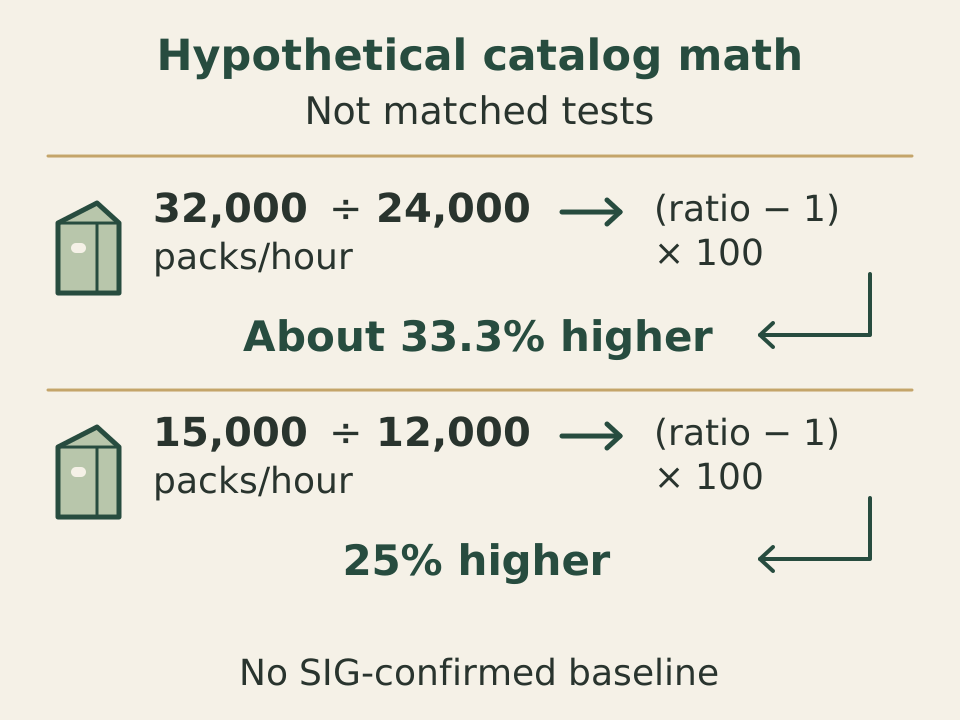
The release claims a one-third improvement in total output and output per area, but does not identify a named baseline model. Public SIG catalog numbers allow illustrative arithmetic. They do not establish which machines SIG used for its improvement claim or whether the compared configurations have equal footprint, product, carton volume or operating conditions.
Scroll horizontally for any hidden columns →
| Hypothetical catalog comparison | Inputs from public SIG material | Our calculation | Limit |
|---|---|---|---|
| XSlim 32 against Smile 24 | 32,000 versus 24,000 packs/hour | (32,000 ÷ 24,000 − 1) × 100 ≈ 33.3% | Different named carton families; not a matched trial |
| Midi 15 against standard Midi 12 | 15,000 versus 12,000 packs/hour | (15,000 ÷ 12,000 − 1) × 100 = 25% | Does not confirm a one-third baseline |
These are our hypothetical calculations from catalog figures checked on October 8, 2026, not additional SIG statements. The directory names Smile 24, while the medium-size equipment page identifies Midi 12 within its range. Catalog rates are not proof of good output for your production run. No square-meter improvement is calculated here because a matched area specification is absent from the announcement.
For a plant review, identify what sits before and after the filler. Product supply, carton handling, closures and secondary packing belong in the proposed line scope. Use the packaging line cost guide to record the integration responsibilities, and the filling-method comparison to keep a filling principle distinct from the complete packaging system.
Takeaway: The arithmetic is reproducible, but the improvement baseline and usable line capacity still require project-specific evidence.
When should a buyer act?
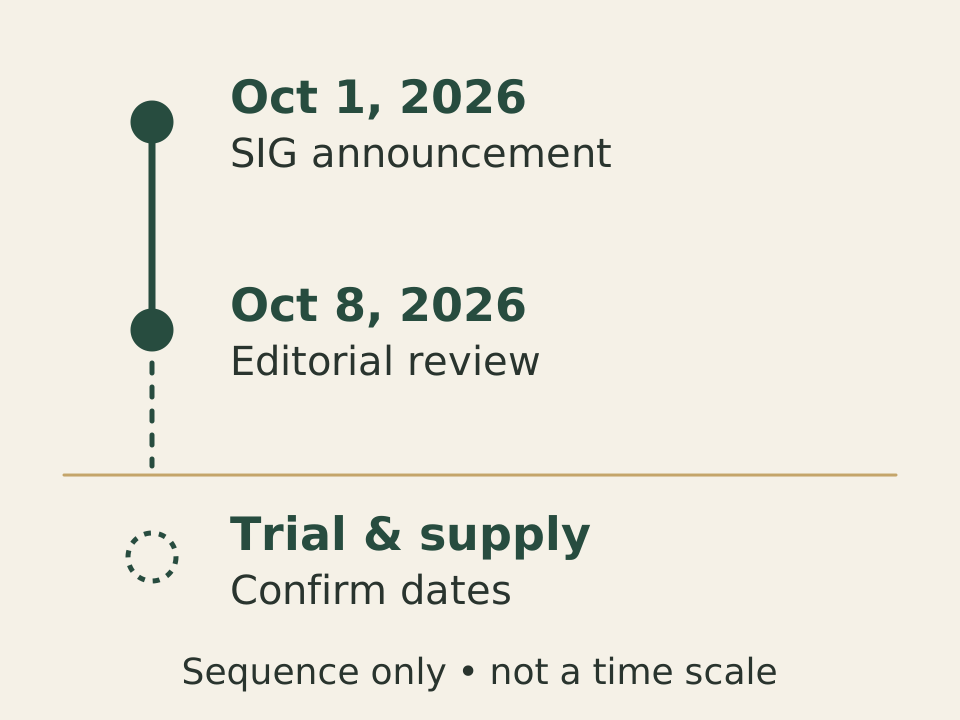
Begin by clarifying application and supply conditions; reserve investment and commissioning dates for documented commitments. The announcement date is a reporting milestone. It is not a disclosed US ordering date, trial date or delivery promise. A supplier response can turn those open questions into project milestones without guessing a launch schedule.
Scroll horizontally for any hidden columns →
| Milestone | Date or status | Source nature and action |
|---|---|---|
| SIG announces the two models | October 1, 2026 | Company release; identify relevant carton family |
| This application review | October 8, 2026 | Editorial review; compile food and SKU questions |
| US quotation and trial access | Confirm with SIG | Obtain written supply and trial scope |
| Equipment delivery and commissioning | Project-specific, not stated in the release | Agree dates after technical and commercial scope |
Before committing a production change, identify who owns the package and process checks. The packaging RFQ checklist provides a structure for assigning responsibilities. The factory acceptance checklist helps distinguish what can be demonstrated at the supplier from what needs the installed production environment.
Takeaway: An announcement supports investigation now; it supplies no dependable US delivery calendar.
What remains open before a procurement decision?
Convert promotional statements into questions with named document owners. Our suggested checklist asks for the information needed to evaluate food protection, pack integrity and the production scope. An equipment demonstration should have an agreed record; it does not automatically replace the food team’s broader validation responsibilities.
Scroll horizontally for any hidden columns →
| Open item | Who can clarify it | Document or record to seek |
|---|---|---|
| Exact carton volumes and closure options | SIG and package supplier | Configuration-specific SKU/pack matrix |
| Food and package compatibility | Food technical team with supplier | Application review and validation plan |
| Improvement baseline and area definition | SIG | Named reference configuration and footprint drawing |
| Waste and changeover definitions | SIG with production team | Test window, included losses and start/stop rules |
| Air-particle claim and sterile process relevance | SIG and food technical team | Measurement method and process-validation scope |
| Existing-line upgrade or retrofit | SIG and plant engineering | Written compatibility assessment |
| US support, supply and timing | Supplier’s US commercial/service team | Project-specific written terms |
Keep the applications overview nearby when turning those questions into a food-specific brief. If the project involves cultured products rather than the assumed beverage, review yogurt packaging before extending the carton shortlist to it.
Takeaway: Each open claim needs a document owner and a defined review, not a stronger adjective in the specification.
When this does not apply
This review is not a recommendation to replace a hot-fill, chilled or retort route with an aseptic carton line. It gives no process temperatures, holding times, validation limits or food-safety assurance. It also makes no claim that installed SIG lines can be upgraded, that every carton size is covered, or that the announced equipment is available in the United States.
Common mistake: Treating particle removal as a stand-alone measure of food safety. Preserve the claim’s air-measurement scope and have the food technical team define the complete verification requirement.
Takeaway: Revisit the shortlist only where the actual food, carton and preservation route support an application review.
FAQ
What is meant by aseptic packaging?
SIG describes a system that heat-treats and cools the liquid food, then fills sterile packs in a sterile chamber. This explains the linked food, package and filling-environment requirements; the model name alone does not validate a particular product or storage period.
What are the different types of aseptic packaging?
SIG’s company overview includes cartons, bag-in-box and spouted pouches. This article covers the two announced carton fillers only. Comparing other formats requires their own product and process specifications rather than carrying the Neo carton rates across to a different package.
Is aseptic sterile or clean?
In SIG’s description, the requirement includes sterile packs and a sterile filling chamber, beyond a general cleanliness check. Keep those specified conditions distinct from an ordinary cleaning record. Your food technical team defines the necessary validation; this article sets no microbiological acceptance limits.
Method and evidence boundaries
The company release establishes what SIG announced. The catalog pages supply the stated speed inputs for our explicitly hypothetical arithmetic. This is an application checklist assembled from public documents, checked October 8, 2026; it is not a site test, supplier endorsement or independent verification of operating results. References and related guides are rendered below.
Sources and method
This article is based on documentary research of the sources listed. It is not a hands-on equipment test. Supplier statements and editorial judgement are identified in the text.
- SIG introduces new high-speed, high-flexibility SIG Neo filling machines for aseptic cartons 2026-10-01 company announcement; capacities and operational claims are not independently verified. Retrieved 2026-10-08.
- Carton filling technology Public catalog speed baselines; hypothetical arithmetic, not confirmation of the release comparison. Retrieved 2026-10-08.
- Bloc/Fit multi-serve aseptic filling equipment Catalog associates Midi 12 with the multi-serve range; published capacity, not a matched trial. Retrieved 2026-10-08.
Next reading
Milk Packaging Formats: Bottles, Cartons and Pouches
How to choose a milk packaging format by heat treatment, cold chain and light exposure, and what bottle, carton and pouch formats mean for filling equipment.
Read the guide
Juice Filling and Packaging: Choosing a Process Before a Machine
Plan juice packaging product-first: chilled, hot fill, HPP or aseptic, then container and filler. Concepts only; process validation stays with the processor.
Read the guide
Factory Acceptance Testing for Packaging Equipment: Planning the Checks
Finding defects after shipment can delay installation. Prepare a FAT protocol, representative materials, raw test records and an agreed punch list.
Read the guideMore in Equipment

How to Choose a Liquid Filling Machine for Food and Beverages
A buyer's framework for choosing a liquid filling machine: project inputs, filling approaches compared, what to validate with samples, and supplier questions.
Read the guide
Liquid Filling Methods Compared: Gravity, Piston and Flowmeter-Based Systems
Compare liquid filling methods by metering principle, product feed and machine structure: gravity, overflow, piston and flowmeter systems and their limits.
Read the guide
Bottle Capping Machine Selection: Caps, Torque and Changeover
How to match a capping machine to the closure and bottle finish: cap types, application vs removal torque, heads, change parts and pre-purchase validation.
Read the guide