
Jam Packaging: Jars, Portion Cups and Sachets for the Recipe You Fill
Match a jam jar, portion cup or sachet to the filler and closure you already run. Record fruit pieces and viscosity before booking a sample trial.
What this article covers
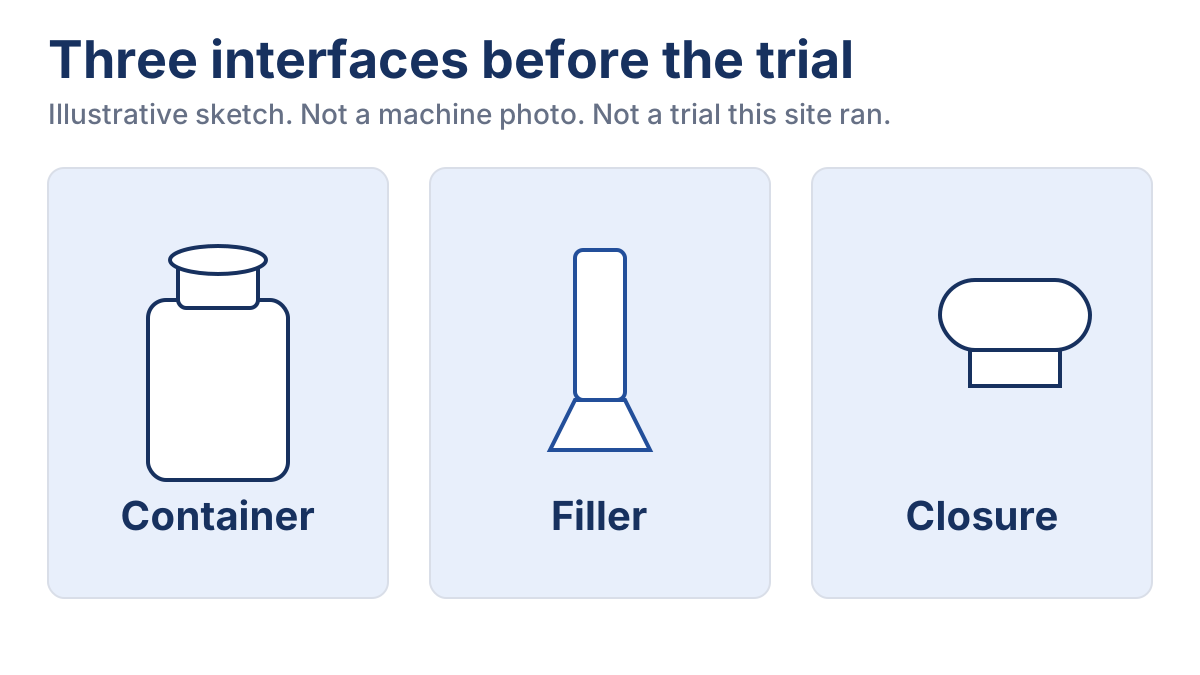
A jam brand choosing a retail jar or a single-serve pack can schedule a sample trial only after the container, the fruit pieces and the filler and closure already on the line are written on one sheet.
Covered
- Retail jar, portion cup and formed sachet as container and closure pairs
- A blank sample record for fruit pieces, viscosity and the fill conditions already set
- Open items on the container, filler and closure interfaces for the recipe in hand
Not covered
- Hot-fill temperatures, acidification formulas, sterilization steps, shelf life and food-safety conclusions
- A catalog of stand-up, spouted or retort pouches
- Production rates, prices and any claim that a listing has been trialled on this site
A jam jar that leaks at the cap, or a single-serve seal that catches fruit on the rim, wastes the sample before the recipe can be judged. Record the container, the fruit pieces and the filler you already run, and keep that sheet with the product you will pack.
Match the jam container to the filler and closure you already run, and write the fruit pieces and viscosity from that recipe before a sample trial is booked. A retail jar, a portion cup and a formed sachet use different closures. Three public listings from MIC Machinery, fetched on 8 October 2026, describe a piston-filled bottle that then goes to a screw cap, a preformed cup that is film-sealed and covered, and a bag that is formed, filled and back-sealed. Those pages are one manufacturer’s catalog, so they are one source, not three separate trials. They give no fruit-piece limit and no viscosity number for jam. Where a title and a parameter table disagree on rate, this page leaves the rate out. The sheet below is filled from the batch and the line you already have.
The applications section starts from the product rather than the machine. See food and beverage packaging by application for that order. This page stays on the jam container and the fill and closure check for the recipe you will pack.
Scroll horizontally for hidden columns. The first column stays in view.
| Input or item | What to write down | Why it decides the trial |
|---|---|---|
| Recipe batch | Name of the jam and the day you will pack the sample | The trial is this batch, not a generic jam |
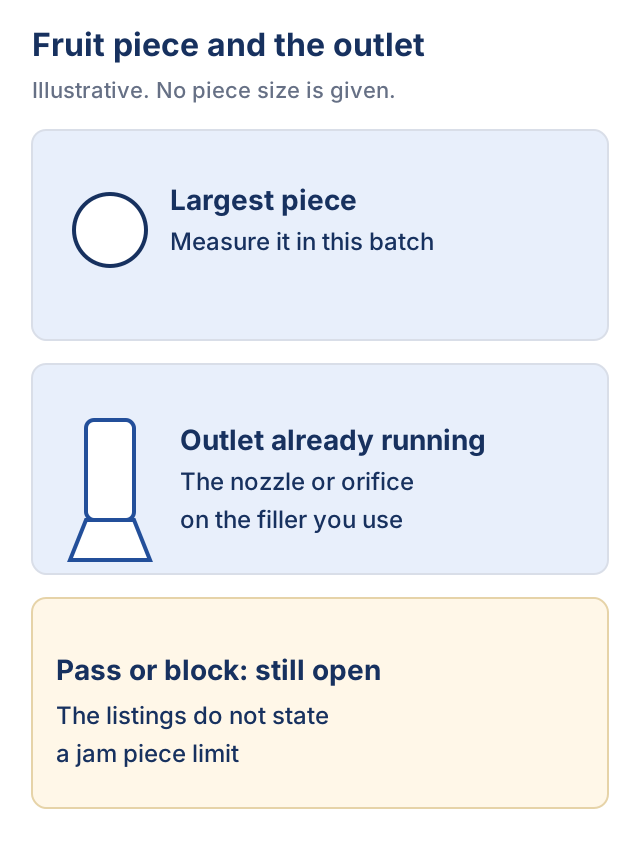
| Largest fruit piece | The longest piece you measure in that batch, or blank if you have not measured one | The outlet has to pass it. The listings state no piece limit |
| Viscosity | The value, unit and method you already use, or “not measured” | The bottle listing calls the class high viscosity and gives no number |
| Container and closure already running | Jar and screw cap, cup with film and cover, or back-seal sachet | The sample follows the process you run |
| Outlet and dose already set | Nozzle or orifice and the dose setting written on the line | A setting that is not written down stays an open item |
Which container and closure pair matches the line you already run?
Start with the container and closure the line already uses. If that line fills a jar and applies a screw cap, the trial pair is that jar and cap. If it drops a cup, seals film and places a cover, the trial pair is that cup, film and cover. If it forms a back-seal sachet, the trial pair is that film and that seal. A listing that names jam, sauce and honey does not move a recipe from one pair to another.
Scroll horizontally for hidden columns. The first column stays in view.
| Container | Closure the listing describes | Filler interface the listing describes | Fruit-piece check |
|---|---|---|---|
| Retail jar or bottle | Screw cap after filling | Piston from a cylinder to a fill pipe. The fill-head diameter follows the container mouth. Page-specific table: bottle diameter 40 mm to 100 mm | Not stated. Measure the piece against the outlet you run |
| Portion cup | Film seal, then a placed cover | Piston fill into a preformed cup, with the cup lifted during filling | Not stated for jam. A separate device on the same page is described for small granules on hummus |
| Formed sachet | Back seal | Form the bag, measure, fill, seal, count. An optional date code is described | Not stated. Piece passage is an open item for your film and your outlet |
The jar row follows the MIC-ZF8 bottle page fetched on 8 October 2026. That page’s title includes jam, sauce and honey. The viscosity sentence on the same page names butter, cream, liquid soap and lotion as high-viscosity examples, so “high viscosity” there is the manufacturer’s class label, not a measurement of your jam. The page-specific table states a suitable bottle diameter of 40 mm to 100 mm. The cup and sachet listings are outside that sentence. Treat 40 mm to 100 mm as that bottle listing’s window, then check it against your jar drawing.
The same bottle page says the fill-head diameter is based on the mouth of the container, and that a conveyor takes the filled bottle to a screw-cap station. Matching a screw cap to a jar finish is covered in bottle capping machine selection. This page does not set a torque.
The cup row follows the MIC cup page fetched the same day. It describes cup drop, detection of an empty cup, piston filling, film sealing and cutting, placement of a cover, and discharge. Station order for a cup fill-seal machine is listed in yogurt cup filling and sealing. That checklist is about yogurt cups. It is not evidence that this jam will seal on the same film. The cup page also describes a measuring-cup device for small granules on hummus. That sentence is not a jam piece size.
The sachet row follows the MIC sachet page fetched the same day. The machine is described as forming the bag, measuring, filling, sealing, counting and, on request, printing a date code. The sachet-specific table names back sealing, a bag length of 20 mm to 160 mm and a bag width of 20 mm to 100 mm. The feature text says Paper/PE, PT/PE, PET/AL/PE, BOPP/PE, tea filter paper and other heat-sealable compounds can be sealed. The parameter row on the same page lists paper/polyethylene, nylon/polyethylene and tea filter paper. Those two film lists are not the same list. The film for your trial is the one you will actually run, written on the sample record. Stand-up, spouted and retort pouches are outside this page. They are sorted by product in pouch packaging for food.
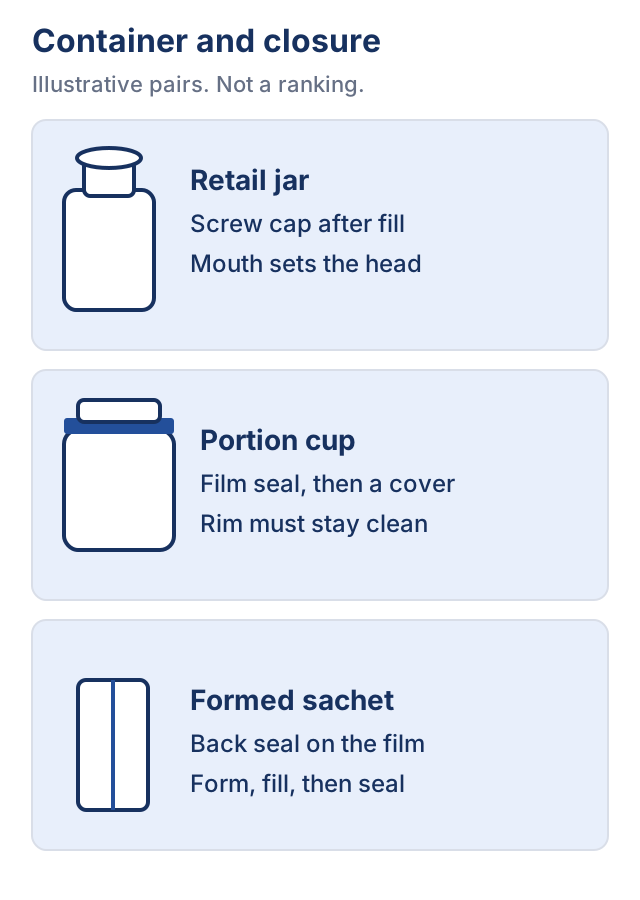
Takeaway: Book the sample on the jar, cup or sachet you already run. Use the other two rows only to see which interface would change.
The piston described on the bottle and cup listings meters a cylinder volume. How that differs from gravity filling and from flowmeter filling is explained in liquid filling methods. This page does not restate those methods. If your line uses a different meter, write that meter on the record. The MIC pages then describe a candidate interface, not the machine you have.
What goes on the sample record for fruit, viscosity and the fill you already run?
Copy one record per batch, per container and per filler setting. Leave a cell blank when the batch has not been measured. A blank is more useful than a number taken from a catalog.
Scroll horizontally for hidden columns. The first column stays in view.
| Field | Write this from the batch you will pack | Leave it blank when |
|---|---|---|
| Product | Jam name, batch and the date of the sample | The trial jam is not the jam named here |
| Largest fruit piece | Longest dimension you measure on pieces in this batch, and whether those pieces are soft or firm | No piece from this batch has been measured |
| Piece content | Smooth, or pieces mixed through, in the words your plant already uses | The batch in the trial is a different texture |
| Viscosity | Value, unit and method you already use. If you do not measure it, write “not measured” | You would be inventing a number for this sheet |
| Container | Drawing or a measured mouth, rim or sachet size, plus the closure that mates to it | The drawing is not the container in the trial |
| Filler already set | Outlet size, dose setting and the meter type on the line today | The setting is not written down |
| Closure already set | Screw cap, film plus cover, or back seal, including the film name you run | The closure in the trial is a different part |
| Result | Empty until the sample is packed and inspected | The row is still a plan |
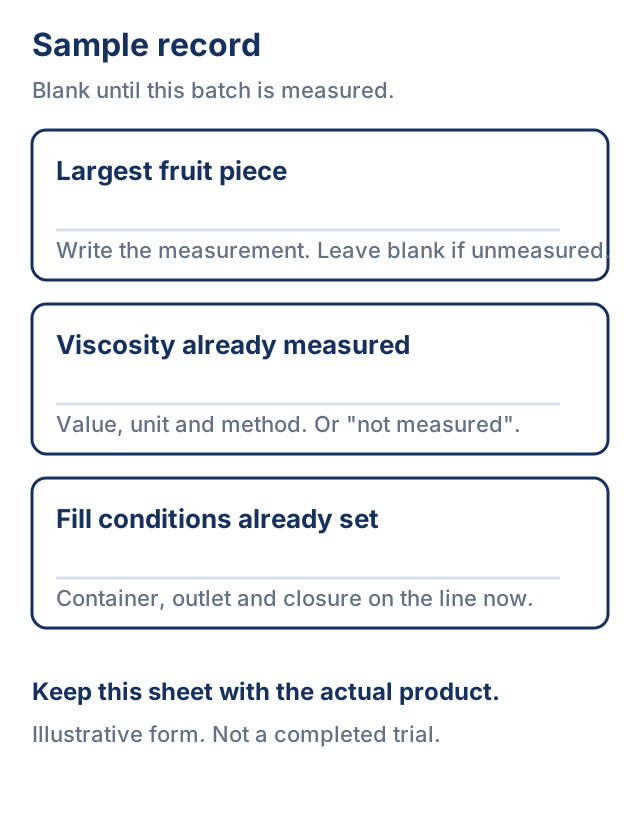
Takeaway: The record is finished when every filled cell comes from this batch and this line. Cells you cannot measure stay blank.
A completed record can later become acceptance checks. The factory acceptance test checklist is the place for those checks after the sample, not a substitute for the jam and the sheet.
Which interface is still open after the public listings?
The listings name the three interfaces. They do not close them for your recipe. Read each row as a question the sample still has to answer.
Scroll horizontally for hidden columns. The first column stays in view.
| Interface | What the 8 October 2026 listings support | Still open on your recipe |
|---|---|---|
| Container | A bottle diameter of 40 mm to 100 mm on the piston-bottle table. A formed bag of length 20 mm to 160 mm and width 20 mm to 100 mm on the sachet table. No cup diameter on the cup page. Two film lists on the sachet page that do not match each other | Your drawing, your film and whether that listing’s window applies to the container you will pack |
| Filler | Piston fill on the bottle page and the cup page. Form, measure and fill on the sachet page. Fill-head diameter tied to the container mouth on the bottle page | The largest piece in this batch against the outlet you already run. The viscosity you already measure, or an honest “not measured” |
| Closure | Screw cap after the bottle fill. Film seal plus a cover on the cup. Back seal on the sachet | Whether fruit, seeds or jam sit on the rim or in the seal when your product is filled on your line |
Takeaway: Schedule the trial only when the open cells are either filled from the batch or explicitly blank. A rate from a page title does not close any cell.
Keep the actual product and the packaging-sample record together. The sample compares that pair. A sheet without the jam, or a jar without the sheet, is not ready to book.
Method and sources
The container, filler and closure descriptions come from three MIC Machinery pages accessed on 8 October 2026: the MIC-ZF8 piston bottle and capping page, the formed-bag jam filling page, and the cup filling and sealing page. They are one manufacturer’s listings. Agreement among them is not three independent performance results.
Each of those pages carries a rate in the title or the body and a parameter table that does not support the same rate. The bottle title and the bottle’s own speed line also sit beside a multi-model table with other speeds. This page therefore uses no bottles-per-hour, cups-per-minute, sachets-per-minute or cups-per-hour figure. Fill-volume ranges that appear as unsorted lists across models are left out for the same reason. The diameter and bag-size figures above are taken only from the page-specific table on the matching listing.
No hot-fill temperature, acidification formula, sterilization step, shelf life or food-safety result is stated, because those pages do not establish them for this recipe and this site has not run the product. Historical index hits for jamon, the cured ham, are not jam and are not used. Real fit of your product, your container and your film still requires the sample trial on the record above.
Sources and method
This article is based on documentary research of the sources listed. It is not a hands-on equipment test. Supplier statements and editorial judgement are identified in the text.
- MIC-ZF8 Jam Packaging Machine (Jam, Sauce, Honey) Supports the bottle listing only: a piston path from a material cylinder through a measuring cylinder to a fill pipe, a fill head whose diameter follows the container mouth, a conveyor to a screw-cap station, and a page-specific bottle diameter of 40 mm to 100 mm. The page title and the multi-model speed table do not use the same rate, so no rate is used. Same manufacturer as the cup and sachet listings.
- MIC Jam Filling Machine (Jam, Honey, Sauce) Supports the sachet listing only: form, measure, fill, seal, count and an optional date code; back sealing; film names in the feature text and a shorter packing-material row; bag length 20-160 mm and width 20-100 mm on the sachet-specific table. The rate is omitted because this page also pastes a bottle-speed table.
- MIC Jam Packing Machine (Yogurt, Sauce, Jam) Supports the cup listing only: cup drop, cup detection, piston fill, film sealing, cover placement and discharge. A separate measuring-cup device is described for small granules on hummus, not as a jam fruit-piece limit. The body text and the parameter table do not state the same rate, so no rate is used.
Next reading
Liquid Filling Methods Compared: Gravity, Piston and Flowmeter-Based Systems
Compare liquid filling methods by metering principle, product feed and machine structure: gravity, overflow, piston and flowmeter systems and their limits.
Read the guide
Bottle Capping Machine Selection: Caps, Torque and Changeover
How to match a capping machine to the closure and bottle finish: cap types, application vs removal torque, heads, change parts and pre-purchase validation.
Read the guide
Pouch Packaging for Food: Stand-Up, Retort, Spouted and Pillow Pouches by Product
A pouch unsuited to heat processing can fail. Select by preservation route, product flow and use, then check film, fitment and filling compatibility.
Read the guideMore in Applications
Milk Packaging Formats: Bottles, Cartons and Pouches
How to choose a milk packaging format by heat treatment, cold chain and light exposure, and what bottle, carton and pouch formats mean for filling equipment.
Read the guide
Yogurt Packaging: Cups, Bottles and Pouches for Different Products
Match yogurt packaging to product type: set, stirred, drinkable or squeeze. Compare cups, bottles and spouted pouches and their filling and sealing needs.
Read the guide
Bottled Water Packaging Lines: From Prepared Containers to Packed Cases
Plan a bottled water packaging line from container supply to palletizing: rinsing, filling, capping, labeling, coding and the interfaces between stations.
Read the guide