
Flour VFFS Packaging: Auger Dosing, Dust and Sample Checks
Choose a flour bagging path by separating auger dosing from bag forming. Compare roll film with premade bags and record dust, sample weights and seal checks.
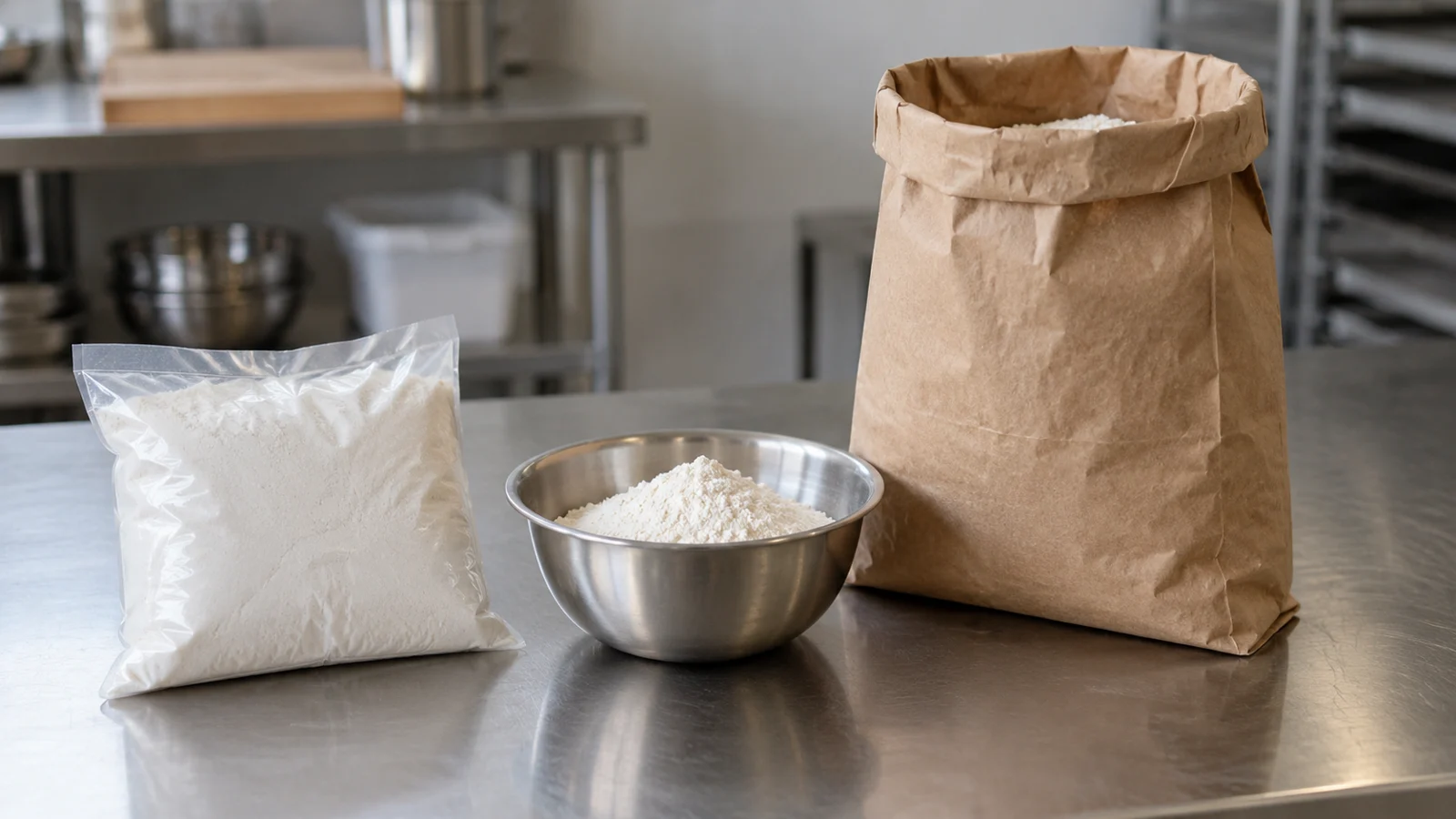
What this article covers
For flour producers choosing a bagging route: identify the dosing and bag-handling modules, then use actual flour and packaging samples to check weight, dust, seals and cleaning.
Covered
- Auger dosing and its interface with a roll-film bagger
- Roll-film, premade pouch and open-mouth sack boundaries
- A copyable flour sample record for weights, dust, sealing and cleaning
Not covered
- Universal bag-weight limits, speeds, tolerances or film specifications
- Machine rankings, prices and shelf-life predictions
- Dust-system engineering and certification of a production installation
Flour on a bag’s sealing margin can spoil the sample run before its filling accuracy has been judged. Start a VFFS machine for flour selection with an auger dosing module matched to a roll-film bagger, then check the actual flour, film and filling sequence together.
The auger meters the flour; the VFFS bagger forms and seals the bag. A premade pouch or an open-mouth sack needs a different bag-handling path. Naming both modules prevents a powder filler from being mistaken for a complete packaging line.
Scroll horizontally for hidden columns. The first column stays in view.
| Input or item | Record before choosing a candidate | Why it matters |
|---|---|---|
| Flour | Product name, ingredients and lot | The sample must represent the product being packed |
| Target fill | Required net mass and the team’s acceptance criteria | A catalog maximum is not a trial result |
| Package supply | Roll film, premade pouch or open-mouth sack | Determines how the bag arrives at filling |
| Dosing | Auger type, feed arrangement and any weight feedback | Identifies what measures and releases the dose |
| Sealing margin | Available clear area above the settled flour | Gives the trial a specific place to inspect |
| Unconfirmed settings | Unknown / verify on the unit | Avoids borrowing speed, tolerance or suction from another application |
The applications overview starts with the product and package. This guide narrows that approach to dry flour and its filling interface. Use the tables below to prepare a sample record, rather than select a machine from its name alone.
Choose the bag path before the machine size
Choose VFFS when the intended package is formed from roll film. Choose a premade-pouch filler when finished empty pouches arrive at the filling station. Treat an open-mouth flour sack as its own handling and closure project.
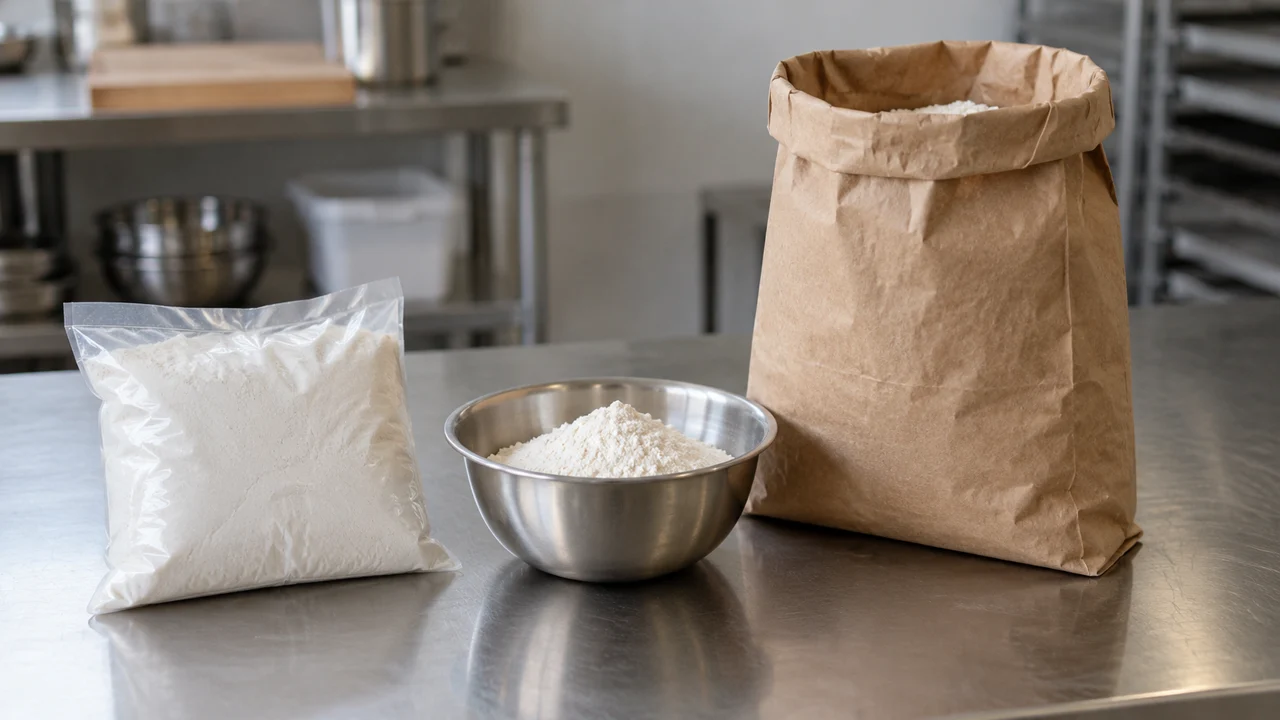
Scroll horizontally for hidden columns. The first column stays in view.
| Package arriving at the line | Candidate path | What needs confirming |
|---|---|---|
| A roll of compatible film | VFFS with an integrated powder filler | Forming set, film dimensions, bag style and filler interface |
| Finished empty retail pouches | Premade-pouch filling and sealing | Pouch opening, support during filling, seal access and powder dosing |
| Open-mouth sacks | Sack filling with a suitable closing system | Sack presentation, filling support, air removal and closure method |
Smartpack’s flour page separates a vertical line for pillow or gusset bags from a premade-pouch line. It also describes different bag-width change arrangements for those routes. That is a useful boundary: a similar finished shape does not prove that two machines receive the package in the same form.
For a sack example, Concetti describes its IGF flour equipment with premade bags and a stated range of 5–50 kg. Its flour route includes auger-fed weighing, de-aeration probes and sewing or pinch-top closure options. Those details belong to Concetti’s configuration. They do not set a weight at which every VFFS system becomes unsuitable.
For a heavier pack, ask which route handles the exact sack or film construction and supports the filled load. Weight alone cannot answer that question. The food pouch formats guide provides the broader format vocabulary.
Separate auger dosing from bag forming
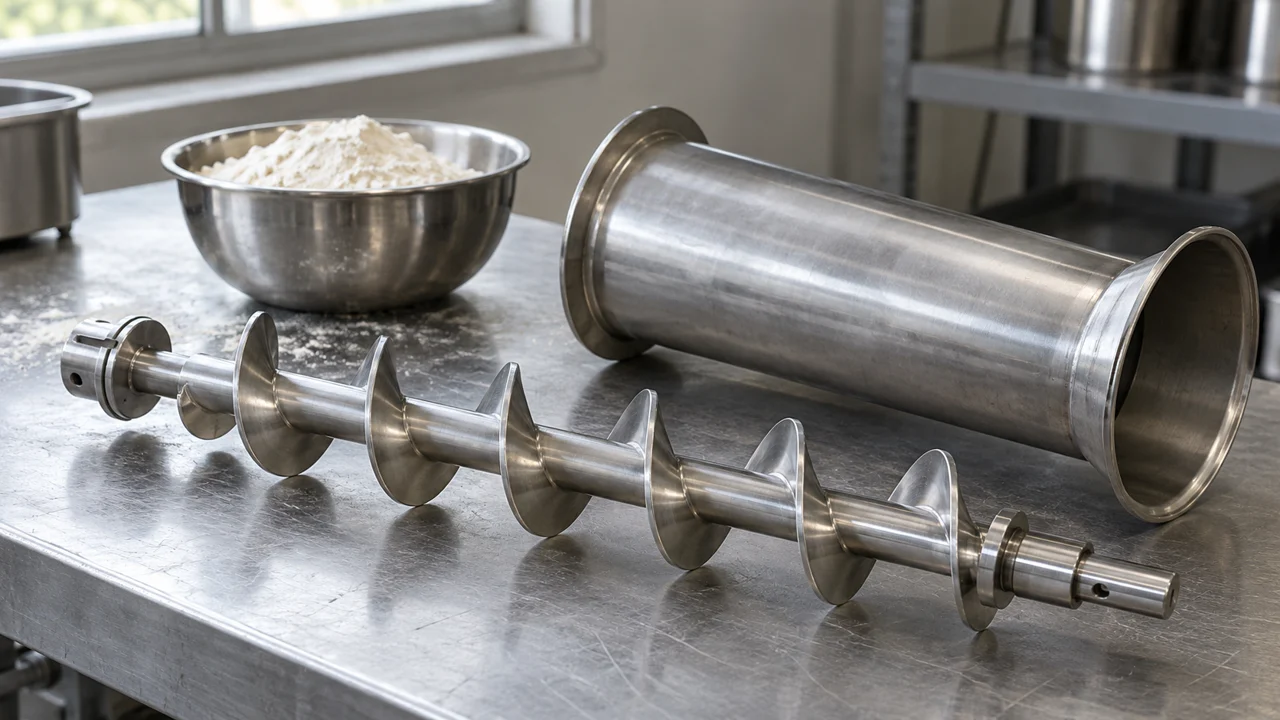
Specify a powder dosing system and its connection to the bagger as separate items. Paxiom’s Star Auger page names flour and describes screw revolutions that dispense a volume of product, with available feedback controls for adjusting that volume. It also lists integration with VFFS equipment, premade-pouch fillers and container conveyors. An auger therefore does not identify the bag path by itself.
Scroll horizontally for hidden columns. The first column stays in view.
| Module | Its job in the proposed system | Interface to write down |
|---|---|---|
| Powder feed and dosing | Supply the filler and meter each release | Feed arrangement, auger tooling, discharge and any weighing feedback |
| VFFS forming and sealing | Form the film into a bag and close it around the dose | Forming tube, filler outlet position and fill/seal timing |
All-Fill’s TAA description makes the mechanical interface concrete: forming-tube diameter, funnel length and overall height are matched to the receiving equipment, while augers and cutoffs are selected for the application. TAA is a dual-position filler example; this is evidence that interfaces need specifying, rather than a recommendation to fit that model to every flour bagger.
Ask the supplier to identify whether the proposed dose is controlled by screw revolutions, direct weighing or weight feedback. During sampling, record both the settings and measured net weights. A volumetric description alone does not supply a demonstrated flour weight tolerance.
A granule line with a multihead weigher is a different starting point. Its presence in search results does not verify its suitability for the flour lot in hand. The rice VFFS guide addresses grain bagging; keep that evidence with the grain application. A supplier proposing another dosing method for flour should demonstrate it with that flour and package.
Check dust at the transfer and sealing locations
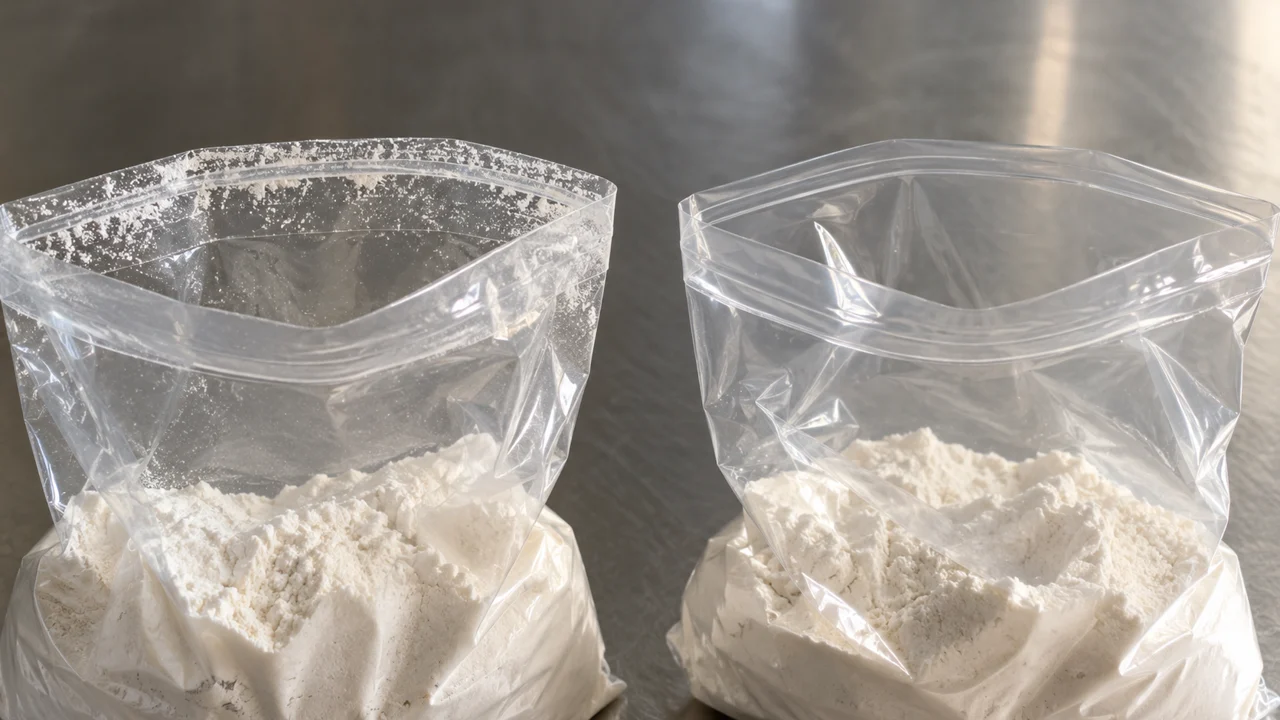
Inspect where the flour moves into the bag and where the film will be sealed. Viking Masek’s dust-control article explains that particles can escape at transfer points and interfere with adhesion when trapped in package seams. It describes suction, static elimination and dust hoods as interventions at different locations. Smartpack’s flour FAQ also describes a filling-nozzle hood and dust-collection connection options.
Those descriptions identify questions to investigate. They supply no extraction setting, guaranteed removal rate or validated sealing recipe for your flour.
Scroll horizontally for hidden columns. The first column stays in view.
| Observation during the sample run | What to investigate | Record with the observation |
|---|---|---|
| Powder escapes around the filling outlet | Hood position, enclosed transfer and the proposed collection connection | Where it appears and at which part of the fill cycle |
| Powder adheres to film above the fill | Static control and product transfer behavior | Film identity, contact location and settings used |
| Flour crosses the intended sealing margin | Dose discharge, available clear margin and fill/seal sequence | Bag sample, photograph and corresponding run condition |
| Residue remains after cleaning | Access to hopper, auger, outlet and nearby surfaces | Parts removed, cleaning procedure and areas still inaccessible |
Treat this table as an inspection plan. A visibly cleaner margin is a reason to proceed to the agreed seal checks, not proof of a sound seal. Keep the package samples so the team can compare the visual observation with its documented closure acceptance method.
A collection port also leaves the collection system itself to be specified. Site dust controls and installation safety require their own assessment.
What the public supplier descriptions establish
The sources support a conditional candidate list. They do not support ranking complete flour lines by speed or accuracy.
Scroll horizontally for hidden columns. The first column stays in view.
| Public description | Useful selection evidence | Still unknown for your project |
|---|---|---|
| Paxiom Star Auger | Flour is a named application; dosing can connect to several packaging paths | Achievable net-weight distribution and sustained line output |
| All-Fill TAA | Filler dimensions and tooling are application-specific interfaces | Suitability of a particular filler/bagger combination |
| Smartpack flour lines | Vertical pillow/gusset bags and premade pouches are separate routes | Actual bag, flour, dust and changeover results |
| Concetti IGF flour route | A separate premade sack route with weighing, air removal and closure choices | Fit with your sack construction and operating conditions |
For a pillow or gusset bag formed on the line, retain an integrated auger/VFFS candidate for sampling. For a purchased pouch or sack, retain the corresponding bag-handling candidate. Keep a candidate only when the supplier can identify both the dosing arrangement and the package path.
Copy this flour sample record
Use a separate record when the flour lot, package or relevant setting changes. The blank cells are for observed results; no performance values have been supplied. These are editorial recommendations for organizing a trial, not results from a production line.
Scroll horizontally for hidden columns. The first column stays in view.
| Field | What to enter | Trial entry |
|---|---|---|
| Product and lot | Flour type, ingredients, lot and sample condition | |
| Package | Film or bag reference, dimensions, construction and supplier | |
| Route and equipment | Roll-film VFFS, premade pouch or sack; actual filler and bagger | |
| Target fill | Required net mass and agreed acceptance criteria | |
| Dose control | Auger tooling, settings, feed condition and feedback mode | |
| Individual sample weights | Empty-package tare and measured net weights, with sample identifiers | |
| Run conditions | Duration, filled bags, accepted bags, rejects and stops | |
| Dust | Location, cycle stage and collection arrangement used | |
| Sealing margin | Powder present or absent; sample and photograph identifiers | |
| Closure checks | Agreed method, acceptance criterion and recorded result | |
| Cleaning | Procedure used, dismantled parts and remaining residue | |
| Change and rerun | One recorded change and the corresponding new sample identifiers |
Keep the actual product and packaging samples with the record. The food packaging material checklist covers the film and material documentation that accompanies those samples.
Before the run, agree how net weight, closure quality and acceptable output will be judged. If flour reaches the sealing margin, investigate and repeat the affected checks after a documented change. If weight results miss the agreed criteria, retain the individual measurements and dosing conditions. If the cleaning procedure leaves inaccessible residue, resolve access before treating the configuration as ready.
The next decision is whether the proposed combination merits a further trial or acceptance against the team’s criteria. An incomplete record calls for another check; it does not justify filling a blank with a catalog figure.
Method and evidence limits
This guide organizes public manufacturer descriptions accessed on 15 October 2026. Viking Masek’s dust article was updated on 21 June 2021. Supplier descriptions establish what each source offers or explains. They are not independent measurements of a flour line.
The route tables and sample record are an editorial synthesis. The photographs show generic packages, loose components and bag margins; they do not document the named equipment or a trial. No production speeds, flour tolerances, extraction settings, film thicknesses, prices or shelf-life claims have been inferred. Confirm those that matter to the project using the actual equipment, flour and package.
Sources and method
This article is based on documentary research of the sources listed. It is not a hands-on equipment test. Supplier statements and editorial judgement are identified in the text.
- Flour Packing Machine Vertical pillow/gusset bags versus premade pouches; auger dosing, optional checkweigher feedback, dust hood and collection interfaces. Marketing performance figures excluded. Library full text fetched 8 October 2026; original page fetched again 15 October 2026.
- Star Auger: Powder Filling Packaging Machine Flour application, screw-revolution volumetric metering, available feedback controls and integration with VFFS, premade-pouch and container equipment. No catalog rate or accuracy transferred to a flour line. Retrieved 15 October 2026.
- Model TAA Automatic Auger Filler Application-specific matching of forming tube diameter, funnel length, height, auger tooling and cutoffs. TAA is a dual-position filler example, not a specification for every flour bagger. Retrieved 15 October 2026.
- 8 Ways to Combat Dust in your Powder & Coffee Packaging Process Transfer-point dust, powder in heat-seal seams, suction, static elimination and dust hoods. Supplier explanation updated 21 June 2021; retrieved 15 October 2026. Does not establish a flour-specific extraction setting or seal recipe.
- Flour bagging machine IGF flour route uses premade bags, auger-fed net or gross weighers, de-aeration and separate closure options. Its stated 5–50 kg range belongs to this supplier example. Retrieved 15 October 2026.
Next reading
Rice VFFS Packaging: Dosing, Bag Formats and Bulk-Bag Boundaries
Rice in the seal wastes the sample. Separate a roll-film bag, a premade pouch and an open-mouth sack before a trial. Leave speed and film thickness blank.
Read the guide
Pouch Packaging for Food: Stand-Up, Retort, Spouted and Pillow Pouches by Product
A pouch unsuited to heat processing can fail. Select by preservation route, product flow and use, then check film, fitment and filling compatibility.
Read the guide
Food Packaging Material Specification Checklist for Buyers
A copyable checklist for food packaging material requests: component specs, FDA and EU documents to ask for, line-fit checks and sample trial records.
Read the guideMore in Applications
Milk Packaging Formats: Bottles, Cartons and Pouches
How to choose a milk packaging format by heat treatment, cold chain and light exposure, and what bottle, carton and pouch formats mean for filling equipment.
Read the guide
Yogurt Packaging: Cups, Bottles and Pouches for Different Products
Match yogurt packaging to product type: set, stirred, drinkable or squeeze. Compare cups, bottles and spouted pouches and their filling and sealing needs.
Read the guide
Bottled Water Packaging Lines: From Prepared Containers to Packed Cases
Plan a bottled water packaging line from container supply to palletizing: rinsing, filling, capping, labeling, coding and the interfaces between stations.
Read the guide