
Rice VFFS Packaging: Dosing, Bag Formats and Bulk-Bag Boundaries
Rice in the seal wastes the sample. Separate a roll-film bag, a premade pouch and an open-mouth sack before a trial. Leave speed and film thickness blank.
What this article covers
A rice packer choosing a roll-film bag, a premade pouch or an open-mouth bulk bag can name the path and the dosing device before a trial, with empty cells where the public pages state no figure.
Covered
- Roll-film bags, premade pouches and open-mouth or auto-bag bulk bags as separate paths
- Supplier weight examples kept inside the sentence that states them
- A blank record for the rice lot, the mix, the dose and the changeover
Not covered
- A single weight where every plant must leave a roll-film bag
- Bag speeds, film thicknesses, prices, gas mixes and shelf life
- Paddy, and a rice-and-beans blend ratio
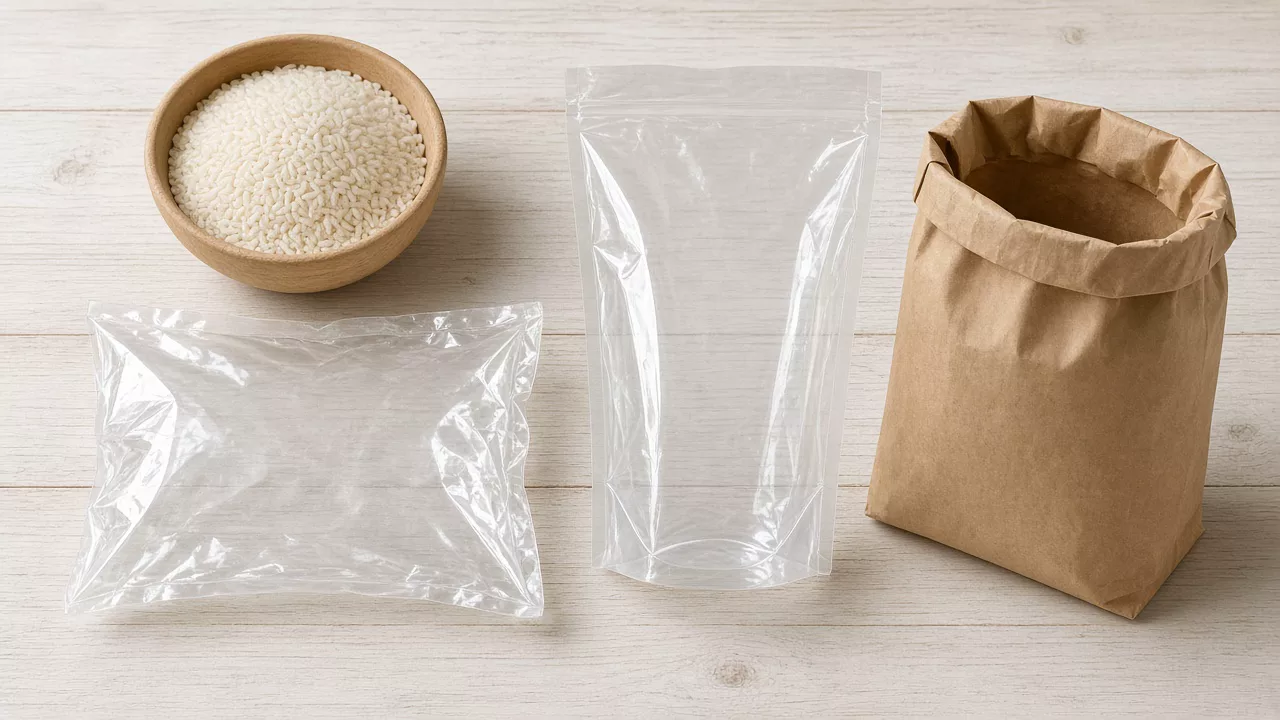
Rice grains in the seal, or a retail bag run on a bulk bagger, waste the sample before the bag path can be judged. Name the path before any trial: a bag formed from roll film, a premade pouch that already exists, or an open-mouth bulk bag.
A VFFS machine for rice is the roll-film path that forms the bag, doses the rice and seals the bag. It is not a single model for a premade pouch and an open-mouth sack. Finopack’s rice packing page, with a stored publication date of 22 April 2021 and fetched on 8 October 2026, separates a vertical form-fill-seal machine for a 1-5 kg rice bag from an auto bagging machine for a 25 kg or 50 kg rice bag. Smartpack’s page of 25 April 2024, fetched the same day, separates a linear-weigher VFFS, a multihead-weigher VFFS, and a multihead weigher for premade pouches. Wolf’s rice and pasta page, with a stored publication date of 25 May 2025 and fetched on 6 October 2026, names rollstock and pre-formed bags, and names both volume-based and weight-based filling, with no mass. Where those pages state no figure, the tables below leave the cell empty.
The applications section starts from the product rather than the machine. See food and beverage packaging by application for that order. This page stays on the rice bag path, the dosing device and the record for the lot you will pack.
Scroll horizontally for hidden columns. The first column stays in view.
| Input or item | What to write down | Why it decides the trial |
|---|---|---|
| Pack path | Roll-film bag, premade pouch, or open-mouth bulk bag | The machine structure follows the path |
| Rice in this lot | The name you will pack. White, jasmine and brown are names on the Wolf page | A different lot is a different record |
| Dose | The mass you will fill. A supplier mass stays with the sentence that states it | A 1-5 kg example is not a 25 kg bag |
| Dosing device | Linear weigher, multihead weigher, volumetric dispenser, or the name on the machine | No page states a cup volume |
| Seal after a short fill | Whether grains sit on the seal area | The pages do not show your film |
Which path is a roll-film bag, a premade pouch, or an open-mouth bulk bag?
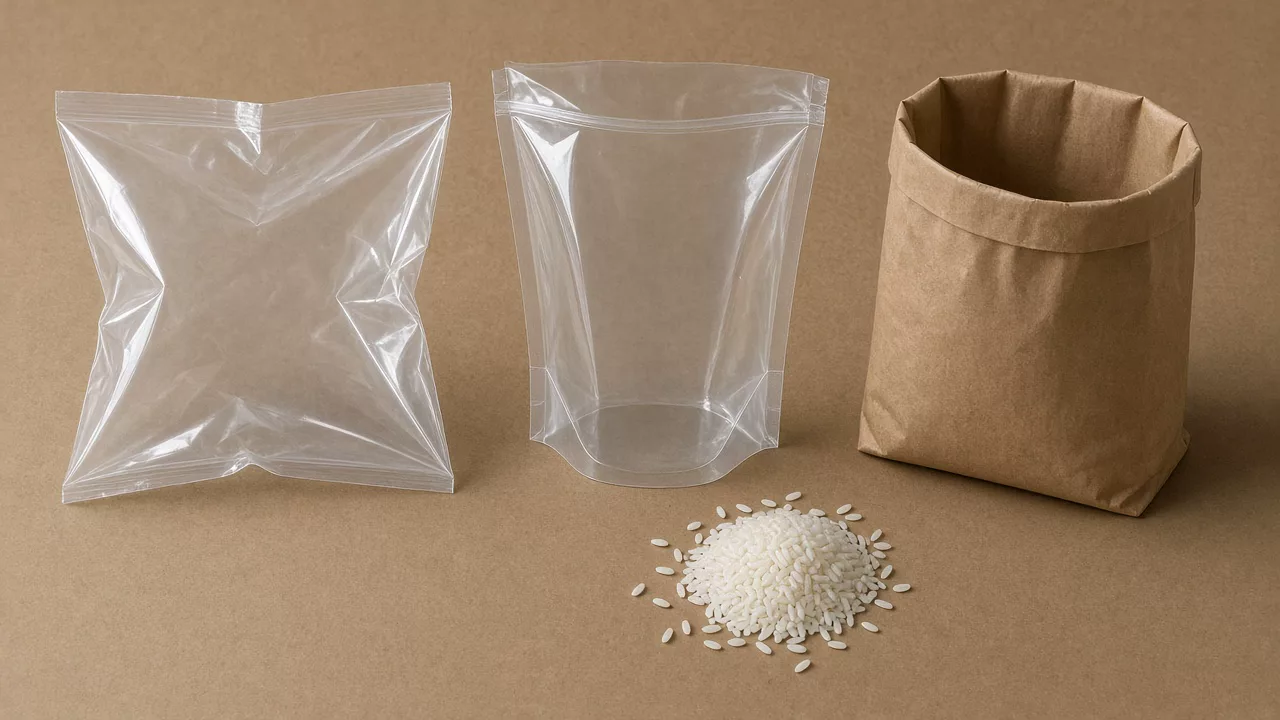
Start with the pack you will run. If the machine forms the bag from a roll of film, the path is the roll-film bag. If the pouch already exists and the machine feeds it, the path is the premade pouch. If the listing is Finopack’s open-mouth bagging machine, or Finopack’s auto bagging machine for a 25 kg or 50 kg rice bag, the path is the bulk bag. Those two Finopack lines are different sentences. A machine that puts finished small bags into a bigger bag is a fourth path. It is not one of these three.
Scroll horizontally for hidden columns. The first column stays in view.
| Path | What the cited page says the machine does | Packs the page names | Mass stated | Speed stated |
|---|---|---|---|---|
| Roll-film bag | Finopack: a vertical form-fill-seal machine for a 1-5 kg rice bag, usually with a 2-head or 4-head linear scale, a granule bucket elevator and a take-off conveyor. Smartpack: a linear-weigher VFFS and a multihead-weigher VFFS form the bag from a film roll. Wolf: vertical packaging machines and vertical baggers, using rollstock or pre-formed packaging | Pillow bags and gusset bags. Smartpack’s linear-weigher section also names a punch hole or a handle hole on the top seal. Wolf also names gusseted sacks | Finopack: 1-5 kg on that VFFS sentence. Smartpack linear weigher: 3-10 kg in the paragraph and in the table. Smartpack multihead VFFS: the paragraph says 3-5 kg and the table says 3-10 kg, so this page does not pick one | |
| Premade pouch | Smartpack: the machine feeds the pouch, weighs and fills the rice, seals the pouch and discharges it. Finopack lists a rotary premade bag packing machine for granules. Wolf names pre-formed bags | Smartpack: premade pouches and premade woven pouches. A vacuum function is described as optional, with no vacuum level. Wolf: stand-up pouches, flat pouches and gusseted bags | ||
| Open-mouth or other bulk bag | Finopack lists an open-mouth bagging machine. A different sentence names an auto bagging machine for 25 kg or 50 kg rice bags. Wolf names larger sacks for foodservice or bulk distribution | Finopack lists woven bags, kraft paper bags and PE inner film paper bags among styles it calls suitable, and does not assign each style to one machine. Wolf: larger sacks, with no mass | 25 kg or 50 kg, only on Finopack’s auto bagging sentence. The open-mouth product link states no mass | |
| Small bags into a big bag, outside this trial | Finopack: a secondary packaging machine packs small bags into a big bag | The page does not name that big bag as the retail rice bag |
The 1-5 kg sentence and the 25 kg or 50 kg sentence are both Finopack’s, fetched on 8 October 2026. A bag of 5 kg sits inside the VFFS sentence. Smartpack’s linear-weigher range, on the page of 25 April 2024, is 3-10 kg in both the paragraph and the table, so a bag above 5 kg is still inside that VFFS table. The pages do not state one weight where every plant leaves a roll-film bag. Use a mass only with the sentence it came from.
Smartpack’s linear-weigher table and its multihead VFFS table both state bag width 100-400 mm and bag length 180-500 mm, and both name laminated film. The premade section says pouch sizes are adjustable on a touch screen and states no width and no length. Finopack lists pillow bags, gusset bags, quad seal bags, kraft paper bags, stand-up zipper bags, PE inner film paper bags and woven bags as suitable, and states no width and no length. Film thickness is not stated on any of the three pages. The thickness cell stays empty.
Wolf’s packaging paragraph also names containers and jars. A jar is not a rice bag path on this page. Pillow bags and stand-up pouches are sorted by food in pouch packaging for food. That page names rice with pillow, gusseted and stand-up pouches. It does not state a rice mass or an open-mouth sack. How a vertical machine forms a bag from a roll of film is outlined in the equipment guides. That section does not name a rice weight.
Takeaway: Book the sample on the path you will run. A mass from one sentence does not move a bag onto another path.
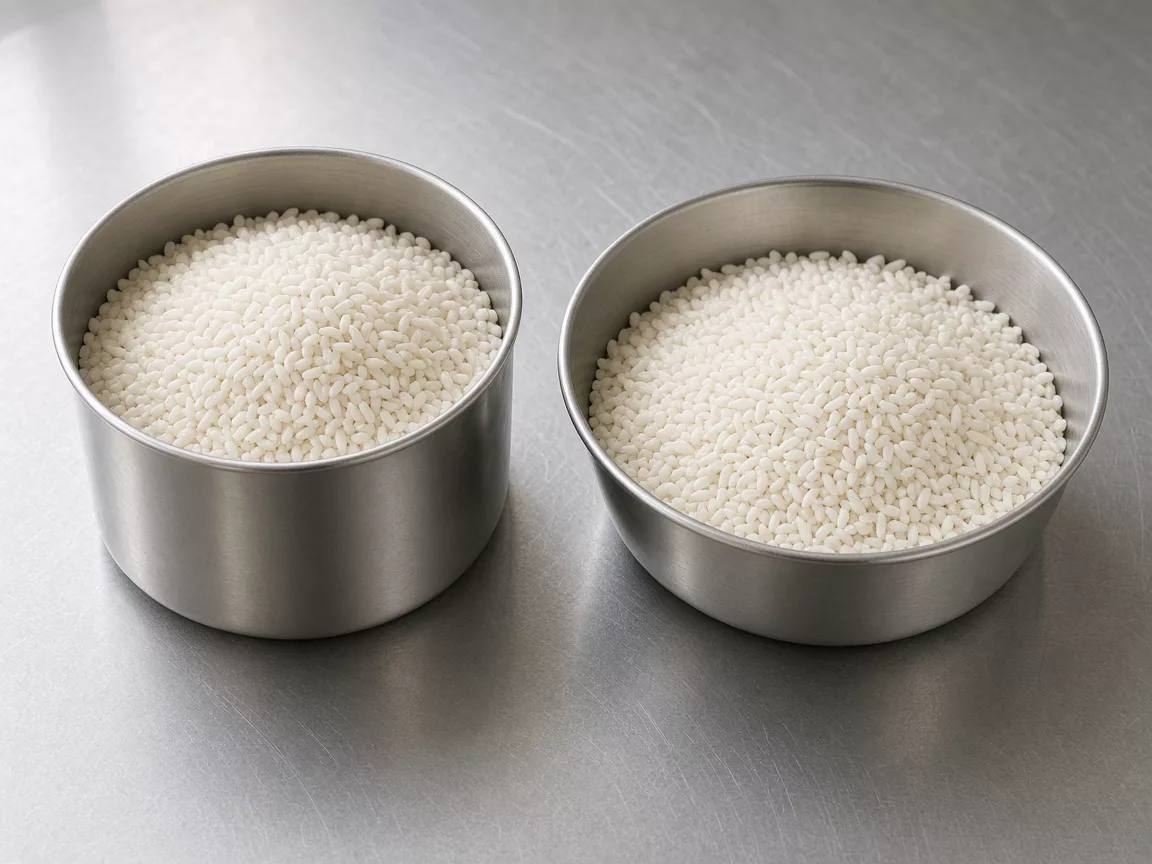
The photograph shows two metal vessels of rice. It is not a scale reading, and it is not a result from a line.
Which dosing method has a figure, and which cell stays empty?
Write the device you will run. The pages name weighing and volume. They do not name a cup volume, and they do not rank accuracy.
Scroll horizontally for hidden columns. The first column stays in view.
| Device | Where it is named for rice | Figure this page uses | Left empty |
|---|---|---|---|
| Linear scale or linear weigher | Finopack’s 1-5 kg VFFS sentence says the machine is usually equipped with a 2-head or 4-head linear scale. Smartpack’s first VFFS section is a linear weigher | The 2-head or 4-head wording, as Finopack’s “usually”. Smartpack’s 3-10 kg on that solution. Bag width 100-400 mm and length 180-500 mm, laminated film, on that table | Cup volume, speed and accuracy |
| Multihead weigher | Smartpack’s pillow-bag VFFS section and its premade-pouch section. Wolf lists multihead weighers among fillers for rice and pasta lines | No single rice mass. Smartpack’s multihead paragraph says 3-5 kg and its table says 3-10 kg. Wolf states no mass | The tolerance stated beside the 3-5 kg phrase. Speed. Any accuracy rank |
| Volumetric dispenser | Wolf lists volumetric dispensers with the multihead weighers and the auger fillers. Finopack’s features list says the machine measures volume, in a list that also names detergent powder, soy beans, sugar, salt, seeds, corn, peanut butter, pasta, cookies and pet foods | None. No cup volume is stated | Cup volume, and which rice bag the volume sentence covers |
| Auger filler | Wolf lists auger fillers in the same sentence as the rice and pasta lines | None | A rice mass for an auger |
Smartpack does not name a volumetric cup. A cup volume from another listing does not fill this cell. Smartpack states packing rates for the linear-weigher machine and for the multihead machine. On the linear-weigher section, the paragraph and the table do not state the same rate. Those rates are not copied. Finopack’s features list also states a bag rate, and a time to change pouches, without naming the rice weight or the bag. Neither figure is used here.
Wolf says its systems offer volume-based and weight-based filling. That sentence does not say which rice lot uses which device. The device cell is filled from the machine you will run, or left empty.
Takeaway: A filled mass comes from the sentence that states it, or from the lot you will pack. A rate stays empty.
What rice, mix and changeover go on the record?
Copy one record per lot, per path and per dose. Leave a cell empty when this lot has not been measured. An empty cell is more useful than a number taken from a different pack.
Wolf’s page names white rice, jasmine rice and brown rice, and it also names pasta shapes. It does not say those products share one bag. A hygiene sentence on that page mentions sticky cooked rice. This record is for the dry rice you will pack, unless the lot in front of you is cooked rice. The three pages do not name paddy. A paddy lot is outside this record.
None of the three pages states a ratio for rice mixed with beans. Smartpack says its machines also package coffee beans, sugar, sunflower seeds and wheat. That sentence is a list of other granules. It is not a blend. If this lot is a mix, write what is in it. If you have not written the mix, leave the cell empty.
Scroll horizontally for hidden columns. The first column stays in view.
| Field | Write this from the lot you will pack | Leave it empty when |
|---|---|---|
| Product | Rice name and the lot you will pack | The trial rice is a different lot |
| Style | White, jasmine, brown, or the words your plant already uses | You would be copying a style the lot is not |
| Cooked or dry | Dry, unless this lot is the cooked rice you will pack | You have not looked at the lot |
| Mix | The contents, if this lot is a mix | You have not written a mix. No page states a rice-and-beans ratio |
| Path | Roll-film bag, premade pouch, or open-mouth or auto-bag bulk bag | The trial is small bags placed into a bigger bag |
| Dose | The mass you will fill. Use 1-5 kg only for Finopack’s VFFS sentence, 3-10 kg only for Smartpack’s linear-weigher solution, and 25 kg or 50 kg only for Finopack’s auto bagging sentence | The pack is not that sentence, or you have not chosen a dose |
| Device | Linear weigher, multihead weigher, volumetric dispenser, auger, or the name on the machine | A catalog title is not the machine in the room |
| Cup volume | No opened page states one. Do not borrow one | |
| Bag size | Width and length you will run. Use 100-400 mm by 180-500 mm only when the trial is one of Smartpack’s two VFFS tables | The path is the premade section, the open-mouth link, or another machine |
| Film or bag material | Laminated film only when the trial is one of those two VFFS tables. Otherwise the material you already have | Film thickness. No page states one |
| Seal after a short fill | Whether grains sit on the seal area | The fill has not been done |
| What changed | Bag style, dose, or dosing device, compared with the last lot | You would be filling a time. The features list states a changeover time without the rice weight or the bag, and that time is not used |
| Gas mix and shelf life | Wolf says gas flushing options are available and states no mix and no shelf-life figure |
Takeaway: A filled cell comes from this lot, or from a supplier sentence labeled with that sentence’s pack. Every other number stays empty.
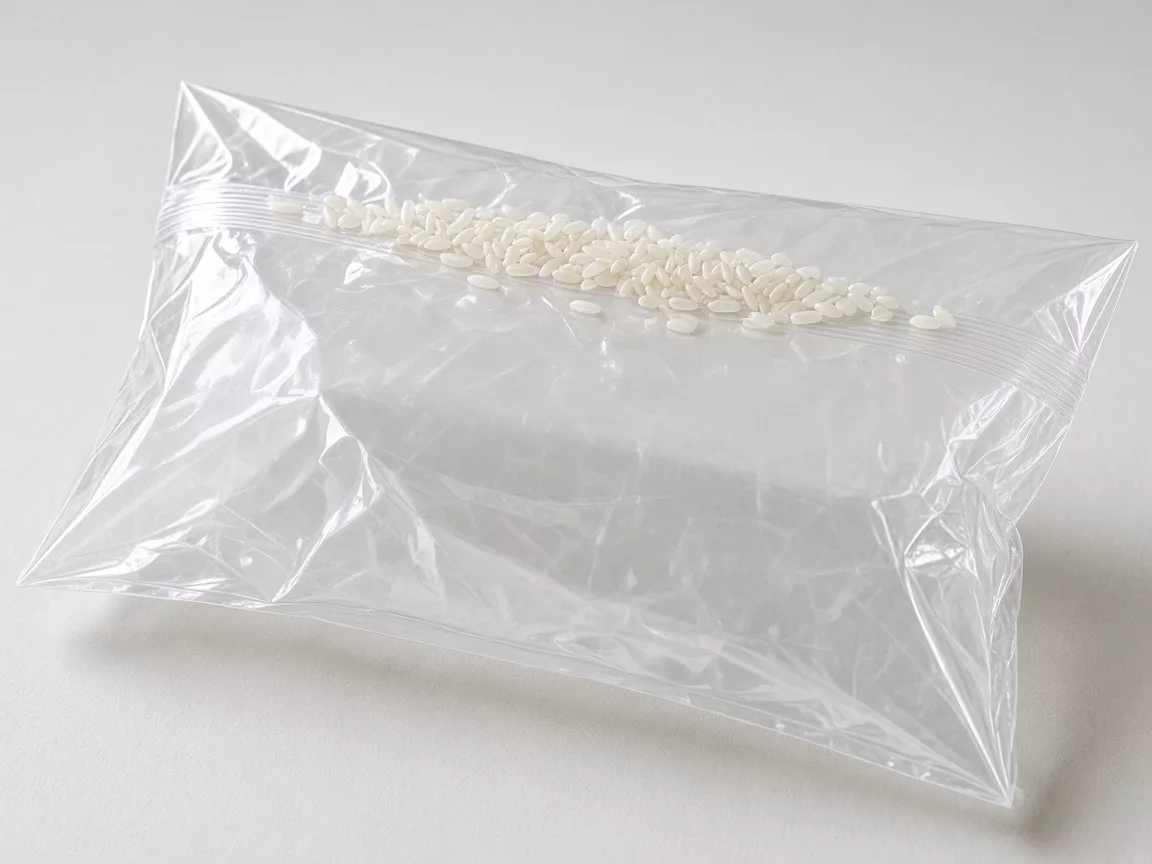
The photograph shows grains on the bag edge. It is not a seal result from a line. Questions about the film structure go on the food packaging material checklist. That checklist does not choose a rice dosing method; film thickness depends on the pouch specification.
Keep the rice and the record together. The trial compares that pair. A sheet without the rice, or a bag without the sheet, is not ready to book.
Method and sources
The path, dose and dosing descriptions come from three public manufacturer pages. Each page is one supplier’s account. Agreement between two sentences on the same page is not two independent trials.
Finopack’s rice packing page has a stored publication date of 22 April 2021 and was fetched on 8 October 2026. The 1-5 kg VFFS sentence, the 2-head or 4-head linear scale, the 25 kg or 50 kg auto bagging sentence, the open-mouth product link, the rotary premade product link, and the secondary machine for small bags inside a big bag are that supplier’s divisions. They are not a weight where every other supplier changes path. The features list states a bag rate and a pouch-change time without the rice weight or the bag. Those two figures are outside the tables above. The same list says the machine measures volume and also makes bags, and it names many products besides rice. That volume sentence is not a cup volume.
Smartpack’s page was published on 25 April 2024 and fetched on 8 October 2026. The 3-10 kg figure is used only where the linear-weigher paragraph and the linear-weigher table agree. The multihead paragraph’s 3-5 kg and the multihead table’s 3-10 kg are both reported, and neither is chosen. Bag width 100-400 mm, bag length 180-500 mm and laminated film are the two VFFS tables. The premade section names pouch feeding, weighing and filling, sealing and discharge, plus premade woven pouches and an optional vacuum function with no vacuum level. Rates and the tolerance beside the 3-5 kg phrase are the supplier’s performance wording. They are not in the tables above.
Wolf’s rice and pasta page has a stored publication date of 25 May 2025 and was fetched on 6 October 2026. It names white rice, jasmine rice and brown rice, rollstock, pre-formed bags, stand-up pouches, flat pouches, gusseted bags and larger sacks. It lists multihead weighers, auger fillers and volumetric dispensers, and it states no mass, no cup volume and no accuracy rank. Gas flushing is named as an option. No gas mix and no shelf-life figure are stated, so neither is on the record. The hygiene sentence about sticky cooked rice does not make cooked rice the default lot.
No price, no bag speed, no film thickness, no gas mix and no shelf life is stated for the reader’s lot. US desktop results saved on 7 October 2026 for the query “vffs machine for rice” were used as a map of the query. Seller rates and marketplace masses from that map are not in the tables above.
Real fit of your rice, your bag and your film still requires the trial on the record.
Sources and method
This article is based on documentary research of the sources listed. It is not a hands-on equipment test. Supplier statements and editorial judgement are identified in the text.
- Rice Packing Machine Supports the split between a vertical form-fill-seal machine for a 1-5 kg rice bag, usually with a 2-head or 4-head linear scale, and an auto bagging machine for a 25 kg or 50 kg rice bag. Also supports a separate secondary machine that packs small bags into a big bag, a listed open-mouth bagging machine, and a listed rotary premade bag machine. Bag styles are listed as suitable without a width, a length or a film thickness. A features list states a bag rate and a pouch-change time without naming the rice weight or the bag, so neither figure is used. Publication date stored from page data as 22 April 2021. Fetched 8 October 2026.
- 5kg Rice Packaging Machine Supports a linear-weigher VFFS, a multihead-weigher VFFS, and a multihead weigher that feeds premade pouches, including woven pouches. The linear-weigher paragraph and table both state 3-10 kg. Both VFFS tables state bag width 100-400 mm, bag length 180-500 mm and laminated film. The multihead paragraph says 3-5 kg and the multihead table says 3-10 kg, so no single mass is used. Rates and a stated tolerance are not copied. The premade section states no pouch width. Published 25 April 2024. Fetched 8 October 2026.
- Rice & Pasta Packaging Machine Solutions Supports rollstock and pre-formed bags, stand-up pouches, flat pouches, gusseted bags and larger sacks, with no mass. Names white rice, jasmine rice and brown rice, and lists multihead weighers, auger fillers and volumetric dispensers, with no cup volume and no accuracy rank. Says gas flushing options are available and states no gas mix and no shelf-life figure. A hygiene sentence mentions sticky cooked rice. Published 25 May 2025. Fetched 6 October 2026.
Next reading
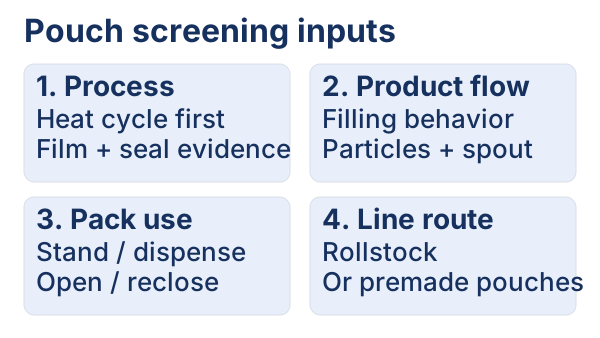
Pouch Packaging for Food: Stand-Up, Retort, Spouted and Pillow Pouches by Product
A pouch unsuited to heat processing can fail. Select by preservation route, product flow and use, then check film, fitment and filling compatibility.
Read the guide
Food Packaging Material Specification Checklist for Buyers
A copyable checklist for food packaging material requests: component specs, FDA and EU documents to ask for, line-fit checks and sample trial records.
Read the guideMore in Applications
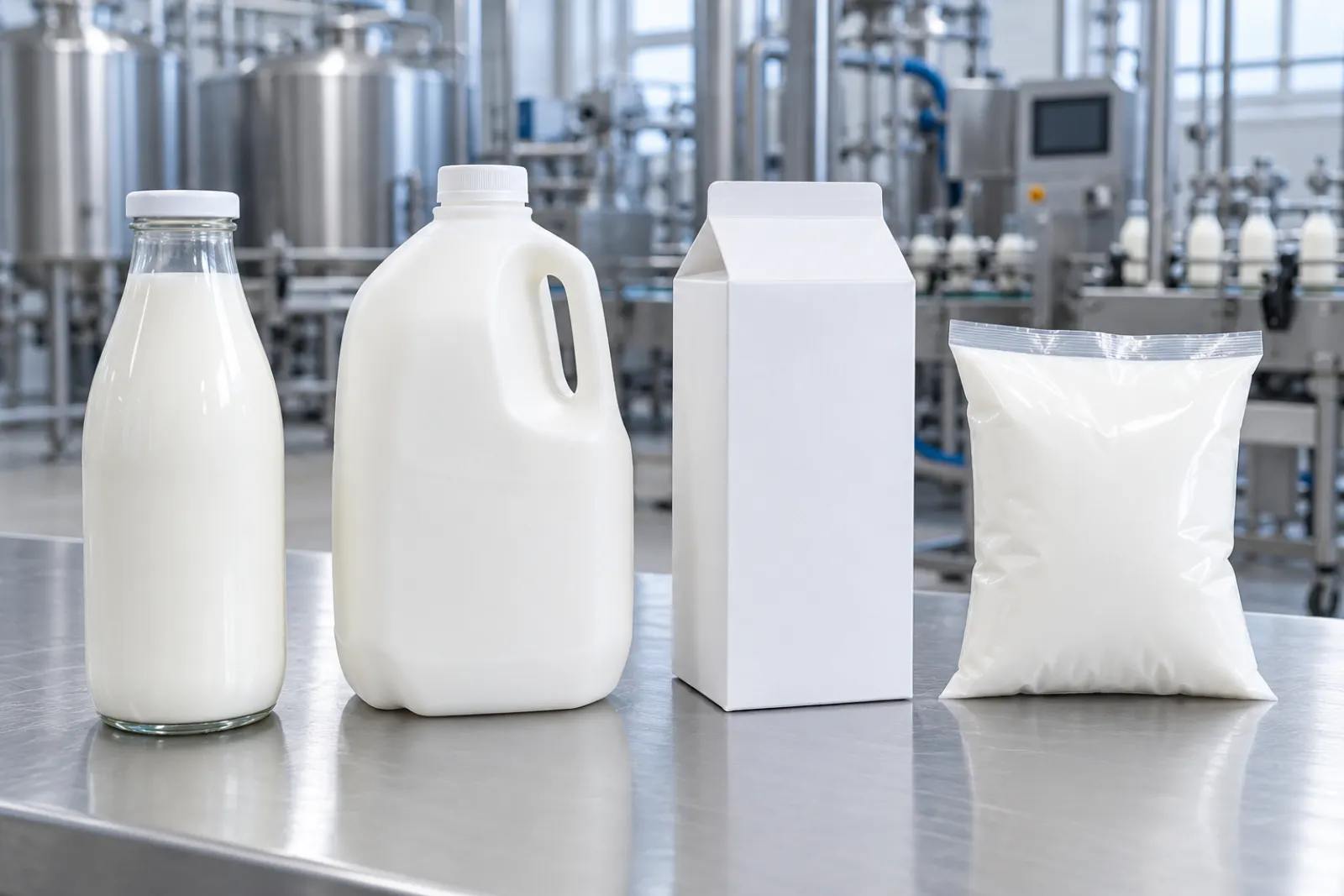
Milk Packaging Formats: Bottles, Cartons and Pouches
How to choose a milk packaging format by heat treatment, cold chain and light exposure, and what bottle, carton and pouch formats mean for filling equipment.
Read the guide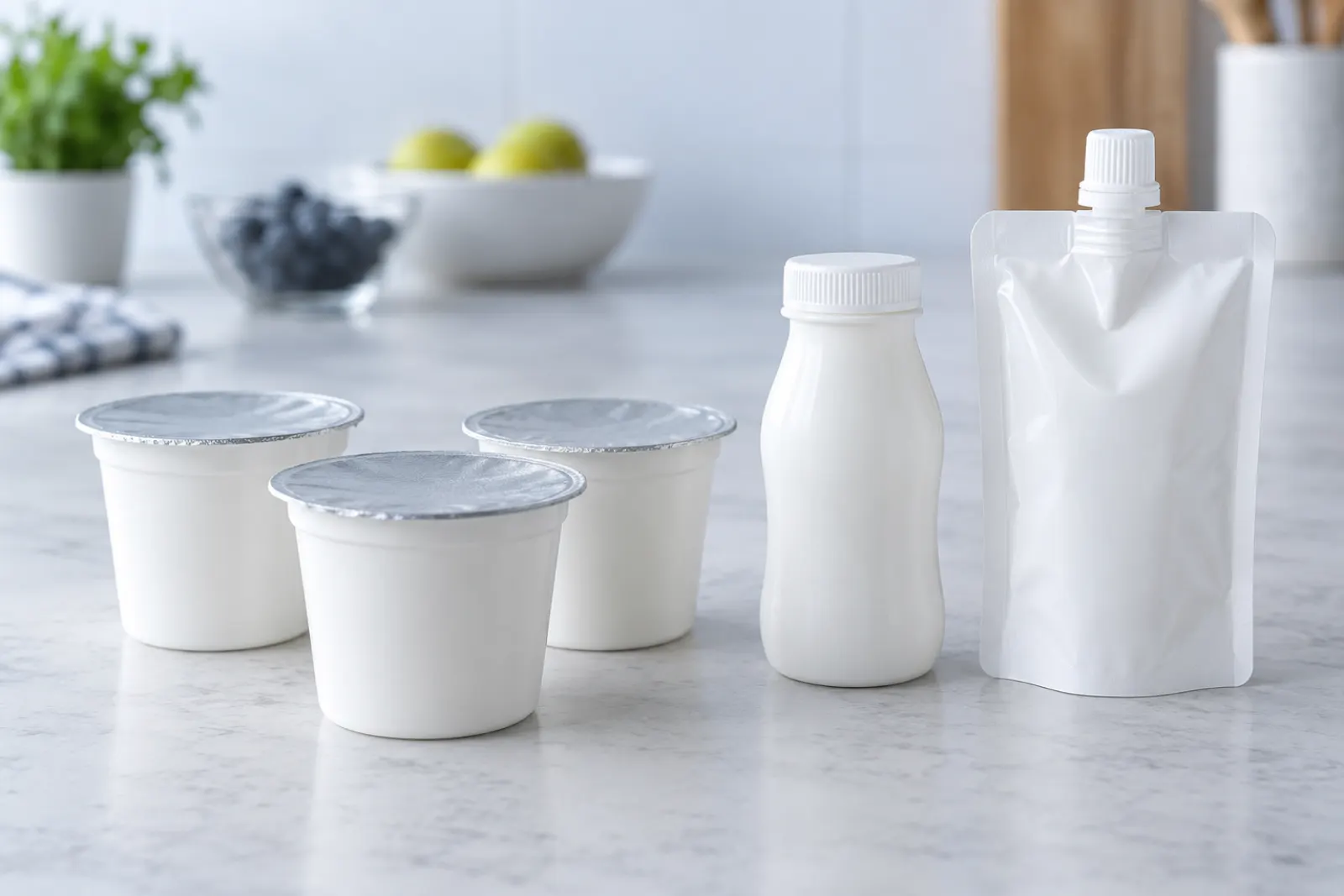
Yogurt Packaging: Cups, Bottles and Pouches for Different Products
Match yogurt packaging to product type: set, stirred, drinkable or squeeze. Compare cups, bottles and spouted pouches and their filling and sealing needs.
Read the guide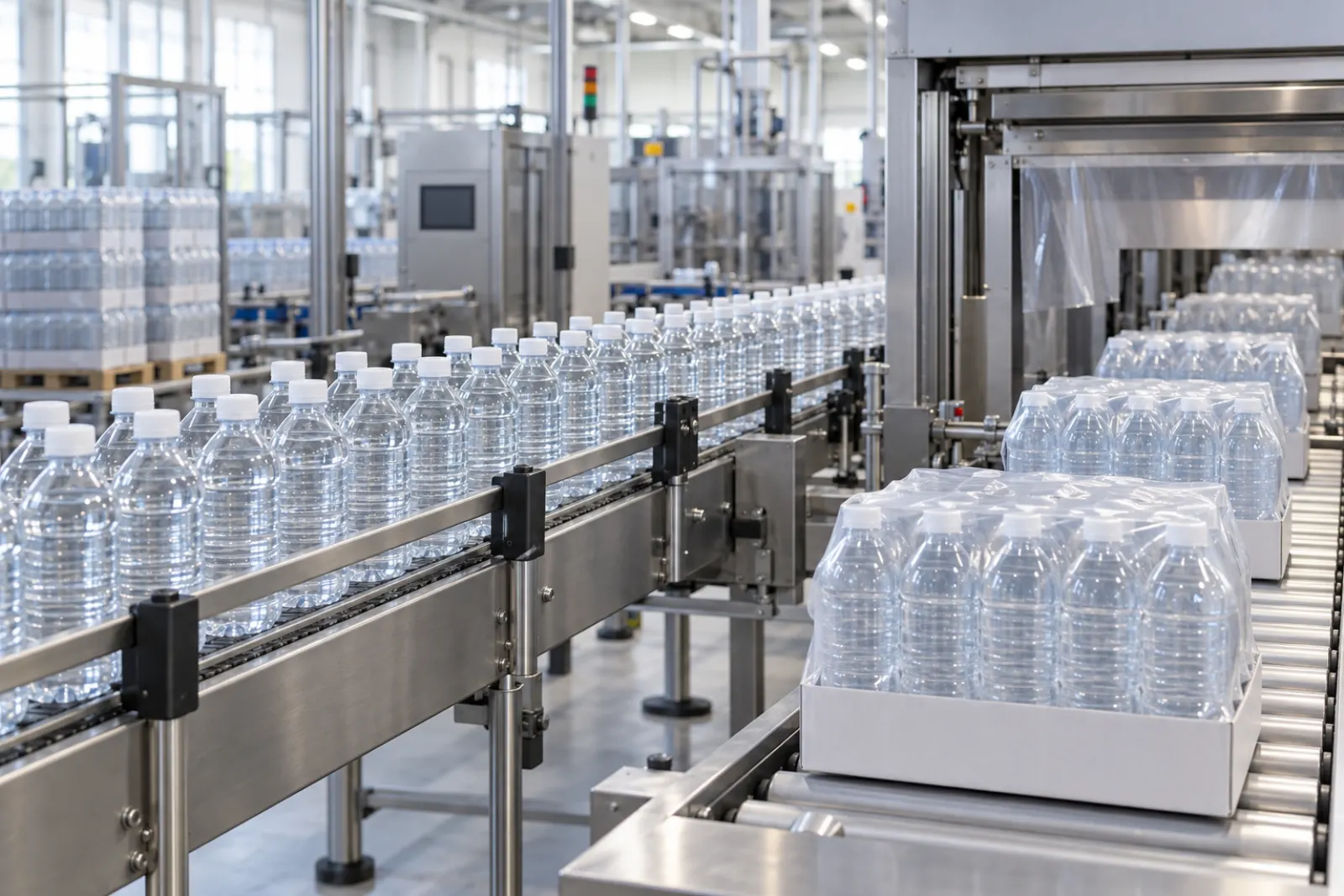
Bottled Water Packaging Lines: From Prepared Containers to Packed Cases
Plan a bottled water packaging line from container supply to palletizing: rinsing, filling, capping, labeling, coding and the interfaces between stations.
Read the guide