
Chicken Packaging: Modified Atmosphere, Vacuum and Skin Packs
Compare poultry MAP, vacuum and skin packaging using retrieved primary documents, with gas guidance, compression, seal boundaries and quality checks kept in scope.
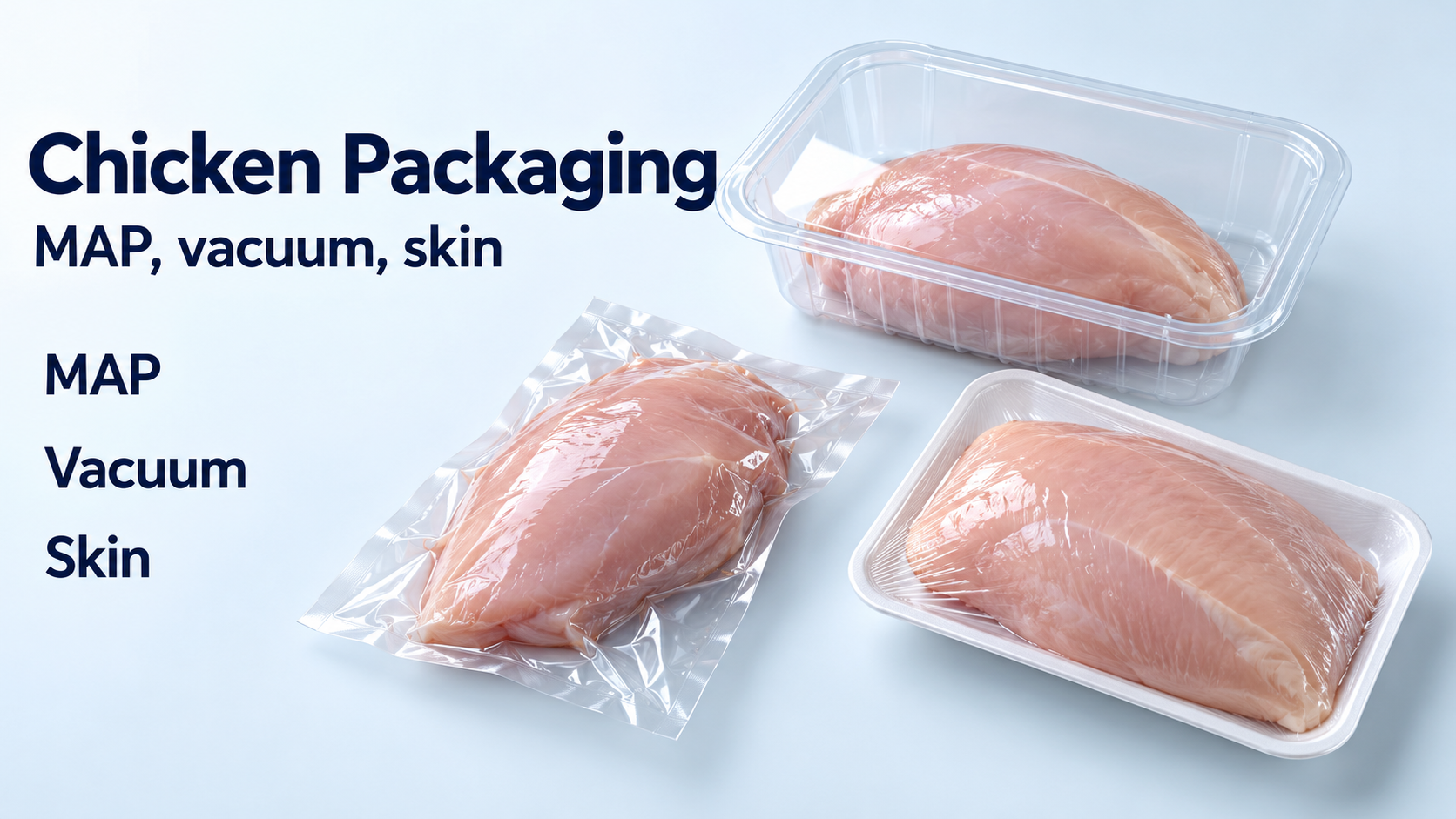
What this article covers
A poultry-only comparison of modified atmosphere, vacuum and vacuum skin packs, separating documented mechanisms from product-specific gas and shelf-life validation.
Covered
- Raw poultry format selection for MAP, flexible vacuum and vacuum skin packs
- Gas guidance and retail pack-collapse boundary stated by Air Products
- Compression, skin-film sealing geometry and complete-pack quality checks
- Records for comparing packaging loss and rejected chicken
Not covered
- A shelf-life guarantee for any chicken product
- An independently validated gas recipe or microbial safety process
- Transferring raw-poultry gas guidance to cooked poultry or other meat
Leaking packs, compressed portions, and collapsed trays can waste chicken as well as packaging. Chicken packaging with a modified atmosphere retains a tailored gas space; flexible vacuum packs remove air and compress the product, while vacuum skin packs conform film to the poultry and seal it to a supporting base.
Choose between them from the actual cut, acceptable compression, package construction, and cold chain. The applications overview places that decision before equipment selection; none of these formats establishes a shelf life by its name.
Quick specifications for a poultry comparison
The useful starting values belong to a particular document and application. The gas and temperature entries below are Air Products’ raw-poultry guidance, retrieved October 19, 2026, rather than a validated process for a particular chicken pack.
Scroll horizontally for hidden columns. The first column stays in view.
| Input or item | Typical value or source | Why it matters |
|---|---|---|
| MAP mechanism | Air replaced by a product-tailored gas mixture; MULTIVAC poultry brochure, April 2022, Solutions spread | A gas-containing pack is a different structure from a conforming vacuum pack |
| Flexible vacuum mechanism | Air removal compresses the product; same brochure | The brochure restricts flexible-film vacuum packs to foods that tolerate compression |
| Vacuum skin mechanism | Conforming film; full-surface or perimeter sealing according to the named process; same brochure | Skin is a process and film/base combination, not a generic lidding-film setting |
| Retail raw-poultry mixture example | 30% CO₂ and 70% N₂; Air Products, explanatory text | A cited general-guidance example requiring product trials |
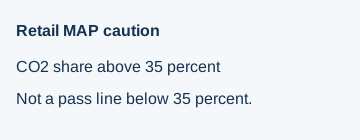
| Retail CO₂ caution | Above 35% can induce pack collapse and excessive drip; same text | A retail-pack boundary that must not be confused with bulk-pack guidance |
| Recommended storage range | −1 °C to +2 °C; same page, Storage temperature | A supplier recommendation for chilled raw poultry and game, not a US legal maximum |
| Shelf life, residual oxygen and seal settings for this product | Unknown | The retrieved documents do not validate the reader’s chicken and package |
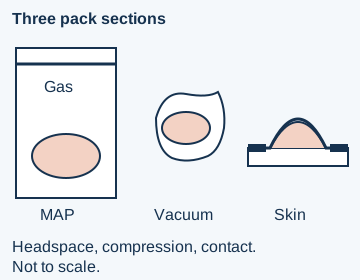
The sections show structure only. They are not measured pack dimensions.
Which format fits the chicken and its presentation?
First decide whether the portion must retain its shape without compression, then establish the film and base arrangement. MULTIVAC’s poultry brochure explains that flexible vacuum packaging compresses its contents. Its skin processes use special films conforming to the product, with distinct seal geometries. The following selection implications derive from those mechanisms; they are not results from a comparative poultry trial. MULTIVAC, April 2022 poultry brochure, Solutions spread.
Scroll horizontally for hidden columns. The first column stays in view.
| Format | Poultry selection implication | Dominant Failure Mode & Prevention |
|---|---|---|
| MAP tray | Consider where a gas space and shape retention are part of the presentation | Collapse and excessive drip under unsuitable CO₂ conditions; trial the actual cut, mixture, tray and cold chain |
| Flexible vacuum pack | Consider when the cut can tolerate compression | Product deformation from compression; assess the loaded portion rather than an empty pack |
| Vacuum skin pack | Consider when conforming presentation on a base is required | Incorrect film/base pairing or seal coverage; confirm the specified skin process and seal geometry on loaded packs |
For skin packaging, the brochure distinguishes MultiFresh, which seals the film over the base surface around the product, from MultiSkin, which uses perimeter sealing. Those descriptions should stay attached to the named processes. A machine described as a traysealer does not by itself identify which skin construction it supports.
Bone-in chicken introduces a further boundary. MULTIVAC’s current poultry page discusses enclosing pointed bones, but supplies no universal puncture limit. Specify the actual cut and bone presentation in the evaluation rather than assuming that any film sold for poultry will perform identically. Its page lists thermoforming, traysealing and inspection as parts of the poultry packaging system. MULTIVAC, Poultry, retrieved October 19, 2026.
How should the published MAP gas guidance be used?
Treat it as a starting point for the raw-poultry trial, with retail and bulk applications kept separate. Air Products describes microbial growth as the principal spoilage mechanism for chilled raw poultry and game and explains that CO₂ inhibits the aerobic spoilage bacteria it names. The page also makes achievable shelf life dependent on species, fat content, initial microbial load, gas mixture, and storage temperature. Air Products, Raw Poultry and Game, explanatory paragraphs.
Threshold rule: For a retail MAP pack of raw poultry, a proposed CO₂ share above 35% crosses the caution in that source for pack collapse and excessive drip. Reassess it with the actual product and pack; a bulk-pack recommendation is not a retail-tray setting. This threshold does not mean that every lower concentration passes.
For the source’s two-component retail example, the percentage balance is explicit:
Nitrogen share (%) = total mixture share (%) − carbon dioxide share (%).
Worked example using only its printed mixture inputs: 100% − 30% CO₂ = 70% N₂. The total is the complete two-gas mixture; it is not residual oxygen, a gas-to-product ratio, or a shelf-life calculation. Source: Air Products, retail mixture paragraph, undated, retrieved October 19, 2026.
The same page recommends chilled storage at −1 °C to +2 °C for raw poultry and game. Its historical legal-temperature footnote is jurisdiction-specific and does not establish a US storage rule. No shelf-life duration from that page is assigned here to MAP, vacuum or skin-packed chicken, because the reader’s product, initial condition and distribution exposure have not been established.
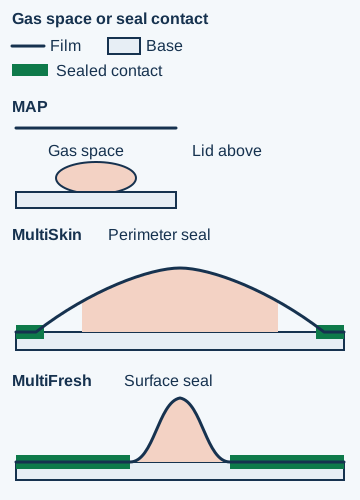
MultiSkin joins the film at the rim. MultiFresh seals across the exposed base. These drawings are not a leak test.
What should the complete-pack evaluation record?
Record the loaded package and its exposure, with gas composition and physical integrity treated as separate observations. The documents describe mechanisms and applications; they supply no common acceptance threshold for every chicken cut. The following is an evaluation record derived from those differences, not a prescribed test method.
Scroll horizontally for hidden columns. The first column stays in view.
| Record | What it resolves |
|---|---|
| Raw poultry cut, skin, marinade, bone presentation and initial condition | Whether the compared packs contain equivalent products |
| Tray or lower web, upper film and selected seal process | Whether a material change also changed the construction |
| Loaded-product shape, film contact, visible drip and pack condition | Whether compression, collapse or presentation changes affect acceptance |
| Gas record for MAP and product temperature history for every format | Whether a change in pack condition coincides with a changed exposure |
| Integrity assessment, acceptance criteria and rejected-pack disposition | Whether a good-looking pack also meets the defined package requirement |
The tray sealing machine guide explains why seal strength and a leak assessment answer different questions. Its machine-mode discussion is the next step once the poultry pack is defined. Seal temperature, dwell, vacuum level, headspace ratio and residual-oxygen acceptance remain unspecified here.
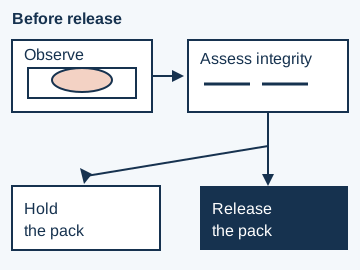
Disposition follows an integrity check. The diagram does not set a shelf life.
Where is the waste and quality boundary?
Compare accepted chicken packs, including the food lost when a pack is rejected. A smaller packaging bill is insufficient evidence of lower total loss if the comparison omits replacement film, discarded poultry, additional handling or interrupted production.
Keep those loss categories as separate records for each construction and use equivalent product and exposure conditions. The food packaging cost guide explains the accepted-complete-pack denominator and the need to define included costs. No price, reject percentage or food-waste reduction is inferred from the format descriptions in this article. A shelf-life or safety decision needs its own product-specific basis.
Method and sources
This poultry-only comparison uses MULTIVAC’s April 2022 brochure, its current poultry application page, and Air Products’ raw-poultry guidance, all retrieved October 19, 2026. Process descriptions are attributed to the brochure; retail gas and storage figures remain within Air Products’ stated scope. The comparison table and evaluation record translate those documented mechanisms into selection questions. They do not extend raw-poultry guidance to cooked chicken or establish a microbial control process.
Sources and method
This article is based on documentary research of the sources listed. It is not a hands-on equipment test. Supplier statements and editorial judgement are identified in the text.
- Poultry: Fresh, frozen or processed Footer 04/2022; Solutions spread, printed pages 14-15: vacuum compression, MultiFresh and MultiSkin seal geometry, MAP gas replacement. Retrieved 2026-10-19.
- Raw Poultry and Game Undated page, retrieved 2026-10-19. Poultry-specific spoilage discussion, retail CO2 caution, cited two-component mixture and recommended storage range. General guidance requiring a product trial; historical UK legal-temperature footnote is not used as US law.
- Poultry packaging solutions Undated page, retrieved 2026-10-19. Poultry formats, pointed-bone application statement, thermoformers, traysealers, labelling and inspection. No universal puncture rating or shelf life is supplied.
More in Applications
Milk Packaging Formats: Bottles, Cartons and Pouches
How to choose a milk packaging format by heat treatment, cold chain and light exposure, and what bottle, carton and pouch formats mean for filling equipment.
Read the guide
Yogurt Packaging: Cups, Bottles and Pouches for Different Products
Match yogurt packaging to product type: set, stirred, drinkable or squeeze. Compare cups, bottles and spouted pouches and their filling and sealing needs.
Read the guide
Bottled Water Packaging Lines: From Prepared Containers to Packed Cases
Plan a bottled water packaging line from container supply to palletizing: rinsing, filling, capping, labeling, coding and the interfaces between stations.
Read the guide